2026 update
A few things have changed in 2026. AI is now allowed in coding rounds at Canva and Meta, detection has improved at companies that still ban it, pay has split at staff+, and the post-onsite wait got longer. Read what changed in 2026 →
What you'll be expected to do
What they're grading- Own an end-to-end analysis: define the question, pull the data, model it, communicate the result
- Design and ship A/B tests for product or growth teams; size them, monitor them, write up the read-out
- Build dashboards and recurring metrics in SQL + your team's BI tool
- Partner with PM and engineering on metric definitions and instrumentation
- Apply basic modelling (regression, classification, clustering) for prediction or segmentation
- Translate analyses into recommendations product or business stakeholders can act on
What does the interview loop look like?
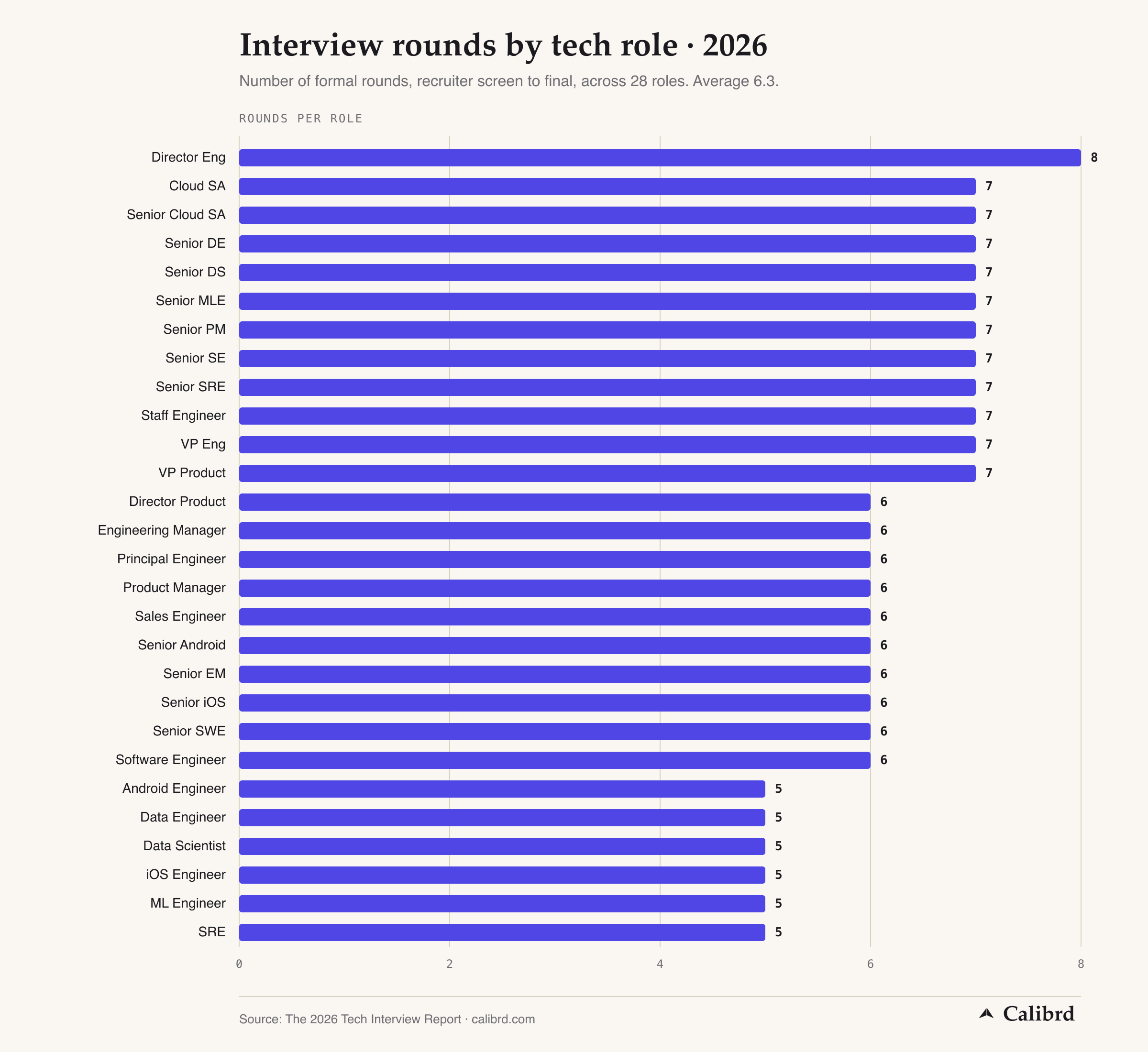
5 rounds · 4–6 weeksMost companies follow a similar pattern for Data Scientist interviews. Total calendar time is 4–6 weeks from recruiter screen to offer.
Background, role calibration, motivation, pay expectations
Usually combines SQL (joins, window functions, CTEs) with Python (pandas / numpy data manipulation). Some companies split into two rounds (Google, Meta DS); AI labs sometimes drop SQL entirely and add ML implementation. Confirm the split with your recruiter
Design an experiment for a given product change, or diagnose a metric drop. Probing on metric choice, sample sizing, guardrails, and how you'd communicate the result
Hypothesis testing, model selection reasoning, basic ML concepts (bias-variance, overfitting), how you'd model a specific business problem end-to-end
Past projects, cross-functional collaboration, handling ambiguity, communicating to non-technical stakeholders
Sample questions you should be ready for
9 of the ones that decide itRepresentative of what companies ask at this level. Every question here can be practised out loud, which is the fastest way to find out whether your answer holds up under follow-ups. Calibrd adds voice practice with coaching on every answer, and a full voice mock interview: a live round with an AI interviewer who has read the role and your CV, then an honest debrief.
- 01“Given a `sessions` table with user_id and event_timestamp, write a query that returns the 7-day retention curve from signup.”
- 02“Walk me through how you'd detect outliers in a metric you're tracking. What rules of thumb do you use, and how do you decide whether to remove them?”
- 03“You ran a t-test and got p = 0.04. What does that actually mean, and what would you check before declaring the test a win?”
- 04“Our DAU dropped 8% week-over-week. Walk me through how you'd diagnose it.”
- 05“Design an A/B test to evaluate a new onboarding flow. Pick the metric, name the unit of randomisation, and tell me how long you'd run it.”
- 06“We're considering launching a referral programme. What metrics would you instrument before launch, and how would you know if it's working in week one?”
- 07“Tell me about an analysis you ran where the result surprised you. What did you do with it?”
- 08“Describe a time a stakeholder disagreed with your conclusion. How did you handle it?”
- 09“Walk me through a project where the data was messy or incomplete. How did you decide what to trust?”
These are the general ones. Paste a real posting and Calibrd predicts the questions that company asks for that exact role, then interviews you on them.
Predict my questions →Compensation benchmark
US majors · USD · medianTypical pay for Data Scientist at major US tech companies, headline numbers in USD. Typical pay in London, Berlin and Singapore is meaningfully lower, and equity varies a lot by company stage.
FAANG L4 Data Scientist total pay is typically $240–310k. Meta E4 DS and Google L4 DS land at the top of this band; Stripe / Airbnb / Spotify a step below. London DS base ~£80–105k. AI-first companies (Anthropic, OpenAI, Scale) often pay 20–40% above this with heavier equity weighting.
How to prep
6 tactical tipsLead behavioural answers with the STAR method: Situation, Task, Action, Result. The tips below build on that structure for this specific role.
- Drill SQL cold, joins, window functions, CTEs, date arithmetic. 30–50 problems is enough if you've used SQL recently; more if you haven't. SQL screens are the most common rejection point at this level
- Brush up on pandas / numpy data manipulation in Python. Many loops have a Python or combined SQL+Python round, and candidates who only prep SQL get caught out. Practise group-by, merge, pivot, basic plotting
- Practise the A/B test framework cold: metric → unit of randomisation → sample size → duration → guardrails → readout. Have a template you can apply to any prompt
- Have 5–6 STAR stories ready, each with quantified impact: lift in conversion, model AUC, dollar value of the decision driven
- Read 'Trustworthy Online Controlled Experiments' (Kohavi), the canonical reference for the A/B test round
- Be ready for one open-ended product question per loop ("DAU is dropping, diagnose it"), practise the segment-first, hypothesis-second structure
Where do Data Scientist candidates fail?
Spot it in a mock firstA few common mistakes that get Data Scientist candidates rejected even when they are otherwise strong. Worth catching in a mock interview before they show up in a real one.
Hearing a question and immediately reaching for a model ("I'd train a random forest") without first looking at what the data actually looks like.
Why it fails
At L4 interviewers want to see you check the data before picking a method: distributions, missing values, join keys, time ranges. Jumping straight to a model signals "I know the tools but not the practice." The candidates who pass spend the first few minutes on data quality questions, not algorithm choice.
Fix
Open every modelling answer by naming 3 things you'd check in the data first. Something like "I'd start by checking the join logic between user and session tables, looking at the distribution of the target variable, and confirming there's no time-period bias." Then pick a method.
Designing an A/B test without naming the metric, sample size, or how you'd handle guardrails.
Why it fails
A/B test rounds at L4 grade on whether you've actually shipped experiments at scale. Vague answers ("we'd run an A/B test and check the results") miss the rigor that distinguishes a real DS from a product analyst. The interviewer is waiting for primary metric + 1–2 guardrails + sample-size estimate + duration.
Fix
Structure A/B test answers as a checklist: primary metric and why, unit of randomisation (user vs session vs request), 1–2 guardrails to prevent gaming, rough sample-size estimate for the MDE you care about, and how long you'd let it run. Even rough numbers ("~50k users per arm, two weeks") land much harder than no numbers.
Describing past projects in terms of effort and ambition, with no quantified impact attached.
Why it fails
DS interviews calibrate against IC3 scope, and they need numbers to do it. "I built a churn model that helped the retention team" tells the interviewer nothing. "I built a churn model with 0.78 AUC that the growth team used to re-segment a $20M ARR cohort and lift retention by 2.3 points" lets them peg you immediately.
Fix
For your top 4–5 stories, attach three numbers each: scale (rows / users / segments), model quality (AUC, precision, MAE, whatever's relevant), and business impact (revenue, retention, conversion delta). Rough numbers beat no numbers. Ask your eng or PM partner before the loop if you don't remember the exact figures.
Recommended resources
No affiliate linksBooks, courses, and tools that come up most often in Data Scientist prep.
- 01Trustworthy Online Controlled Experiments →
The canonical reference for A/B test design. Read chapters 1–7 before the A/B test round.
- 02DataLemur →
SQL practice problems pulled from real DS interview loops at FAANG and major tech.
- 03StrataScratch →
More SQL and Python practice with real interview questions categorised by company.
- 04An Introduction to Statistical Learning →
Free Stanford textbook. Chapters 3, 4, 6 cover the stats / modelling round at L4 depth.
- 05Evan Miller's A/B test calculator →
Sample-size estimation calculator. Worth knowing the math behind it before the experiment round.
- 06Ace the Data Science Interview (Singh & Huo) →
The canonical DS interview book: SQL, statistics, ML, and product-sense questions with the level bar this guide describes.
Frequently asked questions
Is this guide useful if I'm transitioning from another field (analyst, engineer, PhD)?
Yes, the L4 / IC3 bar described here applies whether you came up through analytics, software engineering, or academic research. The interview tests SQL fluency, A/B test rigor, and product judgment, credentials don't substitute for any of those. The biggest delta for transition candidates is having 5+ STAR stories that map your past work to DS-shaped outcomes (analysis → recommendation → measured impact). A PhD without industry impact stories often calibrates lower than a strong analyst with shipped experiments.
How long should I prep before my Data Scientist onsite?
The process takes 4–6 weeks. Add 4–6 weeks of prep if you're rusty on SQL or Python; 2–3 weeks if you're using both daily. The A/B test framework, SQL drills, and pandas refresher are the highest-leverage prep. Don't over-invest in deep ML theory at L4, basic concepts are enough.
What's the most common mistake candidates make at the Data Scientist bar?
Prepping only for SQL when the loop has a Python or combined round. Many candidates with strong analysis skills get caught off-guard when the technical screen asks for pandas data manipulation or a simple algorithm in Python. Confirm the round breakdown with your recruiter and prep both.
What if my interview process is different from what's listed?
Most variation is at the edges. Large tech companies and scale-ups stay within a round or two of what is described here. Smaller startups often run fewer rounds (three or four) with a similar bar at each, and some companies skip the system design or behavioural round. Read the posting and ask the recruiter on the screening call what is coming.
How does this guide compare to running a free scan?
This guide covers the general bar at L4 / IC3. The free scan reads one real posting and opens the report right here: the questions that role and company will ask, a pay benchmark matched to the level and, with your CV, the gaps an interviewer will probe and a CV score. No account or email first; the report is on screen in about a minute.
Walk in ready
Walk into your Data Scientist interview ready.
Paste your actual job and Calibrd predicts what that company asks for this role, where your CV is thin, and what it should pay. Then rehearse the round out loud with honest feedback until you're confident. Free to start.
Not interviewing yet? See if your CV would make the shortlist for a Data Scientist role →
Free to start · No card · Encrypted at rest, never used to train AI, remove anytime