2026 update
A few things have changed in 2026. AI is now allowed in coding rounds at Canva and Meta, detection has improved at companies that still ban it, pay has split at staff+, and the post-onsite wait got longer. Read what changed in 2026 →
What you'll be expected to do
What they're grading- Own a product surface or business-line metric end-to-end; define what "good" looks like and how it's measured
- Lead a research agenda spanning 3–6 months, multiple experiments, modelling work, and analyses tied to a single bet
- Partner with PM, engineering, and design leadership; drive decisions, not just produce charts
- Mentor junior DS; review their experiment designs and analysis plans
- Make build / partner / buy decisions on modelling infrastructure and tooling
- Represent data science in cross-functional planning at the director level
What does the interview loop look like?
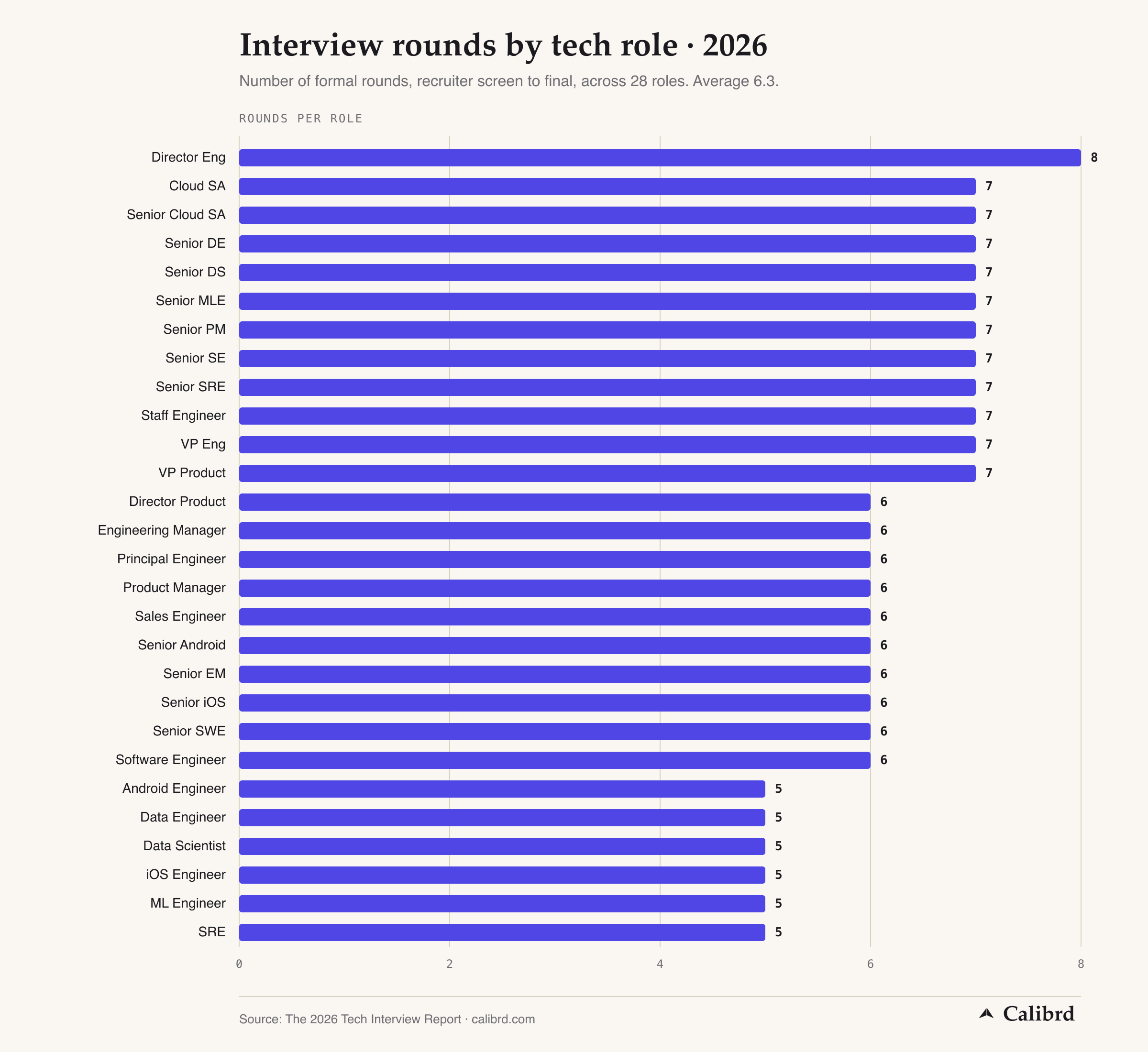
7 rounds · 5–8 weeksMost companies follow a similar pattern for Senior DS interviews. Total calendar time is 5–8 weeks from recruiter screen to offer.
Calibration to senior level, scope of past metric / surface ownership
Biggest research wins, philosophy on experimentation, why this company / surface next
Open-ended business problem with explicit ambiguity, e.g. "engagement on our messaging product is plateauing, how would you investigate and what would you bet on?" Probing on prioritisation and decision quality
Walk through a real experiment you ran, design choices, mistakes, what you'd do differently. Or a complex scenario question with peer interaction effects, novelty, multiple comparisons
Pick a modelling project from your CV; spend an hour explaining the problem framing, method choice, trade-offs, what went wrong, what you'd change
How you operate with senior PM / engineering, conflict resolution, communicating uncertainty to non-technical stakeholders
Strategic judgment at senior+ scope, executive presence, business framing
Sample questions you should be ready for
9 of the ones that decide itRepresentative of what companies ask at this level. Every question here can be practised out loud, which is the fastest way to find out whether your answer holds up under follow-ups. Calibrd adds voice practice with coaching on every answer, and a full voice mock interview: a live round with an AI interviewer who has read the role and your CV, then an honest debrief.
- 01“Engagement on our messaging product has been flat for two quarters. Walk me through how you'd investigate, and what 3 bets you'd run.”
- 02“We're considering pricing model changes, flat-rate vs usage-based. How would you frame the analysis to support the decision?”
- 03“Our retention curve has a steep drop at day 30. What hypotheses do you have, and how would you test them in order?”
- 04“Tell me about a metric you redefined or proposed. How did you build alignment around it?”
- 05“Walk me through a research bet you made that didn't pay off. What signal told you it was time to stop?”
- 06“Our platform has both a search ranker (used in ~60% of sessions) and a home-page recommendation model (~30%). Both are flat on user engagement metrics this quarter. With one quarter of your team's bandwidth, which would you invest in and why?”
- 07“Tell me about a time you owned a metric end-to-end across a quarter. What did the org do differently because of your work?”
- 08“Describe a disagreement with a senior PM or engineering leader on the framing of a problem. How did you operate through it?”
- 09“Walk me through the most ambiguous research question you've owned. What framework did you apply to make it tractable?”
These are the general ones. Paste a real posting and Calibrd predicts the questions that company asks for that exact role, then interviews you on them.
Predict my questions →Compensation benchmark
US majors · USD · medianTypical pay for Senior DS at major US tech companies, headline numbers in USD. Typical pay in London, Berlin and Singapore is meaningfully lower, and equity varies a lot by company stage.
FAANG L5 Senior DS total pay is typically $380–520k. Meta E5 DS and Google L5 DS land at the top of this band; Stripe / Airbnb / Spotify a step below. London Senior DS base ~£115–145k. AI-first companies (Anthropic, OpenAI, Scale) often pay 25–50% above this with heavier equity weighting.
How to prep
5 tactical tipsLead behavioural answers with the STAR method: Situation, Task, Action, Result. The tips below build on that structure for this specific role.
- Prepare 12–15 STAR stories tagged across senior+ signals: strategy, ambiguity, cross-functional influence, multi-quarter ownership, mentorship
- Have a strategic POV on the company's data and product surface, top 3 bets you'd make, ranked, defended
- Pick 1–2 modelling projects from your CV and rehearse the deep-dive cold: every method choice, every trade-off, every counterfactual
- Drill open-ended product sense problems where the framework is to scope it down and rank bets first, not to design a single test
- Read recent A/B test posts from the company's engineering blog, be ready to discuss their experimentation culture in the hiring manager round
Where do Senior DS candidates fail?
Spot it in a mock firstA few common mistakes that get Senior DS candidates rejected even when they are otherwise strong. Worth catching in a mock interview before they show up in a real one.
Walking through past work as "I built a model that did X" without saying what business decision the model enabled, or what the org did differently because of it.
Why it fails
Senior DS interviews are calibrated against scope, not technical depth alone. At L5 the question is whether you OWN the decision the model serves, not just whether you built the model. "Built a churn model" is a mid-level story; "got the growth team to reorganise their interventions around the segments my model surfaced, which lifted retained ARR by $4M" is a senior story.
Fix
For each major project, rehearse the answer to "what did the org do differently because of this work?" If the answer is "they looked at my dashboard" or "they used the model output," that's still mid-level framing. Push it to a decision: a launch killed, a strategy changed, a budget reallocated.
Treating an open-ended product question ("engagement is plateauing, what would you do?") as a single A/B test to design.
Why it fails
Senior DS interviews probe whether you can prioritise across many possible experiments, not just design one. A single-test answer reads as "I think like a mid-level who can execute on a brief." The strategic frame is: 3 hypotheses about what's happening, the cheapest test for each, what order you'd run them in, and what would kill each bet.
Fix
When you get an open-ended product prompt, structure as: 3 hypotheses, cheapest signal for each, ranking by expected value × probability, and what you'd do if each one fails. The ranking + the kill criteria are the senior signal.
Picking a modelling approach ("I'd use XGBoost") without explaining what you'd try first, why, or what you'd switch to if it didn't work.
Why it fails
At L5 interviewers grade the reasoning behind the method choice, not the choice itself. "I'd use XGBoost" reads as following a recipe. The signal is the decision path: I'd start with logistic regression for interpretability, switch to gradient boosting if I need 5+ points of AUC, consider deep models if the data is high-dimensional or has interaction effects baseline can't capture.
Fix
Structure modelling answers as a decision tree: first attempt + reason (usually a simpler baseline), what would tell you to escalate to a more complex method, what would tell you the current method is wrong. Rough trade-offs land, explicit reasoning matters more than picking the "right" model.
Recommended resources
No affiliate linksBooks, courses, and tools that come up most often in Senior DS prep.
- 01Trustworthy Online Controlled Experiments →
Kohavi et al., canonical A/B test reference. Senior loops probe interaction effects, novelty, and multiple comparisons; chapters 8–17 cover these.
- 02Causal Inference: The Mixtape →
Free online textbook by Scott Cunningham. Causal methods (diff-in-diff, IV, synthetic control) come up in senior cases more than mid-level.
- 03Storytelling with Data →
Cole Nussbaumer Knaflic. For the cross-functional rounds, communicating analysis to senior PM / engineering / executive audiences.
- 04Spotify Engineering blog (data posts) →
Real-world senior DS work at scale. Pattern-match their writeups before the tech talk round.
- 05Stripe, How we ship metrics →
Their internal blog covers their metric philosophy in depth. Helpful for the metric-design strategy round.
- 06Ace the Data Science Interview (Singh & Huo) →
The canonical DS interview book: SQL, statistics, ML, and product-sense questions with the level bar this guide describes.
Frequently asked questions
I'm currently a Data Scientist (L4 / IC3). Should I read this guide or the Data Scientist guide first?
Read the Data Scientist guide first. Companies calibrate L5 / IC4 candidates against the L4 / IC3 bar with a clear scope-gap lens, they want to see where you stand today, then probe the gap up to L5 / IC4. Read this guide AFTER you understand the L4 / IC3 baseline, so you know exactly which signals you need to demonstrate for the step-up.
How long should I prep before my Senior DS onsite?
The process takes 5–8 weeks. Add 6–8 weeks of prep, the open-ended product / strategy round is the highest-leverage piece, and it's the round candidates most often under-prepare. Research the company's product surface and have a top-3 bets framework you can apply on demand.
What's the most common mistake candidates make at the Senior DS bar?
Answering at the same depth as a mid-level. Senior DS rounds need strategic framing on top of technical fluency: priorities across bets, decisions enabled by the work, cross-functional influence stories. Strong IC3-level answers will get you downleveled here.
What if my interview process is different from what's listed?
Most variation is at the edges. Major tech companies (FAANG, scale-ups, mid-size SaaS) follow processes within 1–2 rounds of what's described. Smaller startups often run fewer rounds (3–4) but the bar at each round is similar; less-tech-mature companies sometimes skip system design or behavioural rounds entirely. Read the posting and ask the recruiter on the screening call; they'll tell you what's coming.
How does this guide compare to running a free scan?
This guide covers the general bar at L5 / IC4. The free scan reads one real posting and opens the report right here: the questions that role and company will ask, a pay benchmark matched to the level and, with your CV, the gaps an interviewer will probe and a CV score. No account or email first; the report is on screen in about a minute.
Walk in ready
Walk into your Senior DS interview ready.
Paste your actual job and Calibrd predicts what that company asks for this role, where your CV is thin, and what it should pay. Then rehearse the round out loud with honest feedback until you're confident. Free to start.
Free to start · No card · Encrypted at rest, never used to train AI, remove anytime