2026 update
A few things have changed in 2026. AI is now allowed in coding rounds at Canva and Meta, detection has improved at companies that still ban it, pay has split at staff+, and the post-onsite wait got longer. Read what changed in 2026 →
What you'll be expected to do
What they're grading- Train and deploy ML models against a defined product or business problem
- Build training and evaluation pipelines, often in Python + a framework like PyTorch / TensorFlow / JAX
- Own the data, features, and labels for your model, partnering with DE or DS upstream
- Set up monitoring, retraining cadence, and shadow / canary deployments
- Write production-grade Python: tests, code review, CI/CD
- Partner with DS, DE, and product engineering on the cross-functional surface around your model
What does the interview loop look like?
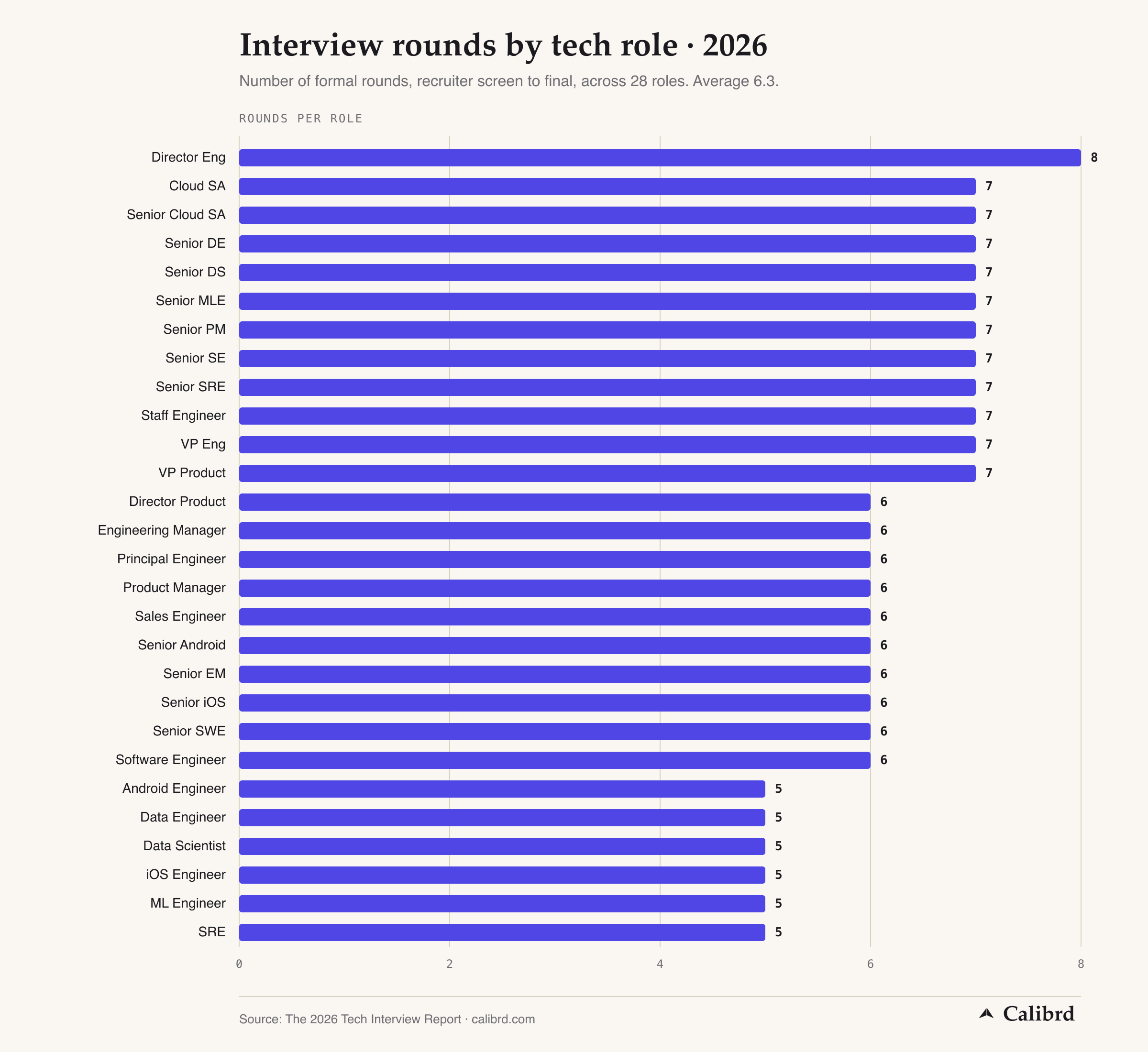
5 rounds · 4–6 weeksMost companies follow a similar pattern for ML Engineer interviews. Total calendar time is 4–6 weeks from recruiter screen to offer.
Background, role calibration, motivation, pay expectations
LeetCode-medium algorithm + pandas / numpy data manipulation. Some companies add a small ML implementation (write k-means, gradient descent, or attention from scratch)
Design an end-to-end ML system: data → training → serving → monitoring. Common prompts: recommendation system, fraud detection, ranking. Bar is moderate-scale at L4
Classical ML concepts (bias-variance, regularisation, model selection), or deep learning fundamentals if the role is DL-focused. Sometimes a paper-discussion round at AI labs
Past projects, cross-functional collaboration with DS / DE, handling production incidents, deployment war stories
Sample questions you should be ready for
9 of the ones that decide itRepresentative of what companies ask at this level. Every question here can be practised out loud, which is the fastest way to find out whether your answer holds up under follow-ups. Calibrd adds voice practice with coaching on every answer, and a full voice mock interview: a live round with an AI interviewer who has read the role and your CV, then an honest debrief.
- 01“Implement k-means from scratch in Python, no sklearn. Walk through how you'd handle empty clusters and initialisation.”
- 02“Given a 10GB CSV of training data that doesn't fit in memory, implement a PyTorch DataLoader that streams from disk efficiently. Walk through how you'd handle class imbalance during sampling.”
- 03“Walk me through how you'd debug a model whose offline AUC is 0.85 but online performance is closer to random.”
- 04“Design the recommendation system for our home feed. Cover training data, features, serving latency, and what you'd monitor in production.”
- 05“Design a fraud-detection system that scores transactions in under 50ms. Walk through model choice, feature pipeline, and retraining cadence.”
- 06“Design a feature store for a 50-engineer ML team. What's the read / write split, and how do you handle online / offline parity?”
- 07“Tell me about an ML project you shipped to production. What broke first?”
- 08“Describe a time your model performed well offline but worse online. How did you diagnose and fix it?”
- 09“Walk me through a disagreement with a data scientist or product partner on a model choice or feature.”
These are the general ones. Paste a real posting and Calibrd predicts the questions that company asks for that exact role, then interviews you on them.
Predict my questions →Compensation benchmark
US majors · USD · medianTypical pay for ML Engineer at major US tech companies, headline numbers in USD. Typical pay in London, Berlin and Singapore is meaningfully lower, and equity varies a lot by company stage.
FAANG L4 ML Engineer total pay is typically $260–340k. Pay tracks L4 SWE closely with occasional equity premium at AI-first companies (Anthropic, OpenAI, Mistral, Scale), often 30–60% above this band at the staff / principal end.
How to prep
5 tactical tipsLead behavioural answers with the STAR method: Situation, Task, Action, Result. The tips below build on that structure for this specific role.
- Drill 60+ LeetCode mediums plus 20+ pandas / numpy practice problems. The coding round at MLE bar is closer to SWE than to DS
- Practise 3–4 canonical ML system design problems cold: recommendation, fraud detection, ranking, search. Pattern-match the rest from there
- Be ready to implement at least one ML algorithm from scratch, k-means, gradient descent, simple neural network forward+backward pass. AI labs almost always ask this
- Read Chip Huyen's 'Designing Machine Learning Systems', the canonical reference for the ML system design round
- Have 5–6 STAR stories with production-deployment specifics: model AUC, latency budget, retraining cadence, post-launch issues you debugged
Where do ML Engineer candidates fail?
Spot it in a mock firstA few common mistakes that get ML Engineer candidates rejected even when they are otherwise strong. Worth catching in a mock interview before they show up in a real one.
Designing an ML system around the model and never mentioning the training data pipeline or labels.
Why it fails
MLE system design rounds grade on whether you understand that the model is maybe 10% of the system. The rest is data ingestion, labelling, training pipelines, serving infrastructure, monitoring. Candidates who go straight to "I'd use a gradient boosted tree with these features" without saying where the data comes from or how labels are generated signal "researcher who hasn't shipped to prod."
Fix
Open every ML system design answer by walking through the data first: what's the source, how often does it refresh, how are labels generated (explicit feedback, implicit, human-labelled), what's the training pipeline cadence. Then move to model choice. Spend at least the first 10 minutes on the data and pipeline.
Solving the coding question correctly but not narrating the ML-specific reasoning around it.
Why it fails
Coding rounds for MLE grade on both algorithmic correctness and ML judgment. Implementing k-means correctly without mentioning empty-cluster handling, initialisation sensitivity, or how you'd choose k tells the interviewer you've memorised the algorithm but haven't run it on real data. The signal is the conversation around the code, not just the code.
Fix
When you implement an ML algorithm, narrate the gotchas as you go: initialisation matters because of local minima, here's how you'd handle empty clusters, here's how you'd pick k in practice. Treat the algorithm like something you'd actually deploy, not a textbook recipe.
Discussing past projects without naming what got deployed, what the model's prod metric was, or what broke after launch.
Why it fails
MLE interviewers calibrate against IC3 production experience. Stories that stop at "the model got 0.85 AUC" miss the production reality where models drift, features go stale, training pipelines break. The pattern interviewers describe afterwards is usually "strong on the model itself, no idea if they've actually run one in prod."
Fix
For each ML project story, push it past offline metrics: what shipped, what was the online metric, what went wrong after launch (drift, data quality issues, latency spikes), what you changed because of it. Even one specific post-launch failure earns more credibility than three clean offline-AUC stories.
Recommended resources
No affiliate linksBooks, courses, and tools that come up most often in ML Engineer prep.
- 01Designing Machine Learning Systems (Chip Huyen) →
Canonical reference for ML system design. Read end-to-end before the system design round.
- 02Made With ML →
Free practical course on MLOps and production ML. Useful for the deployment / monitoring sections of system design.
- 03Machine Learning Interviews Book (Chip Huyen) →
Question bank and frameworks for ML interview prep. Free online.
- 04LeetCode (Top 150 Interview Questions) →
For the algorithmic coding round. 50–80 mediums is usually enough for the MLE bar.
- 05Papers With Code, SOTA section →
Skim the SOTA leaderboards for the domain you're interviewing in (CV, NLP, recsys). Helps in the depth / paper-discussion round.
- 06Machine Learning System Design Interview (Aminian & Xu) →
The reference for the ML system design round: recommendation, ads, search, and feed problems worked end to end at the bar this loop grades.
Common scenarios
Situations that come up a lotI'm a data scientist with 3 years of experience trying to move into MLE. How do I close the coding gap when most of my work has been notebooks and SQL?
The coding bar is the real delta. DS interviews mostly stay in pandas / SQL territory; MLE asks for LeetCode-mediums in 40 minutes on top of the pandas / numpy work. If your last algorithm-style coding was university, plan for 8–12 weeks of LeetCode, 60+ mediums minimum, with the Top 150 list as a starting filter. Separately, drill writing Python outside notebooks: classes, type hints, pytest, a small FastAPI service. Interviewers grade against "could this person commit production code unsupervised" and notebooks-only candidates often fail that signal even when the modelling is solid. Skip the from-scratch ML implementation grind unless you're targeting AI labs, for product MLE roles, knowing when to reach for sklearn vs PyTorch matters more than implementing gradient descent from memory. In the behavioural round, lead with what you've taken to production, not what you've trained. "I built a model that hit 0.85 AUC" is a DS answer; "I deployed a model and watched its precision drop 8% in week one from training-serving skew" is the MLE answer.
I'm a backend engineer with 4 years of experience and want to move into MLE without a CS-grad ML background. What's the realistic path?
Two paths, only one of them works without a 6-month rewind. The hard path is competing on modelling: catching up on ML theory, doing Kaggle, retraining your CV around projects you didn't really own. Most backends who try this either get stuck in DS-style rejections ("strong coding, no ML depth") or end up in IC3 offers despite the prior YoE. The easier path is ML platform / ML infra / model serving, backend depth is the actual bottleneck for most ML teams, and L4 / L5 infra roles at companies with mature ML stacks (Stripe, Netflix, Spotify, LinkedIn, Uber, Shopify) often value SWE pedigree over modelling depth. Read about feature stores, online inference, training pipelines. Drill the ML system design canonical problems (recommender, fraud detection, feature store) and frame your past work as "the systems that make ML reliable in production". Your coding bar is already above what MLE rounds expect. In the behavioural round, your story is that ML teams are bottlenecked on systems work, not modelling, and you're the person who solves that.
I'm finishing a PhD in NLP with 4 years of academic research. How do I interview for MLE at a product company without sounding like a researcher?
The disconnect is mostly about scope, not technical knowledge. Product MLE interviewers are not impressed by paper counts, they're filtering for whether you can ship something that survives contact with real users. Three concrete adjustments. Strip the paper-heavy framing from your CV; lead with whatever shipped or got close to shipping, even if it was a small internal tool or a model served behind a lab demo. In the behavioural round, the words "deployed", "users", "production" need to appear in your stories, interviewers physically listen for them. For ML system design, learn the things academia rarely teaches: serving latency budgets, retraining cadence, online / offline parity, A/B testing methodology. Read Designing Machine Learning Systems by Chip Huyen cover-to-cover before the system design round. Where research backgrounds actually win is the depth round, if there's a 60-minute deep-dive on a paper you wrote, you have an advantage no industry MLE has. Use it. Don't volunteer it before being asked, and don't go past 10 minutes on theory before pivoting back to what would change about the model in production.
I've been the only MLE at a 20-person startup for 2 years and own the whole stack. How do I prep for FAANG MLE interviews where everything is specialised?
Owning the whole stack is the strength; the gap is system design at scale. At a 20-person startup, "production ML" might mean a few thousand requests per day on a single server; FAANG MLE interviews assume you reason about 50k QPS, model sizes that don't fit in single-GPU memory, and training data measured in billions of examples. Prep means napkin-math fluency: every component of an ML system, sized out loud. "Storage budget for serving features, training cost per epoch, latency target at p99". Drill 4–5 canonical ML system design problems at scale (recommender at FAANG scale, ad ranking, fraud detection, search, feature store for a 200-engineer org). The coding round will feel familiar; the system design rounds will not. For the behavioural round, your generalist scope is genuinely impressive, but reframe it: "I owned the whole stack" reads as small to a FAANG L4 interviewer; "I made these specific architectural decisions and here's what they bought us" reads as senior. Be ready for the question "have you ever scaled past 10k QPS", if no, have a credible answer for how you'd approach it from first principles rather than dodging.
I'm a generalist developer with 3 years of experience and zero formal ML work. Is MLE even a realistic target, or should I aim for something easier?
Realistic but a 6–12 month project, not a 2-month sprint. The gap isn't ML theory, that's a few weeks of self-study, it's the absence of any ML work to point at on your CV. The interview loop is built around past projects; without one you'll get filtered before the screen. Honest path: spend 3–6 months building a real ML project end-to-end on the side. Not Kaggle (interviewers see through it). Something with real users, real data, real deployment. A small SaaS tool with an ML feature, an open-source contribution to a popular ML library, a research collaboration with someone's lab, anywhere you can answer "what broke after launch" with a real story. Then start interviewing. Until you have that, ML platform / MLOps-adjacent roles (training pipeline reliability, serving infra) are realistic without modelling experience, your generalist depth is directly useful and the team will train you up on the ML side. Pure modelling MLE without modelling work to point at is the path that usually doesn't work.
Frequently asked questions
Is this guide useful if I'm a Data Scientist transitioning to MLE, or a SWE moving into ML?
Yes, the L4 / IC3 bar described here applies whether you came from DS, SWE, or research. The biggest delta for DS-to-MLE transitions is the coding bar (closer to SWE LeetCode than DS SQL). For SWE-to-MLE, the gap is usually the ML system design round, building intuition for training pipelines, feature stores, and online / offline parity. Prep for the gap that's actually your weak side; don't over-invest in what's already strong.
How long should I prep before my ML Engineer onsite?
The process takes 4–6 weeks. Add 6–8 weeks of prep, LeetCode + 3–4 ML system design canonical problems is the highest-leverage prep. Don't skip the from-scratch ML implementation practice; AI labs almost always ask this.
What's the most common mistake candidates make at the ML Engineer bar?
Treating it like a DS interview. The MLE coding bar is closer to SWE than DS, and the system design round expects production thinking (latency, monitoring, retraining) not just modelling. DS-style answers focused on offline metrics get downleveled here.
What if my interview process is different from what's listed?
Most variation is at the edges. Major tech companies (FAANG, scale-ups, mid-size SaaS) follow processes within 1–2 rounds of what's described. Smaller startups often run fewer rounds (3–4) but the bar at each round is similar; less-tech-mature companies sometimes skip system design or behavioural rounds entirely. Read the posting and ask the recruiter on the screening call; they'll tell you what's coming.
How does this guide compare to running a free scan?
This guide covers the general bar at L4 / IC3. The free scan reads one real posting and opens the report right here: the questions that role and company will ask, a pay benchmark matched to the level and, with your CV, the gaps an interviewer will probe and a CV score. No account or email first; the report is on screen in about a minute.
Walk in ready
Walk into your ML Engineer interview ready.
Paste your actual job and Calibrd predicts what that company asks for this role, where your CV is thin, and what it should pay. Then rehearse the round out loud with honest feedback until you're confident. Free to start.
Free to start · No card · Encrypted at rest, never used to train AI, remove anytime