2026 update
A few things have changed in 2026. AI is now allowed in coding rounds at Canva and Meta, detection has improved at companies that still ban it, pay has split at staff+, and the post-onsite wait got longer. Read what changed in 2026 →
What you'll be expected to do
What they're grading- Implement features end-to-end against a defined spec, with manageable scope
- Write tests, fix bugs, and respond to code-review feedback efficiently
- Participate in on-call rotations and incident response for your team's services
- Estimate work, break down tasks, and ship within a sprint cadence
- Collaborate with a tech lead or staff engineer on design decisions
What does the interview loop look like?
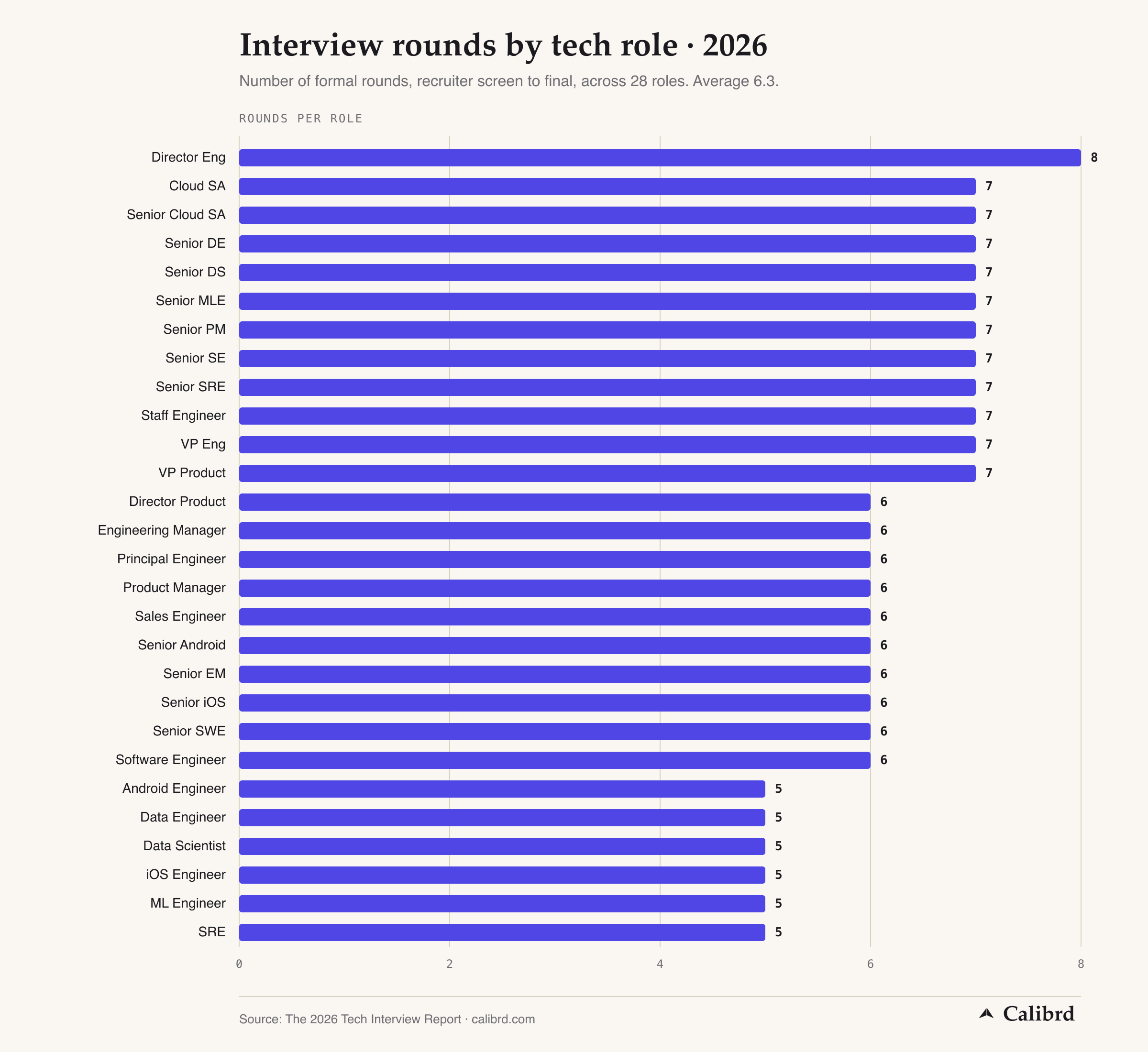
6 rounds · 3–5 weeksMost companies follow a similar pattern for Software Engineer interviews. Total calendar time is 3–5 weeks from recruiter screen to offer.
Background, motivation, basic role fit
1–2 medium algorithm/data-structure problems on a shared editor
Algorithms / data structures, optimal solution + complexity analysis
Object-oriented design, API design, or applied problem-solving
Component-level design, e.g. design a URL shortener, a rate limiter, a chat feature
Past projects, collaboration, conflict, learning velocity
Sample questions you should be ready for
9 of the ones that decide itRepresentative of what companies ask at this level. Every question here can be practised out loud, which is the fastest way to find out whether your answer holds up under follow-ups. Calibrd adds voice practice with coaching on every answer, and a full voice mock interview: a live round with an AI interviewer who has read the role and your CV, then an honest debrief.
- 01“Given a list of integers, find the longest subarray with sum equal to a target value.”
- 02“Implement an LRU cache. Walk through the data structure choices and trade-offs.”
- 03“Reverse a linked list iteratively. Then do it recursively. Compare space complexity.”
- 04“Design a URL shortener (bit.ly). Cover the encoding scheme, storage, and caching layer.”
- 05“Design a rate limiter. What algorithm, token bucket, sliding window, fixed window? Why?”
- 06“Design the back-end for an autocomplete service that handles 100k QPS.”
- 07“Tell me about a project you're proud of. What was your specific contribution?”
- 08“Describe a time you disagreed with a code reviewer. How did you resolve it?”
- 09“Tell me about a time you missed a deadline. What did you learn?”
These are the general ones. Paste a real posting and Calibrd predicts the questions that company asks for that exact role, then interviews you on them.
Predict my questions →Compensation benchmark
US majors · USD · medianTypical pay for Software Engineer at major US tech companies, headline numbers in USD. Typical pay in London, Berlin and Singapore is meaningfully lower, and equity varies a lot by company stage.
Google L4 / Meta E4 / Amazon SDE II (L5) / Apple ICT3 — the mid level for 2–4 years in. FAANG L4 total pay is typically $260–340k. London ~£70–95k base. Berlin / Stockholm ~€65–85k.
How to prep
5 tactical tipsLead behavioural answers with the STAR method: Situation, Task, Action, Result. The tips below build on that structure for this specific role.
- 01Drill 100+ LeetCode mediums focused on arrays, strings, hashmaps, trees, graphs
- 02Practice talking through your approach BEFORE coding, interviewers grade communication
- 03Time yourself: optimal solution + edge cases + tests in 25 minutes
- 04For system design, master one canonical problem (URL shortener) cold, pattern-match the rest
- 05Prepare 5 specific past-project stories using STAR format, ready to redirect to any behavioural prompt
Where do Software Engineer candidates fail?
Spot it in a mock firstA few common mistakes that get Software Engineer candidates rejected even when they are otherwise strong. Worth catching in a mock interview before they show up in a real one.
Hearing the problem, then jumping straight into typing code without asking any questions.
Why it fails
At L3 the bar isn't just "can you code". Interviewers are watching whether you scope the problem before solving it. Questions like "are inputs guaranteed sorted?" or "should this handle empty arrays?" are part of the grade. Skipping that step makes you look like someone who builds the wrong thing and has to redo it.
Fix
Take 30 seconds at the start to restate the problem in your own words and ask one or two clarifying questions. Even something simple like "should this be in-place or can I use extra space?" tells the interviewer you're thinking before doing.
Describing a project with no numbers, no users, no scale, no specific contribution.
Why it fails
Interviewers at this level need something concrete to peg you against. "I built a feature for the dashboard" tells them nothing. "I built the export feature used by around 5k users a week and cut report-generation time from 30 seconds to under 2" lets them place you immediately.
Fix
Before the interview, write down 3-4 projects with three numbers each: scope, scale, impact. Rough numbers are fine. If you don't know the scale, ask your tech lead before the loop. The goal is to never get caught describing work in adjectives.
Telling the same polished success story for every behavioural prompt, including the ones asking about failure.
Why it fails
Interviewers want to see how you handle imperfect projects: bugs you caused, deadlines you missed, code reviews that taught you something. A loop where every story is a clean win signals either no self-awareness or no real experience. Both downlevel you.
Fix
Prep at least two stories about things that didn't go to plan: a bug you shipped that broke prod for 20 minutes, a feature you over-scoped and had to cut down, a code review where you defended bad code and were wrong. The recovery is the signal, not the original mistake.
Recommended resources
No affiliate linksBooks, courses, and tools that come up most often in Software Engineer prep.
- 01LeetCode, Top 150 Interview Questions →
The canonical practice list. Cover the array, string, hashmap, tree, and graph problems, most loops draw from this surface area.
- 02Cracking the Coding Interview (McDowell) →
Reference text for the coding bar. Data structures, algorithms, and the behavioural framework all worth re-reading.
- 03Grokking the System Design Interview →
For the light system design round. Walk through URL shortener, rate limiter, and a chat feature cold before the loop.
- 04A Philosophy of Software Design (Ousterhout) →
Short Stanford book on code hygiene. Pattern-match the deep-cut design questions on naming, complexity, and simple-vs-clever code.
- 05Designing Data-Intensive Applications (Kleppmann) →
Worth starting now even at L3. Chapters 1–3 cover the foundation you'll keep referencing at every senior+ level.
- 06The Software Engineer's Guidebook (Gergely Orosz) →
The clearest published chapters on what each level owns — read the senior and tech-lead chapters to calibrate where your stories place you.
Frequently asked questions
Is this guide useful if I'm a recent grad, or should I read the new-grad guide first?
If you're graduating or in your first year of full-time work, start with the New Grad Software Engineer guide — the loop there is lighter (online assessment plus one or two coding rounds, rarely any system design) and calibrated to the entry bar. This guide covers the mid-level bar (Google L4, Meta E4, Amazon SDE II) for engineers with roughly two to four years in, where a light system design round and deeper project ownership come into play. The technical fundamentals overlap, but the scope expectations and the process differ, so read the one that matches where you are now.
How long should I prep before my Software Engineer onsite?
The process itself takes 3–5 weeks from screen to offer. Add 4–6 weeks of prep if you've been heads-down at work; 2–3 weeks if you're actively practising. LeetCode mediums + 5 STAR stories is the priority order.
What's the most common mistake candidates make at the Software Engineer bar?
Coding in silence. Even with the correct answer, interviewers grade your thought process out loud. Narrate trade-offs, edge cases, and complexity as you go — that's the bar at this level.
What if my interview process is different from what's listed?
Most variation is at the edges. Major tech companies (FAANG, scale-ups, mid-size SaaS) follow processes within 1–2 rounds of what's described. Smaller startups often run fewer rounds (3–4) but the bar at each round is similar; less-tech-mature companies sometimes skip system design or behavioural rounds entirely. Read the posting and ask the recruiter on the screening call; they'll tell you what's coming.
How does this guide compare to running a free scan?
This guide covers the general bar at L4 / IC3. The free scan reads one real posting and opens the report right here: the questions that role and company will ask, a pay benchmark matched to the level and, with your CV, the gaps an interviewer will probe and a CV score. No account or email first; the report is on screen in about a minute.
Walk in ready
Walk into your Software Engineer interview ready.
Paste your actual job and Calibrd predicts what that company asks for this role, where your CV is thin, and what it should pay. Then rehearse the round out loud with honest feedback until you're confident. Free to start.
Free to start · No card · Encrypted at rest, never used to train AI, remove anytime