2026 update
A few things have changed in 2026. AI is now allowed in coding rounds at Canva and Meta, detection has improved at companies that still ban it, pay has split at staff+, and the post-onsite wait got longer. Read what changed in 2026 →
What you'll be expected to do
What they're grading- Set technical strategy for a 30+ engineer organisation; write the docs everyone aligns to
- Identify and unblock cross-team technical risks before they become incidents
- Drive multi-quarter initiatives that span 3+ teams, own the design, the rollout, and the org change
- Mentor senior engineers; own the things that raise the bar org-wide: design-review standards, the RFC process, the testing bar
- Represent engineering in product / business strategy conversations at the director level
- Author RFCs that change how the org operates, testing standards, deployment practices, on-call rotations
What does the interview loop look like?
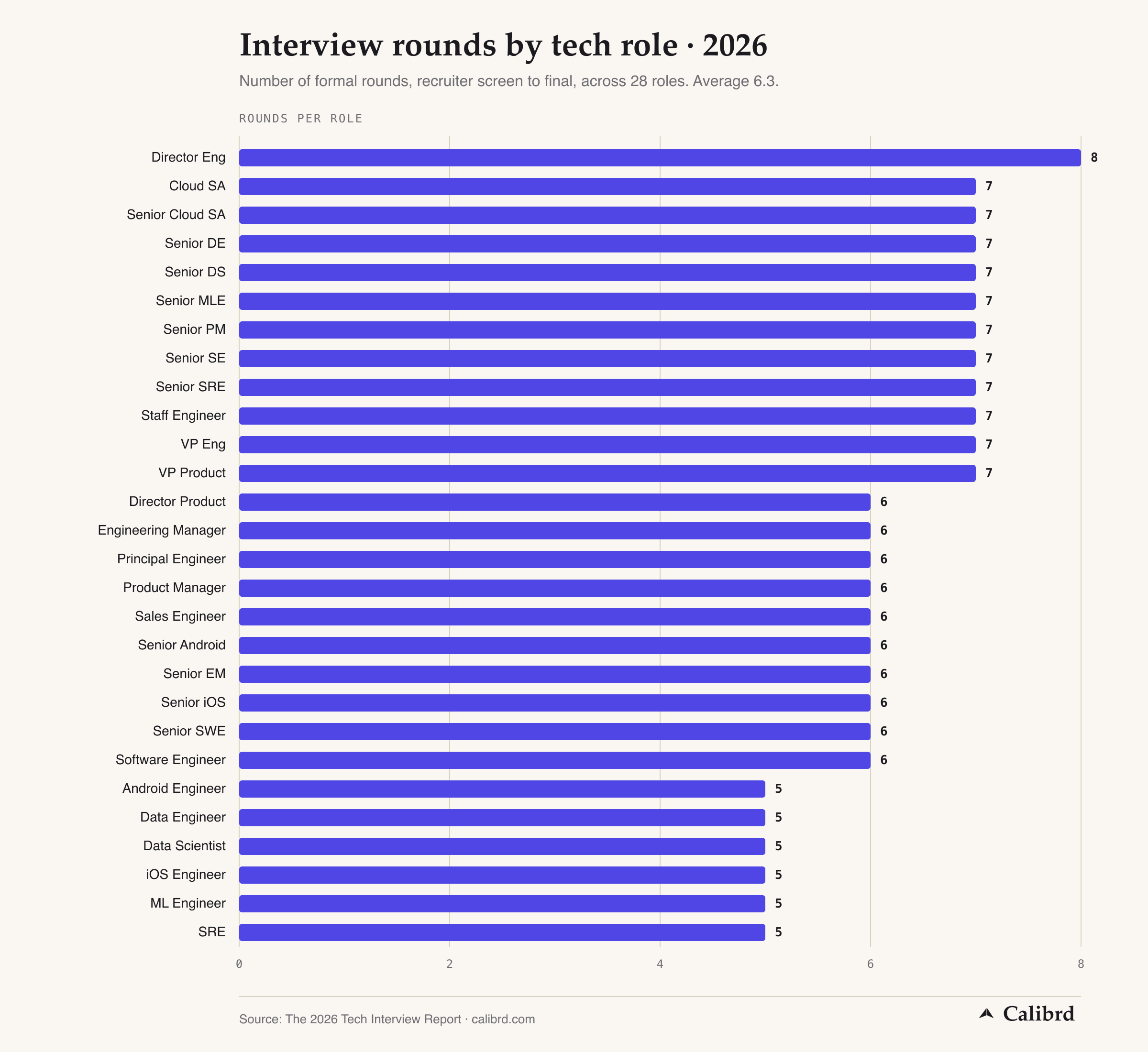
7 rounds · 5–8 weeksMost companies follow a similar pattern for Staff Engineer interviews. Total calendar time is 5–8 weeks from recruiter screen to offer.
Calibration to L6, career arc, scope of past impact
Often skipped or replaced with a project deep-dive, depends on company. If retained: harder coding + design hybrid
Large-scale system design with explicit cost / trade-off probing, multi-region, multi-tenant, evolving requirements
Either a second design problem OR you walk through a real system you architected, the company's existing system, possibly
Pick a project from your CV; spend an hour explaining the design, trade-offs, what went wrong, what you'd change. Bar: senior engineers grilling you on every choice
Strategic thinking, ambiguity, prioritisation, influence
Org-level impact, how you communicate with executives, technical leadership philosophy
Sample questions you should be ready for
7 of the ones that decide itRepresentative of what companies ask at this level. Every question here can be practised out loud, which is the fastest way to find out whether your answer holds up under follow-ups. Calibrd adds voice practice with coaching on every answer, and a full voice mock interview: a live round with an AI interviewer who has read the role and your CV, then an honest debrief.
- 01“Design a globally-distributed key-value store with tunable consistency. Walk through CAP trade-offs in production.”
- 02“Design the data infrastructure for a 100M-user analytics platform. Real-time and batch, how do they coexist?”
- 03“Design a feature flag platform that scales to 50k SDK clients and 1M flag evaluations per second.”
- 04“Tell me about a multi-quarter technical strategy you authored. How did you get the org to align?”
- 05“Describe a time you reversed a major technical decision. What was the cost, political and technical?”
- 06“Walk through how you've raised the technical bar in your current org. What artefacts can you point to?”
- 07“Tell me about a project you owned that failed. What was the org-level impact, and what did you change in your approach afterwards?”
These are the general ones. Paste a real posting and Calibrd predicts the questions that company asks for that exact role, then interviews you on them.
Predict my questions →Compensation benchmark
US majors · USD · medianTypical pay for Staff Engineer at major US tech companies, headline numbers in USD. Typical pay in London, Berlin and Singapore is meaningfully lower, and equity varies a lot by company stage.
FAANG L6 total pay is typically $600–800k. The gap to L5 is mostly equity. London Staff SWE base ~£110–145k. Pre-IPO Staff equity is highly variable; check the cap table carefully.
How to prep
5 tactical tipsLead behavioural answers with the STAR method: Situation, Task, Action, Result. The tips below build on that structure for this specific role.
- 01Pick 1–2 projects from your CV and rehearse the deep-dive cold, every design choice, every trade-off, what you'd do differently now
- 02Read past RFCs from staff engineers at the company you're interviewing at, study their writing style
- 03For system design, practise explicit cost analysis (servers, storage, latency budgets), L6 expects numbers, not hand-waving
- 04Have 8–10 STAR stories covering the staff signals: org impact, technical strategy, cross-functional influence, mentorship at scale
- 05Prepare a 30/60/90 plan answer, what you'd do in your first 90 days at this specific company
Where do Staff Engineer candidates fail?
Spot it in a mock firstA few common mistakes that get Staff Engineer candidates rejected even when they are otherwise strong. Worth catching in a mock interview before they show up in a real one.
Spending most of the 60-minute deep-dive narrating the system you built, without ever questioning the design choices.
Why it fails
Staff interviewers grade the deep-dive on judgment, not memory. They want to hear which decisions you'd reverse if you started over, what you'd ship differently with 6 more months, and which trade-offs hurt the most in production. A walkthrough that sounds like documentation reads as "remembered the work but didn't learn from it".
Fix
Before the loop, pick 2-3 design choices from the project and write a paragraph each on what was right, what was wrong, and what you'd do differently now. Bring those into the deep-dive as natural pauses: "this is the partitioning scheme we picked; looking back, I'd argue against it for these reasons".
Designing the system for the target scale without ever explaining how you'd migrate from a real existing system to get there.
Why it fails
L6 design rounds care about evolution, not just the steady state. A clean design that ignores the messy migration path reads as "thinks like a senior IC, hasn't actually rolled anything out at scale". The interviewer is waiting for you to say "and here's how we'd phase this in over two quarters without breaking anything".
Fix
After laying out the target architecture, spend 5 minutes on the rollout: how you'd dual-write, how you'd compare outputs, where the rollback levers sit, what you'd do if metrics regress. Even rough phasing earns the signal.
Going into the coding hour at full L5 intensity, and missing that the round was really about how you'd lead a review.
Why it fails
Some L6 loops drop coding entirely. Others keep it but use the round to grade how you'd run a code review or pair with a senior engineer. If you treat it like an L5 coding test, you can solve the problem and still come across as "still operating at IC4". The signal is what you'd say in a review, not just whether you'd ship the code.
Fix
Confirm the round type during the recruiter screen. If it's a coding-and-leadership hybrid, narrate as you go: "here's the obvious solution; here's what I'd push back on if I saw this in a review; here's what I'd ask the author about".
Recommended resources
No affiliate linksBooks, courses, and tools that come up most often in Staff Engineer prep.
- 01Designing Data-Intensive Applications (Kleppmann) →
Re-read for the L6 deep-dive round. Chapters 5–11 (replication, partitioning, transactions, consistency, stream processing) are the highest-leverage.
- 02Staff Engineer: Leadership Beyond the Management Track (Will Larson) →
Canonical reference for the Staff IC track. Chapters on archetypes and operating philosophy come up in hiring-manager rounds.
- 03lethain.com (Will Larson's blog) →
The reference blog for staff+ technical leadership. The Eng-Strategy and Working-with-Stakeholders posts come up in cross-functional rounds.
- 04Pragmatic Engineer Newsletter (Gergely Orosz) →
Practitioner depth on staff-level engineering at FAANG vs scale-ups. Pattern library for the project deep-dive round.
- 05Hello Interview, staff-level system design →
Free video walkthroughs at staff scope (multi-region, cost analysis, migration paths). Pattern-match before the system design round.
- 06The Staff Engineer's Path (Tanya Reilly) →
The other canonical staff-track book, alongside Larson. Reilly's big-picture-thinking / execution / levelling-up split maps directly onto how staff loops grade.
Frequently asked questions
I'm currently a Senior SWE (L5 / IC4). Should I read this guide or the Senior SWE guide first?
Read the Senior SWE guide first. Companies calibrate L6 / IC5 candidates against the L5 / IC4 bar with a clear scope-gap lens, they want to see where you stand today, then probe the gap up to L6 / IC5. Read this guide AFTER you understand the L5 / IC4 baseline, so you know exactly which signals you need to demonstrate for the step-up.
How long should I prep before my Staff Engineer onsite?
The process takes 5–8 weeks. Add 8–12 weeks of prep, the project deep-dive is the highest-leverage round. Pick 1–2 projects from your CV and rehearse them cold: every design choice, every trade-off, what you'd do differently now.
What's the most common mistake candidates make at the Staff Engineer bar?
Describing technical work without org-level impact. The Staff bar is about how a 30+ person org operated differently because of you, not whether you shipped a hard system. Frame every story around what shipped at the org level, not the project level.
What if my interview process is different from what's listed?
Most variation is at the edges. Major tech companies (FAANG, scale-ups, mid-size SaaS) follow processes within 1–2 rounds of what's described. Smaller startups often run fewer rounds (3–4) but the bar at each round is similar; less-tech-mature companies sometimes skip system design or behavioural rounds entirely. Read the posting and ask the recruiter on the screening call; they'll tell you what's coming.
How does this guide compare to running a free scan?
This guide covers the general bar at L6 / IC5. The free scan reads one real posting and opens the report right here: the questions that role and company will ask, a pay benchmark matched to the level and, with your CV, the gaps an interviewer will probe and a CV score. No account or email first; the report is on screen in about a minute.
Walk in ready
Walk into your Staff Engineer interview ready.
Paste your actual job and Calibrd predicts what that company asks for this role, where your CV is thin, and what it should pay. Then rehearse the round out loud with honest feedback until you're confident. Free to start.
Free to start · No card · Encrypted at rest, never used to train AI, remove anytime