2026 update
A few things have changed in 2026. AI is now allowed in coding rounds at Canva and Meta, detection has improved at companies that still ban it, pay has split at staff+, and the post-onsite wait got longer. Read what changed in 2026 →
What you'll be expected to do
What they're grading- Own a major project or sub-system end-to-end, design, implementation, and operational health
- Lead 2–4 junior engineers technically without being their manager
- Take part in cross-team technical decisions and write design docs that survive review
- Mentor mid-level engineers; participate in interview loops as a regular interviewer
- Operate independently, propose work, scope it, and ship without close supervision
- Influence team-level technical direction and unblock peers in incident response
What does the interview loop look like?
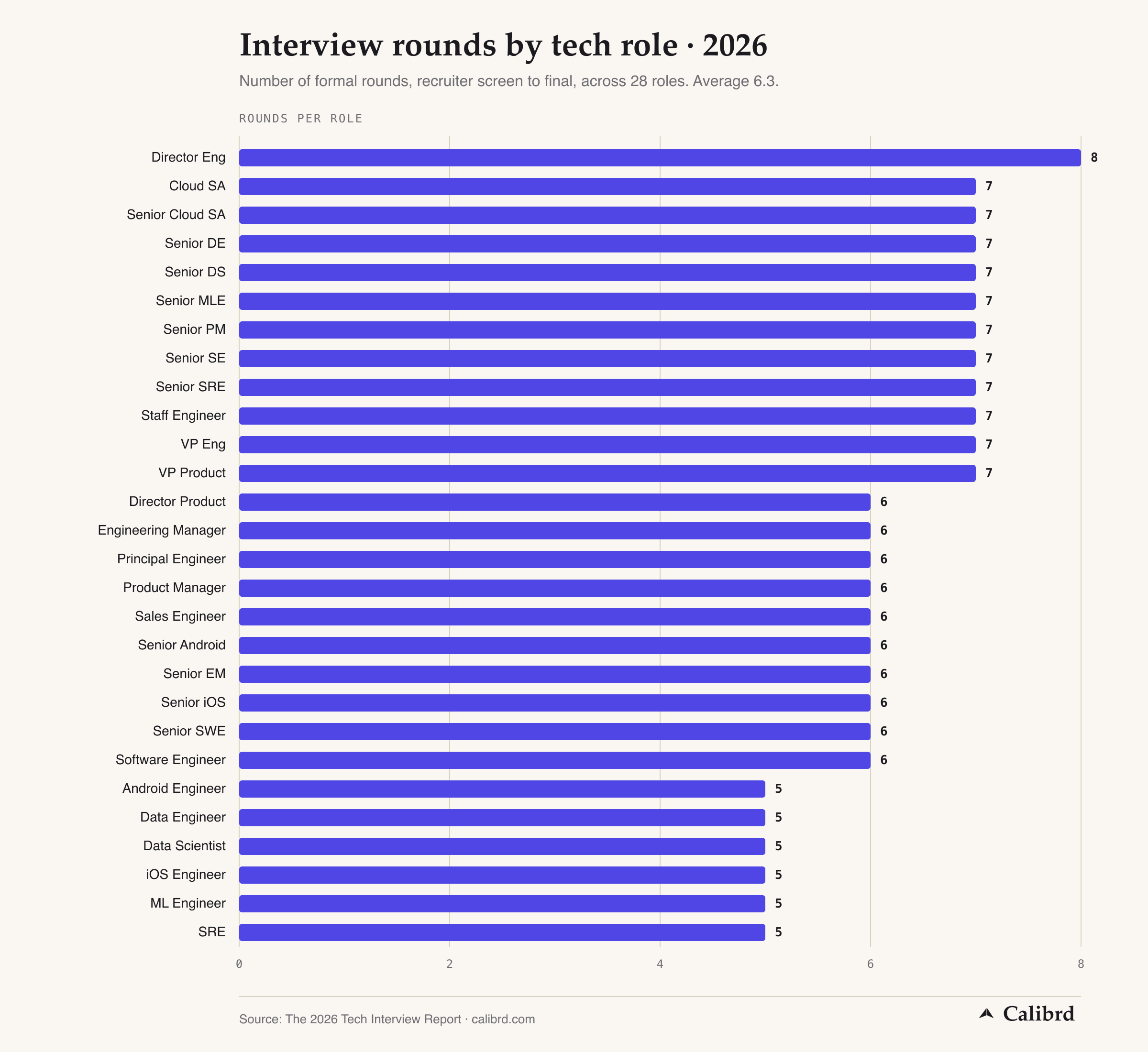
6 rounds · 4–6 weeksMost companies follow a similar pattern for Senior SWE interviews. Total calendar time is 4–6 weeks from recruiter screen to offer.
Career narrative, level calibration, motivation, pay expectations
Hard LeetCode-style problem; expect to optimise and discuss complexity in detail
Greenfield design at scale, e.g. design Twitter, Slack, Uber dispatch. Probing on consistency, scale numbers, failure modes
Two medium problems or one harder problem; clean code expected
Walk through a project from your CV, design choices, trade-offs, what you'd change
Scope, impact, conflict, mentoring, influence without authority
Sample questions you should be ready for
9 of the ones that decide itRepresentative of what companies ask at this level. Every question here can be practised out loud, which is the fastest way to find out whether your answer holds up under follow-ups. Calibrd adds voice practice with coaching on every answer, and a full voice mock interview: a live round with an AI interviewer who has read the role and your CV, then an honest debrief.
- 01“Implement a thread-safe in-memory cache with LRU eviction, TTL, and bounded size. Discuss concurrency model.”
- 02“Given a stream of events with skewed key distribution, design a real-time top-K counter that fits in 1GB of memory.”
- 03“Walk through how you'd debug a production incident where p99 latency doubled but throughput is unchanged.”
- 04“Design Twitter's home timeline. Cover fanout-on-write vs fanout-on-read; pick one and defend it.”
- 05“Design a distributed message queue (think: Kafka). Partitioning, replication, ordering guarantees.”
- 06“Design a rate-limited public API at 100k QPS with multi-region failover.”
- 07“Tell me about a project where you led the technical direction. What did the org ship as a result?”
- 08“Describe a time you disagreed with a senior engineer or manager. How did you advocate for your position?”
- 09“Walk me through a production incident you led the response on. What changed afterwards?”
These are the general ones. Paste a real posting and Calibrd predicts the questions that company asks for that exact role, then interviews you on them.
Predict my questions →Compensation benchmark
US majors · USD · medianTypical pay for Senior SWE at major US tech companies, headline numbers in USD. Typical pay in London, Berlin and Singapore is meaningfully lower, and equity varies a lot by company stage.
FAANG L5 total pay is typically $300–400k. London Senior SWE median ~£80–105k base. Pre-IPO unicorns often equity-heavy with similar total pay if exit happens.
How to prep
5 tactical tipsLead behavioural answers with the STAR method: Situation, Task, Action, Result. The tips below build on that structure for this specific role.
- 01Master 3–4 system-design canonical problems cold (Twitter, Uber, Slack, payments), pattern-match everything else
- 02Have 6–8 STAR stories ready, each demonstrating different signals: technical depth, leadership, conflict, ambiguity, failure
- 03For the deep-dive round, prepare a 5-minute pitch on your most impactful project and stress-test it for follow-ups
- 04Read 'Designing Data-Intensive Applications' (Kleppmann) cover-to-cover, it's the lingua franca of L5 system design
- 05Target the highest-leverage signal in each round: scope, ownership, technical depth, not just correctness
Where do Senior SWE candidates fail?
Spot it in a mock firstA few common mistakes that get Senior SWE candidates rejected even when they are otherwise strong. Worth catching in a mock interview before they show up in a real one.
Talking about your last project as "we shipped X", "the team owned Y" all the way through.
Why it fails
The interviewer can't tell what you actually did. When they can't tell, they assume the smaller version. At L5 they're trying to figure out if you led the technical work or just helped with it. If it's all "we", they end up guessing "helped".
Fix
Pick two or three real decision points and use "I" for those. Something like "I argued for the partition scheme even though the EM wanted to wait," or "I owned the rollout because nobody else wanted to." You don't need to switch everywhere. Just enough that you're visible in the story.
Heads-down coding for 30 minutes, working solution at the end, almost nothing said in between.
Why it fails
Getting the answer right is the floor at L5, not the bar. What interviewers are actually scoring is the conversation around the code: did you weigh a couple of approaches before picking one, can you name the time complexity, do edge cases come to you without being asked. A silent solution leaves them with very little to go on, and the write-up tends to end up something like "can do mid-level work, not sure beyond that".
Fix
Spend the first two minutes saying out loud what approaches you could take and why you're picking the one you are. Once the code works, talk through what could break: empty input, duplicates, scale. You don't need to handle every edge case. Just show you see them.
Designing the system without putting numbers on anything: no QPS estimate, no storage math, no latency budget.
Why it fails
Most L5 system design scorecards have an explicit line for whether you can think about scale with numbers. If you go a whole hour without sizing anything, that line stays empty no matter how good the rest of the design is. The write-up afterwards usually reads "designed it well in the abstract, but I have no idea if it would actually work in production".
Fix
Early on, do the napkin math out loud. Something like "10M users, maybe a third active per day, two requests per session, so around 600 QPS." It doesn't have to be right. The interviewer just needs to see you do the math before you pick a database.
Recommended resources
No affiliate linksBooks, courses, and tools that come up most often in Senior SWE prep.
- 01Designing Data-Intensive Applications (Kleppmann) →
The canonical reference for the L5 system design round. Read cover-to-cover before the onsite, every chapter is interview-relevant.
- 02System Design Interview Volume 1 (Alex Xu) →
Practical companion to DDIA. 15 canonical problems (Twitter, Uber, payments) worked end-to-end.
- 03Hello Interview, system design walkthroughs →
Free video walkthroughs of canonical problems by an ex-Meta staff engineer. Higher signal than most paid prep content.
- 04Pragmatic Engineer Newsletter (Gergely Orosz) →
Practitioner depth on what senior engineering actually looks like across companies. Useful framing for the deep-dive round.
- 05LeetCode, Top 150 Interview Questions →
Still relevant at L5, the coding bar is harder but the underlying patterns are the same. 60–80 mediums plus a few hards is usually enough.
- 06The Software Engineer's Guidebook (Gergely Orosz) →
The clearest published chapters on what each level owns — read the senior and tech-lead chapters to calibrate where your stories place you.
Common scenarios
Situations that come up a lotHow do I prep for a Senior SWE interview at FAANG when I'm coming from a Series B startup with no big-tech experience?
The calibration delta is mostly system-design depth and the scope you've owned. Series B engineers usually build end-to-end (the strength) but at smaller load (the gap). For system design, prep 3–4 canonical problems cold, URL shortener, Twitter timeline, payments, and practise napkin-math estimates (QPS, storage, latency budgets) for every component. Big-tech interviewers grade you on whether you reason about scale with numbers, not just architecture diagrams. For behavioural, scrub your STAR stories for "we" → "I". Series B operates as a generalist; FAANG interviewers want to know specifically what you owned. The L5 bar at Google or Meta is roughly "led a major feature end-to-end and made one or two architectural calls that shaped the team's direction."
I'm a Senior backend engineer trying to move into ML engineering. How should I tailor my prep when my production ML experience is limited?
Honest answer: most Senior MLE roles want production ML experience (training, deployment, monitoring) that backend doesn't directly map to. Two paths that work. First, target ML platform / ML infra roles instead of pure modelling, your backend depth is directly relevant for serving infra, feature stores, and pipeline reliability. The system-design rounds will play to your strengths. Second, if you want pure modelling roles, spend 3–4 months on practical projects (Kaggle, paper replications, an OSS ML library contribution) to build a portfolio you can point to. In the interview, drill numpy/pandas + basic PyTorch for the coding rounds, and one canonical system, "design a recommender" or "design a feature store", cold. The behavioural round is where backend → MLE transitions get sold or lost; have a clear narrative for why ML now, not just "AI is hot."
I was laid off three months ago from a Senior SWE role. How do I handle "why are you between jobs" and "why did you leave" questions?
Be matter-of-fact. "I was part of a 15% reduction in [month]. The work was good; the macro wasn't." Don't apologise or over-explain. Interviewers have screened a lot of layoff candidates in 2024–2026, they're looking for self-awareness, not justification. If asked what you've been doing since, have one specific answer: "two contract engagements", "open-source contribution plus interviewing", "a focused side project I can show you." Vague answers like "looking around" read as not actively engaged. For "why did you leave" when it was actually a layoff, say "company-initiated reduction" once and move on. Spending too long on it signals you're carrying it. Time-box your answer to 30 seconds, if they want more, they'll ask.
How do I tell if I'm ready for a Senior SWE (L5) versus Staff (L6) interview at Google or Meta? What's the actual scope difference?
Roughly: if you've led a single project end-to-end with 2–3 collaborators, you're L5. If your decisions shape how work happens beyond your own team (RFC frameworks other teams adopted, standards you set, cross-team initiatives you drove), you're closer to L6 — Will Larson's Staff line is scope beyond one team. The fastest test: look at your last performance cycle's promo doc, or write one mentally. L5 bullets are "delivered X with Y impact", your direct contributions. L6 bullets are "set the team's approach to Z" or "made the case for [system change] and led the org through it", multiplicative impact. If most of your strongest examples are first-person delivery, target L5. If you're routinely "I argued for…", "I built consensus around…", target L6. When unsure, interview for L5 first, it's easier to upgrade to L6 with an offer in hand than to be hired a level down after rejection.
I've only worked on internal tools as a Senior SWE, no large-scale system design experience. How do I prepare for the system design round at FAANG?
Internal-tools experience is a gap but not a blocker. The trick is to translate what you do know into system-design language: internal tools at any company involve auth, permissioning, caching, data ingestion, batch jobs, all foundational primitives. Reframe your past work in those terms before the interview. Spend three weeks pre-interview on four canonical problems (URL shortener, chat, video platform, payments). Master one cold, most others pattern-match. For each, practise the canonical flow: clarify requirements → estimate scale → design → identify bottlenecks → trade-offs. Use a whiteboard. The L5 bar isn't "you've designed Netflix"; it's "you can reason through scale with napkin math and trade-offs out loud, and recover when challenged." Internal-tools engineers who prep this way often do better than scale-company engineers who never had to articulate why they built things a certain way.
Frequently asked questions
I'm currently a Software Engineer (L4 / IC3). Should I read this guide or the Software Engineer guide first?
Read the Software Engineer guide first. Companies calibrate L5 / IC4 candidates against the L4 / IC3 bar with a clear scope-gap lens, they want to see where you stand today, then probe the gap up to L5 / IC4. Read this guide AFTER you understand the L4 / IC3 baseline, so you know exactly which signals you need to demonstrate for the step-up.
How long should I prep before my Senior SWE onsite?
The process takes 4–6 weeks. Add 6–8 weeks of prep, system design fluency takes the longest to build (3–4 weeks dedicated), plus 6–8 STAR stories ready before the behavioural round.
What's the most common mistake candidates make at the Senior SWE bar?
Treating system design as a Q&A. The signal at L5 is whether you DRIVE the conversation, propose, justify, evolve under pressure. Senior candidates who wait passively for the interviewer to lead get marked down hard, even with technically correct answers.
What if my interview process is different from what's listed?
Most variation is at the edges. Major tech companies (FAANG, scale-ups, mid-size SaaS) follow processes within 1–2 rounds of what's described. Smaller startups often run fewer rounds (3–4) but the bar at each round is similar; less-tech-mature companies sometimes skip system design or behavioural rounds entirely. Read the posting and ask the recruiter on the screening call; they'll tell you what's coming.
How does this guide compare to running a free scan?
This guide covers the general bar at L5 / IC4. The free scan reads one real posting and opens the report right here: the questions that role and company will ask, a pay benchmark matched to the level and, with your CV, the gaps an interviewer will probe and a CV score. No account or email first; the report is on screen in about a minute.
Walk in ready
Walk into your Senior SWE interview ready.
Paste your actual job and Calibrd predicts what that company asks for this role, where your CV is thin, and what it should pay. Then rehearse the round out loud with honest feedback until you're confident. Free to start.
Free to start · No card · Encrypted at rest, never used to train AI, remove anytime