2026 update
A few things have changed in 2026. AI is now allowed in coding rounds at Canva and Meta, detection has improved at companies that still ban it, pay has split at staff+, and the post-onsite wait got longer. Read what changed in 2026 →
What you'll be expected to do
What they're grading- Run a product organisation of 100+ across multiple product areas or business units
- Partner with CEO and CTO at the executive table on company strategy
- Own product investment thesis: which surfaces to scale, which to sunset, when to acquire
- Build and develop a director-level leadership bench (4–8 directors reporting in)
- Be accountable for company-level product outcomes, revenue, retention, market expansion
- Represent product to the board; own analyst and customer relationships at the exec level
What does the interview loop look like?
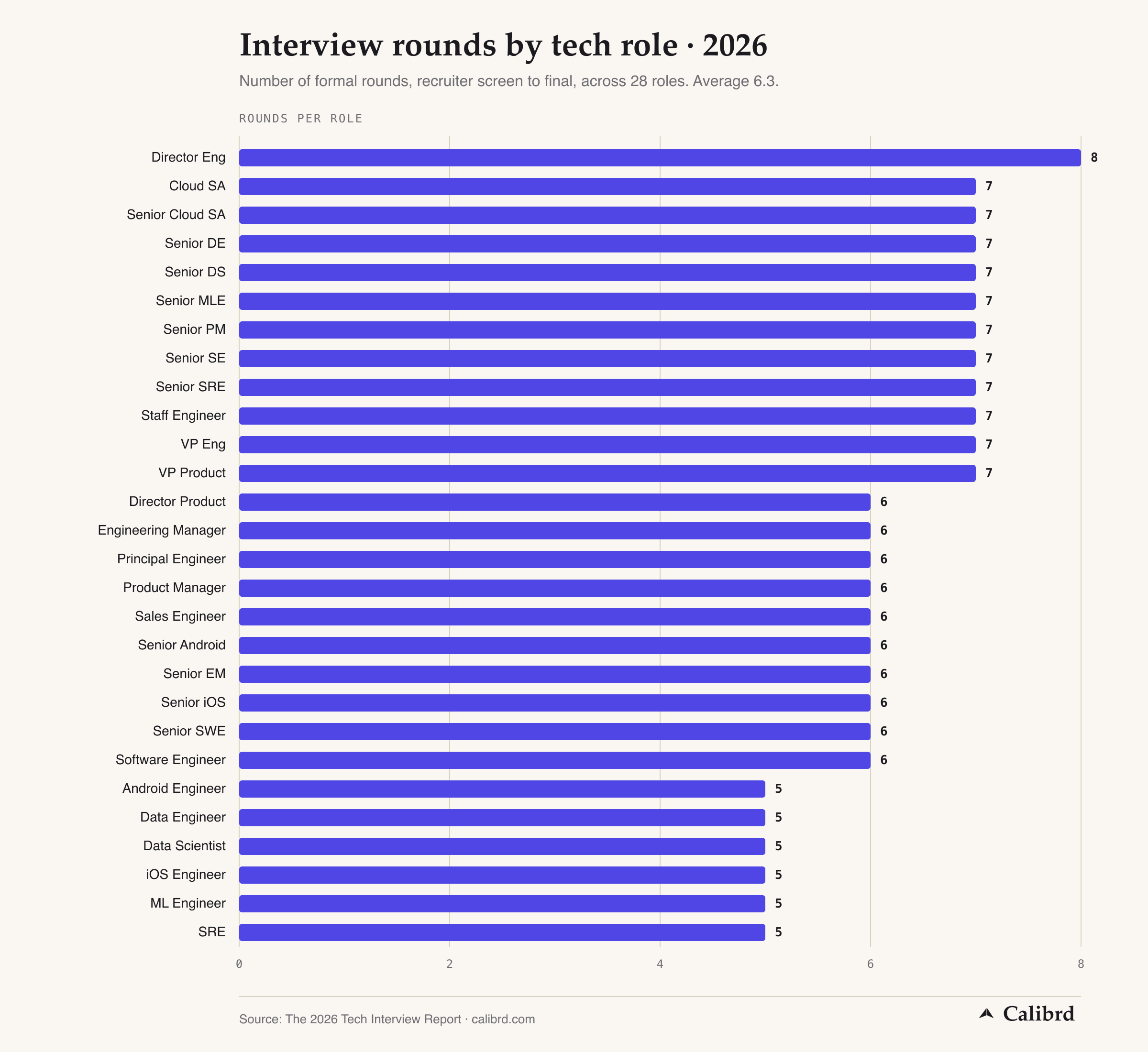
7 rounds · 12–24 weeksMost companies follow a similar pattern for VP Product interviews. Total calendar time is 12–24 weeks from recruiter screen to offer.
Calibration to VP, executive presence, scope of org and business owned
Strategic alignment, operating philosophy, why this company at this stage
Cross-functional operating skill, running product alongside engineering, finance, sales
Long-term strategic judgment, growth thesis, market expansion plans
Sometimes you meet the directors; sometimes the directors interview you
Independent reference triangulation across past CEOs, peers, reports
Comp, equity, transition window, public announcement planning
Sample questions you should be ready for
8 of the ones that decide itRepresentative of what companies ask at this level. Every question here can be practised out loud, which is the fastest way to find out whether your answer holds up under follow-ups. Calibrd adds voice practice with coaching on every answer, and a full voice mock interview: a live round with an AI interviewer who has read the role and your CV, then an honest debrief.
- 01“What's your view of our product portfolio's biggest strategic opportunity over the next 3 years?”
- 02“Walk me through how you'd allocate product investment across our growth surfaces.”
- 03“Tell me about a fundraise or M&A event where product was central to the diligence. What did you own?”
- 04“Describe how you'd partner with our CTO on the next 18 months of platform strategy.”
- 05“Walk me through how you've built an executive product bench from scratch, who you hired, who you grew, who you let go.”
- 06“Tell me about a time the CEO and you disagreed on product strategy. How did you operate?”
- 07“Describe a major product pivot or sunset you led at the 100+ person scale.”
- 08“What's a product or strategic decision you made that you wish you could undo?”
These are the general ones. Paste a real posting and Calibrd predicts the questions that company asks for that exact role, then interviews you on them.
Predict my questions →Compensation benchmark
US majors · USD · medianTypical pay for VP Product at major US tech companies, headline numbers in USD. Typical pay in London, Berlin and Singapore is meaningfully lower, and equity varies a lot by company stage.
VP Product total pay is typically $1.4–2.8M+, heavily equity-weighted. Pre-IPO unicorn VP Product roles often come with 0.5–2.5% equity. Pay closely tracks company stage, revenue, and ownership of company-level outcomes (growth, retention, market expansion).
How to prep
5 tactical tipsLead behavioural answers with the STAR method: Situation, Task, Action, Result. The tips below build on that structure for this specific role.
- Prepare a multi-year strategic perspective on the company, be ready to discuss it with the CEO and the board
- Have a clear executive operating philosophy you can articulate: how you partner with CEO, how you build directors, how you shape product culture
- Get coaching on board-level communication if you haven't done it, a different skill from internal exec presentation
- Be ready for compensation negotiation at the executive level: equity vesting, cliffs, change-of-control terms
- Talk to recent VPs at the company (or in their network) before final rounds, the role is often more politically nuanced than the JD describes
Where do VP Product candidates fail?
Spot it in a mock firstA few common mistakes that get VP Product candidates rejected even when they are otherwise strong. Worth catching in a mock interview before they show up in a real one.
Getting asked a question about company strategy and spending most of the answer on product details.
Why it fails
The CEO and board are listening for executive judgment, not product fluency. They assume the second is there. A VP candidate who pivots company-strategy questions into product-feature stories reads as "great Director, not quite a peer at the executive table yet." The pattern usually surfaces in the CEO round and ends the loop.
Fix
Practice answering strategy questions in business language first, product second. "Our biggest 3-year risk is competitive, our SMB segment is losing pricing power against Stripe" is a VP answer. "Our biggest 3-year risk is the onboarding funnel, we need to redesign step 3" is a Director answer dressed up.
Going into the CEO or board round without a clear thesis on where product investment should go over the next 12-18 months.
Why it fails
VP interviews are buying your judgment, not your resume. The CEO is hiring someone they can disagree with productively. Without an investment thesis (even a rough one), you have nothing to disagree about, which makes the conversation feel like a status check. Strong VP candidates leave the room with the CEO already lobbying internally for them.
Fix
Before final rounds, draft a one-page product investment thesis: top 3 bets, what each costs, what you'd kill to fund them, why this sequence. Hold it loosely. The point is to have a position the CEO can push on, not a plan they have to accept.
Couldn't name the company's biggest product risk over the next 3 years.
Why it fails
Generic answers signal you haven't researched the company's specific exposure. VP rounds are full of people who've read the public docs, talked to former employees, and have a sharp opinion. Generic risk answers read as "hadn't done the homework", which at this level is a credibility issue, not just a prep gap.
Fix
Talk to 3-5 people who've worked at the company in the last 2 years before final rounds. Read every public product announcement, every earnings-call mention of product strategy. Form a specific risk thesis (competitive encroachment, retention cliff, platform dependency, market timing) and be ready to defend it.
Recommended resources
No affiliate linksBooks, courses, and tools that come up most often in VP Product prep.
- 01Empowered (Cagan + Jones) →
The reference book for product leadership at the VP+ level. Read cover-to-cover; the operating model is the central exam.
- 02The Hard Thing About Hard Things (Ben Horowitz) →
Operating philosophy at the executive level. Comes up in CEO and board rounds, chapters on tough decisions and managing through crisis.
- 03Lenny's Newsletter →
The reference newsletter for product leadership. Posts on org design, growth strategy, and CEO partnership come up in VP-level prep.
- 04First Round Review, Product & Strategy →
Practitioner writing from successful CPOs and VPs. The strategic-bets, board-management, and portfolio posts come up directly in CEO rounds.
- 05Inspired (Cagan) →
Re-read for the product-operating-model framing VPs are expected to instil across their org from day one.
- 06Cracking the PM Career (Bavaro & McDowell) →
The explicit PM ladder this guide's level bar comes from — what changes between PM, Senior PM, and product leadership, with the skills split per level.
Common scenarios
Situations that come up a lotI'm a Senior Director of Product running 4 PMs and 2 designers and want to interview for VP. What's the actual scope delta and how do I know I'm ready?
Sr Director runs an organisation; VP sets the product bets the company makes and defends them at the board. The fastest test: in the last year, how many product decisions have you owned that reached the CEO or the board deck? If most of your decisions stopped at your CPO's desk, you're still operating at Sr Director level. If you've been the one presenting the multi-year roadmap to the board, owning a single thesis on where the company should compete, or negotiating directly with sales / GTM leaders on commercial trade-offs, you're already doing VP work and the title is mostly catch-up. Interview-wise, the biggest gap most Directors have is being able to compress a year of product strategy into a 4-minute board-style answer. Prep two or three examples where you owned a strategic bet, with the context, the call you made, the outcome, and your reflection, that lands harder than any framework. If you can't name two strategic bets you personally owned end-to-end, you're probably not VP-ready yet. Take the Sr Director offer at a larger company first; it'll get you the VP title faster than a stretched VP loop will.
I'm a VP of Product at a B2B SaaS company and now interviewing at a B2C consumer-app company. How different is the role, and how do I prep?
Different enough that some B2B → B2C transitions don't work even when the loop goes well. B2B VPs run portfolio strategy across enterprise customer segments, work closely with sales on roadmap commitments, and measure success in ACV, NDR and logo retention. B2C VPs run mass-market product strategy with little direct customer contact, measure success in retention curves and engagement metrics, and live and die by A/B testing infrastructure. The skills that made you effective in B2B (account-level customer empathy, sales partnership, enterprise feature trade-offs) don't all transfer; the skills B2C demands (growth-loop intuition, data-fluency at population scale, comfort with experimentation as the primary decision tool) you probably haven't built. Interviewers will probe for both, be ready to acknowledge once that B2C is newer to you, and bring evidence that you've operated in data-heavy environments and have a strong working relationship with engineering on experimentation infrastructure. Read Lenny's Newsletter posts on growth, the Reforge curriculum, and any case studies on the target company's product mechanics. Most B2B → B2C transitions that work involve a deliberate downlevel (Sr Director instead of VP) for 12–18 months to build credibility, then re-level inside.
I came up through engineering, then moved into PM 6 years ago, and I'm now Director of Product. Will the eng-to-PM background hurt or help at VP interviews?
Both, depending on how you frame it. Helps: technical-product depth (you can credibly talk about engineering trade-offs, AI infra, platform decisions), engineering trust (your CTO peer will partner with you faster than they would with a non-technical PM), and execution credibility (eng-to-PM folks are typically strong at shipping). Hurts: VPs are filtered hard on customer-and-market judgment, and eng-to-PM backgrounds often have a thinner muscle for customer interviews, GTM instincts and pricing strategy than people who came up in marketing-flavoured PM roles. Prep for the gap, not the strength. Two months pre-interview, do 20+ customer calls (even informally, talk to existing users of products you admire), read the GTM-heavy material (Lenny's Newsletter, First Round Review, Reforge on positioning), and build an opinion on the target company's market position before the interview. In behavioural rounds, lead with a customer-led story, not an engineering-led one, that's the signal interviewers are listening for. The technical depth is your asymmetric edge; don't waste loop time proving you're technical when you should be proving you understand customers.
I'm a VP of Product at a Series C startup that just did a 25% layoff. The CEO survived but I'm interviewing externally. How honest do I need to be about it?
Honest, briefly, and unflinching. Senior product interviewers in 2026 have seen enough downturns that what they filter for is your operating story under pressure, not whether your last company hit plan. The version that hurts is the one where you can't name the strategic call you'd have made differently, or where you blame the CEO, the macro or the board. The version that lands is something like "we made the call to invest in [direction] in Q1, I supported it; with hindsight I'd have argued harder for [alternative] given what we knew about [signal we underweighted], and here's how that shaped the way I weigh evidence now". Don't volunteer the layoff before being asked, it'll show in your dates. When they bring it up, two sentences on the macro context, one sentence on what you led product through, and pivot to what's next. If references will be called (they will), make sure your CEO will speak to your strategic contribution warmly even when the outcome wasn't there. Don't sound bitter; bitterness at the exec level reads as a hard-to-manage signal that no CEO wants to hire.
I'm a VP of Product at a 40-person seed-stage startup. Should I expect the VP title to translate at a Series B company at 200 people, or am I going to get downlevelled?
Be ready for friction. "VP of Product" at 40 people often means "the most senior PM, doing PM work plus some strategy", which at a Series B / 200-person company is solidly a Senior PM or Director role, not a VP one. VP at 200 people usually means running 3–6 PMs, owning quarterly business reviews with the CEO, partnering with a VP of Engineering and VP of Marketing, and operating one level removed from individual product decisions. Most seed-stage VPs interviewing at Series B land at Director or Sr Director, not VP. Don't argue title in the screen, interview at the level the recruiter offers, perform, and let the loop signal where you actually slot. If you land a Director offer at a credible company, take it; the operating learning at 200 people is what gets you to a real VP role at a larger company in 18–24 months. Pushing for the VP title at this stage usually backfires, either the offer doesn't materialise, or it does and you get fired in year one because the role wasn't a fit. The fast path to a senior-org VP role is via the right Sr Director seat, not via title preservation.
Frequently asked questions
I'm currently a Director Product (PM4 / M3). Should I read this guide or the Director Product guide first?
Read the Director Product guide first. Companies calibrate VP candidates against the PM4 / M3 bar with a clear scope-gap lens, they want to see where you stand today, then probe the gap up to VP. Read this guide AFTER you understand the PM4 / M3 baseline, so you know exactly which signals you need to demonstrate for the step-up.
How long should I prep before my VP Product onsite?
The process takes 12–24 weeks. Add 12+ weeks of prep if you're new to executive interviewing. The board / CEO-level communication is a different skill from internal exec conversations, get coaching if you haven't done it before.
What's the most common mistake candidates make at the VP Product bar?
Underestimating CEO and board fluency. VP rounds are political as much as product-strategic. Practising executive communication, concise updates, strategic recommendations, comfort with ambiguity, matters more than product depth at this level.
What if my interview process is different from what's listed?
Most variation is at the edges. Major tech companies (FAANG, scale-ups, mid-size SaaS) follow processes within 1–2 rounds of what's described. Smaller startups often run fewer rounds (3–4) but the bar at each round is similar; less-tech-mature companies sometimes skip system design or behavioural rounds entirely. Read the posting and ask the recruiter on the screening call; they'll tell you what's coming.
How does this guide compare to running a free scan?
This guide covers the general bar at VP. The free scan reads one real posting and opens the report right here: the questions that role and company will ask, a pay benchmark matched to the level and, with your CV, the gaps an interviewer will probe and a CV score. No account or email first; the report is on screen in about a minute.
Walk in ready
Walk into your VP Product interview ready.
Paste your actual job and Calibrd predicts what that company asks for this role, where your CV is thin, and what it should pay. Then rehearse the round out loud with honest feedback until you're confident. Free to start.
Free to start · No card · Encrypted at rest, never used to train AI, remove anytime