2026 update
A few things have changed in 2026. AI is now allowed in coding rounds at Canva and Meta, detection has improved at companies that still ban it, pay has split at staff+, and the post-onsite wait got longer. Read what changed in 2026 →
What you'll be expected to do
What they're grading- Run an engineering organisation of 100+ engineers across multiple product areas
- Partner with CEO and CPO at the executive table on company strategy
- Own engineering investment thesis: where to spend, where to cut, when to acquire
- Build and develop a director-level leadership bench (4–8 directors reporting in)
- Be accountable for company-level technical outcomes, reliability, velocity, security
- Represent engineering to the board; own relationship with the CTO if separate role exists
What does the interview loop look like?
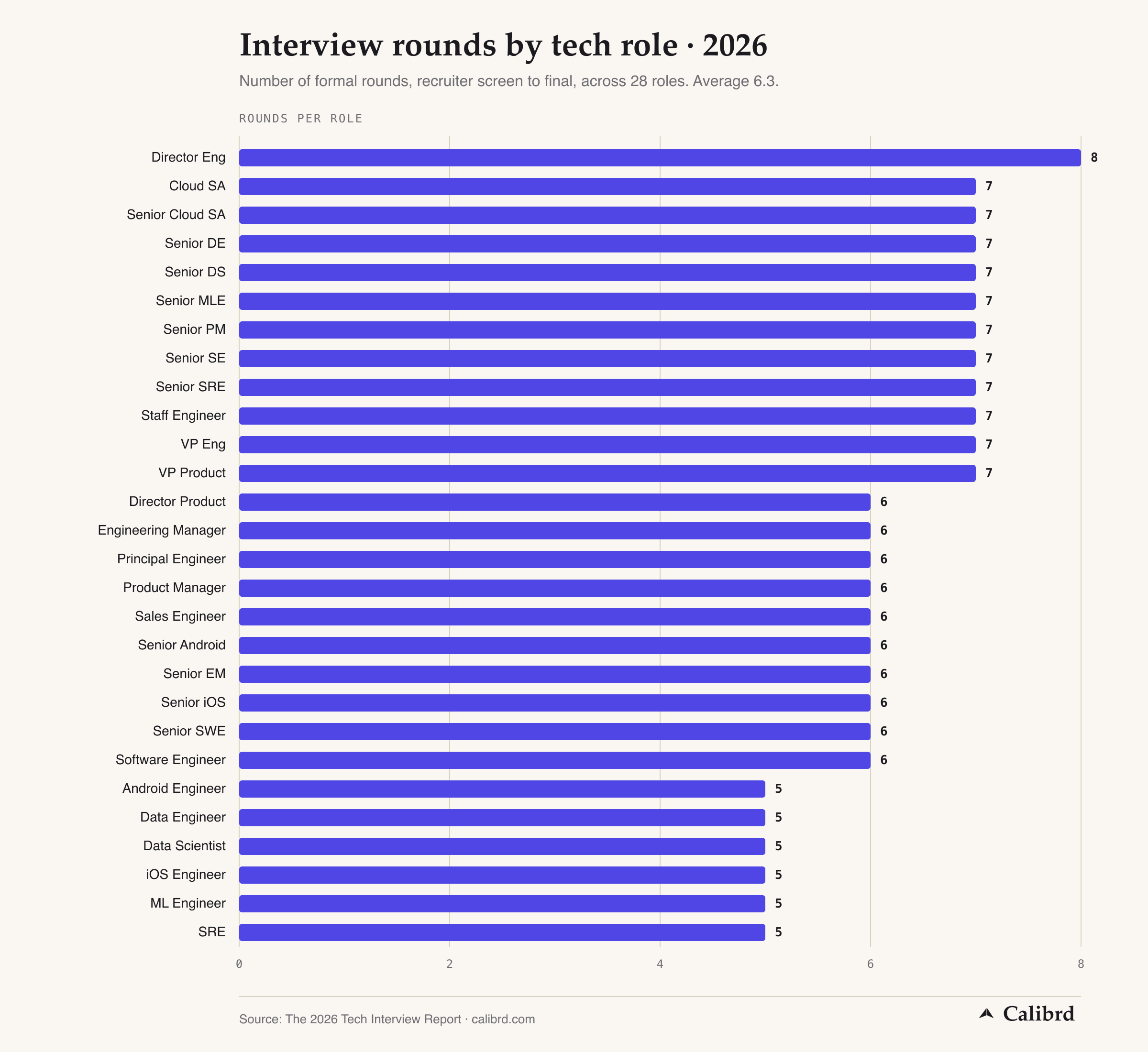
7 rounds · 12–24 weeksMost companies follow a similar pattern for VP Eng interviews. Total calendar time is 12–24 weeks from recruiter screen to offer.
Calibration to VP, executive presence, scope of org and business owned
Strategic alignment, operating philosophy, why this company at this stage
Cross-functional operating skill, running a function alongside other functions
Long-term strategic judgment, fundraise / IPO context if relevant
Directors and staff engineers interview you on technical judgment and operating philosophy. Probing on architectures you've owned, technical bets you've made, and your ability to engage at the staff or principal level on real technical decisions. Their feedback carries significant weight on the offer
Independent reference triangulation across past CEOs, peers, reports
Comp, equity, transition window, public announcement planning
Sample questions you should be ready for
8 of the ones that decide itRepresentative of what companies ask at this level. Every question here can be practised out loud, which is the fastest way to find out whether your answer holds up under follow-ups. Calibrd adds voice practice with coaching on every answer, and a full voice mock interview: a live round with an AI interviewer who has read the role and your CV, then an honest debrief.
- 01“What's your view of our company's biggest technical risk over the next 3 years?”
- 02“Walk me through how you'd allocate a $50M engineering budget at our company.”
- 03“Tell me about a fundraise or M&A event where engineering was central to the diligence. What did you own?”
- 04“Describe how you'd partner with our CPO on the next 18 months of product strategy.”
- 05“Walk me through how you've built an executive engineering bench from scratch. Specifically, who you hired, who you grew, who you let go.”
- 06“Tell me about a time the CEO and you disagreed on engineering strategy. How did you operate?”
- 07“Describe a fundamental org reshape you led at the 100+ engineer scale.”
- 08“What's a technical or organisational decision you made that you wish you could undo?”
These are the general ones. Paste a real posting and Calibrd predicts the questions that company asks for that exact role, then interviews you on them.
Predict my questions →Compensation benchmark
US majors · USD · medianTypical pay for VP Eng at major US tech companies, headline numbers in USD. Typical pay in London, Berlin and Singapore is meaningfully lower, and equity varies a lot by company stage.
VP Eng total pay is typically $1.5–3M+, heavily equity-weighted. Pre-IPO unicorn VP roles often come with 0.5–2.5% equity. Pay closely tracks company stage, revenue, and ownership of company-level outcomes.
How to prep
6 tactical tipsLead behavioural answers with the STAR method: Situation, Task, Action, Result. The tips below build on that structure for this specific role.
- 01Prepare a multi-year strategic perspective on the company, be ready to discuss it with the CEO and the board
- 02Have a clear executive operating philosophy you can articulate: how you partner with CEO, how you build directors, how you shape culture
- 03Stay technically credible, refresh on a major architecture decision you owned, a technical bet that didn't pan out, and the company's recent public engineering writing. The engineering bench probes specifics, not leadership philosophy
- 04Get coaching on board-level communication if you haven't done it, it's a different skill from internal exec presentation
- 05Be ready for compensation negotiation at the executive level: equity vesting, cliffs, change-of-control terms
- 06Talk to recent VPs at the company (or in their network) before final rounds, the role is often more politically nuanced than the JD describes
Where do VP Eng candidates fail?
Spot it in a mock firstA few common mistakes that get VP Eng candidates rejected even when they are otherwise strong. Worth catching in a mock interview before they show up in a real one.
Getting asked a question about company strategy and spending most of the answer on technical details.
Why it fails
The CEO and board are listening for executive judgment, not technical fluency. They assume the second is there. A VP candidate who pivots company-strategy questions into technical stories reads as "great Director, not quite a peer at the executive table yet". The pattern usually surfaces in the CEO round and ends the loop.
Fix
Practice answering strategy questions in business language first, technical second. "Our biggest 3-year risk is competitive, Stripe is encroaching on the SMB segment we depend on" is a VP answer. "Our biggest 3-year risk is our monolith, refactoring will take 4 quarters" is a Director answer dressed up.
Going into the CEO or board round without a clear thesis on where engineering investment should go over the next 12-18 months.
Why it fails
VP interviews are buying your judgment, not your resume. The CEO is hiring someone they can disagree with productively. Without an investment thesis (even a rough one), you have nothing to disagree about, which makes the conversation feel like a status check. Strong VP candidates leave the room with the CEO already lobbying for them.
Fix
Before final rounds, draft a one-page investment thesis: top 3 bets, what each costs, what you'd kill to fund them, why this sequence. Hold it loosely. The point is to have a position the CEO can push on, not a plan they have to accept.
Getting asked "what's our biggest technical risk over the next 3 years" and giving a generic answer about scaling or tech debt.
Why it fails
Generic answers signal you haven't researched the company's specific exposure. VP rounds are full of people who've read the company's public docs, talked to former employees, and have a sharp opinion. Generic risk answers read as "hadn't done the homework", which at this level is a credibility issue, not just a prep gap.
Fix
Talk to 3-5 people who've worked at the company in the last 2 years before final rounds. Read every public engineering blog post, every earnings call mention of technical investment. Form a specific risk thesis (vendor concentration, regulatory exposure, talent flight from a critical team) and be ready to defend it.
Treating the engineering bench review as casual conversation rather than a technical assessment.
Why it fails
The directors and staff engineers who'd report to you are doing a serious technical evaluation, and their feedback weighs heavily on the final offer call. VP candidates who haven't kept their technical edge sharp get caught here: vague on technical trade-offs, unable to engage on the actual systems the company runs, can't name a specific technical decision they'd revisit. The pattern feedback afterwards is usually "strong manager, not sure they'd earn the staff engineers' respect".
Fix
Before final rounds, refresh on the technical specifics: an architecture you owned in the last 5 years, a technical bet that didn't work and what you learned, a recent piece of the company's public engineering writing you have a genuine opinion on. Treat the bench review as the most important technical round, not a friendly chat with future reports.
Recommended resources
No affiliate linksBooks, courses, and tools that come up most often in VP Eng prep.
- 01The Engineering Executive's Primer (Will Larson) →
Required reading for VP candidates. Covers executive operating model, 90-day onboarding, board interactions, and CEO partnership patterns.
- 02The Hard Thing About Hard Things (Ben Horowitz) →
Operating philosophy at the executive level. Comes up in CEO and board rounds, chapters on tough decisions and managing through crisis.
- 03High Output Management (Andy Grove) →
Foundational for executive operating skill. Re-read the chapters on leveraged management and the executive review process.
- 04Lenny's Newsletter →
Cross-functional patterns at the executive table. Useful for CEO / CPO partnership framing and the recurring VP-of-Eng interview themes.
- 05Become a Great Engineering Leader (James Stanier) →
Covers the skills the top of the loop probes: communicating upward to the CEO and board, writing strategy, and running a large org through leaders rather than direct involvement.
- 06The Manager's Path (Camille Fournier) →
Read The Big Leagues chapter — Fournier's definition of the senior-leadership job: setting multi-year direction, managing through directors, and owning engineering's results to the CEO.
Common scenarios
Situations that come up a lotI'm a Director of Engineering managing 30 people across 4 teams and want to interview for VP roles. What's the actual scope delta and how do I know I'm ready?
The Director-to-VP jump is more about politics than headcount. A Director runs an org; a VP sets where the org is going, sells that direction to the CEO and board, and absorbs cross-functional friction with Product, GTM and Finance. The fastest test: in the last 6 months, how many decisions have you made that went all the way to the executive table? If the answer is mostly "my decisions stop at my VP's desk", you're still operating as a Director. If you've been the one carrying the technical-strategy slide at the QBR, presenting headcount asks to the CFO, or being the voice in the room when Product proposes a roadmap that breaks your timeline, you've started doing VP work and the title is mostly catch-up. Interview-wise, the biggest gap most Directors have is CEO-round fluency: speaking in business outcomes rather than engineering metrics, having an opinion on the company's market position, being comfortable saying "I don't know yet" without losing the room. Prep two or three concrete examples where you operated at the executive level, those carry the loop more than any organisational design framework.
I'm a VP of Engineering at a 60-person startup and considering a VP role at a 1500-person scaleup. How different is the job, and will my experience translate?
Same title, genuinely different jobs. At 60 people you're a player-coach, probably still in code reviews, hiring every senior engineer personally, and running architecture reviews yourself. At 1500 you're running an organisation through 3–4 layers of management; your day is leverage and influence, not technical work. The transition is rough for people who got the VP title early in a small company because the skills that made them effective (deep technical judgment, fast unilateral decisions, founder-level intensity) become liabilities at scale, where the job is "set the operating model, then hold the senior leaders accountable to it". Interviewers at the scaleup will probe specifically for this, expect questions like "how do you scale technical decision-making when you can't be in every architecture review" and "how do you set engineering culture across 6 timezones". Lean hard on any moments where you delegated and watched outcomes happen without you. If you've never run engineering through layers, acknowledge that openly, they're filtering for self-awareness, not omniscience.
I'm a VP of Engineering at a series-B startup. We hit a rough patch, missed product-market fit, layoffs, founder transition, and I'm now interviewing externally. How much does that hurt me?
Less than you think if you can talk about it honestly. Executive interviewers in 2026 have lived through enough founder transitions and missed-PMF stories that what they're filtering for is self-awareness and operating instinct, not a clean track record. The version that hurts is the one where you can't name what you'd have done differently, or where you blame the CEO / market / cofounders without owning your share. The version that lands is something like "we made the call to invest in [direction] in Q2, I supported it then; with hindsight I'd have argued harder for [alternative], and here's what I learned about how I weigh evidence under pressure". Don't volunteer the layoff story before being asked, it shows in your timeline and they'll bring it up. When they do, two sentences about the macro, one sentence about what you led the team through, and pivot to what's next. Don't sound bitter about the founder; even when they were wrong, sounding bitter at the exec level reads as "will be hard to manage upward". Interviewers will check references; make sure your former CEO will speak warmly even if the company didn't work.
I'm a senior IC who never went into management, but I'm 15 years in and now want to interview for VP of Engineering. Is that realistic?
Honest answer: rarely. The VP loop tests for operating skill (running through layers, performance management, executive partnership) that long-tenure ICs simply haven't practised, even very senior ones. Most VP hires came up through Director and Sr Director roles where they ran 10, then 30, then 80 people; the muscle is built over years, not interviewed for. Two paths can work. The first is an IC-flavour exec role (Chief Architect, VP of Engineering Excellence, Distinguished Engineer reporting to CTO) where your technical depth is the point and you're not running a large org. These exist at companies with mature engineering ladders (Stripe, Netflix, Anthropic, Meta) but they're rare and usually filled by internal candidates with strong reputations. The second is to take a Sr Director role first as a deliberate skill-rebuild, accept the lateral on title, learn the operating side for 18–24 months, then go for VP. Skipping straight from IC to VP almost always ends badly for both you and the company within 12 months, even when the interview goes well.
I've been at the same company for 12 years and rose to VP of Engineering internally. I haven't interviewed in over a decade. How do I prep without sounding stale?
The biggest risk for long-tenured internal VPs is sounding parochial, assuming the patterns at your current company are universal, or talking about "how we do X" as if it's how the industry does X. Two months pre-interview, do active reading: Will Larson's An Elegant Puzzle and The Engineering Executive's Primer, Camille Fournier's The Manager's Path, every recent issue of Pragmatic Engineer that touches on org design. Talk to 5–8 external VPs (LinkedIn warm-intros via your network) about how they're running things, culture rituals, performance management, AI tooling rollout, return-to-office. By the time you sit down with the CEO of a target company, you should be able to compare three or four different operating models, not just describe yours. The other risk is interview rust: the cadence of stating problem → context → decision → outcome → reflection, all in 3–4 minutes, is a different communication skill from running an internal meeting. Practise out loud, ideally with a coach or peer who'll give you brutal feedback. Don't apologise for the long tenure, pitch it as depth, but show you've kept your operating frame current.
Frequently asked questions
I'm currently a Director Eng (M3 / M4). Should I read this guide or the Director Eng guide first?
Read the Director Eng guide first. Companies calibrate VP candidates against the M3 / M4 bar with a clear scope-gap lens, they want to see where you stand today, then probe the gap up to VP. Read this guide AFTER you understand the M3 / M4 baseline, so you know exactly which signals you need to demonstrate for the step-up.
How long should I prep before my VP Eng onsite?
The process takes 12–24 weeks. Add 12+ weeks of prep if you're new to executive interviewing. The board / CEO-level communication is a different skill from internal exec conversations, get coaching if you haven't done it before.
What's the most common mistake candidates make at the VP Eng bar?
Underestimating CEO and board fluency. VP rounds are political as much as technical. Practising executive communication, concise updates, strategic recommendations, comfort with ambiguity, matters more than technical depth at this level.
What if my interview process is different from what's listed?
Most variation is at the edges. Major tech companies (FAANG, scale-ups, mid-size SaaS) follow processes within 1–2 rounds of what's described. Smaller startups often run fewer rounds (3–4) but the bar at each round is similar; less-tech-mature companies sometimes skip system design or behavioural rounds entirely. Read the posting and ask the recruiter on the screening call; they'll tell you what's coming.
How does this guide compare to running a free scan?
This guide covers the general bar at VP. The free scan reads one real posting and opens the report right here: the questions that role and company will ask, a pay benchmark matched to the level and, with your CV, the gaps an interviewer will probe and a CV score. No account or email first; the report is on screen in about a minute.
Walk in ready
Walk into your VP Eng interview ready.
Paste your actual job and Calibrd predicts what that company asks for this role, where your CV is thin, and what it should pay. Then rehearse the round out loud with honest feedback until you're confident. Free to start.
Free to start · No card · Encrypted at rest, never used to train AI, remove anytime