2026 update
A few things have changed in 2026. AI is now allowed in coding rounds at Canva and Meta, detection has improved at companies that still ban it, pay has split at staff+, and the post-onsite wait got longer. Read what changed in 2026 →
What you'll be expected to do
What they're grading- Own a product area served by one or more full engineering teams (8–15 engineers), often spanning teams
- Define multi-quarter strategy for your product area, write the docs leadership aligns to
- Lead complex cross-functional initiatives, partnering with design, engineering, marketing, sales, support
- Mentor PM2 and PM3 peers; participate in PM hiring loops as a regular interviewer
- Make build/buy/partner decisions with clear analytical justification
- Represent product in director-level forums and partner with engineering tech leads
What does the interview loop look like?
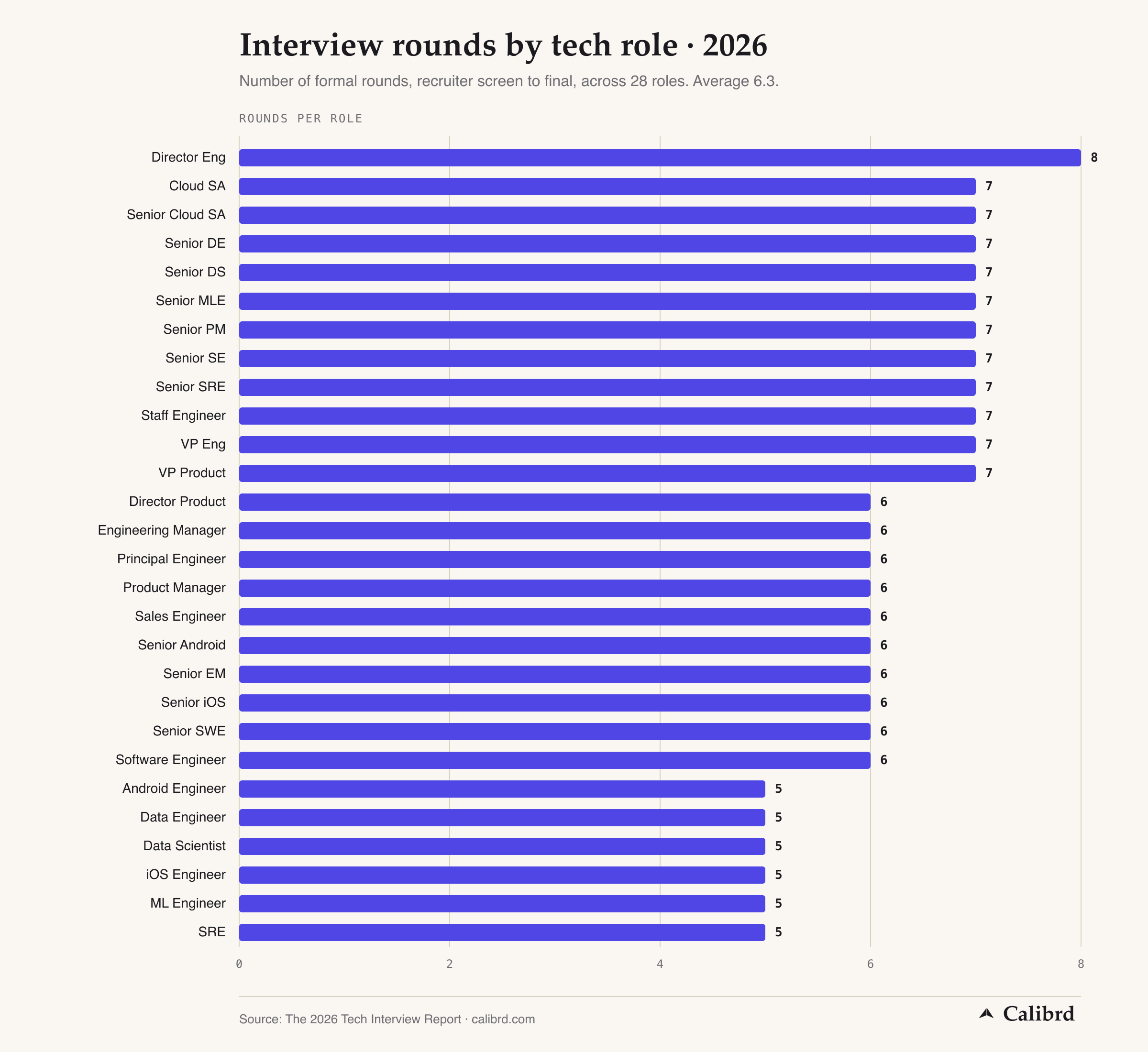
7 rounds · 5–8 weeksMost companies follow a similar pattern for Senior PM interviews. Total calendar time is 5–8 weeks from recruiter screen to offer.
Calibration to senior level, scope of past surfaces owned
Product philosophy, biggest wins, why this company / surface next
Open-ended product problem with explicit ambiguity, e.g. 'How would you grow a product like Notion in the enterprise?'
Multi-quarter or multi-year strategic decision, pricing, positioning, build vs partner
Real product situation with data, define metrics, diagnose, propose investments
How you operate with senior engineers; conflict resolution; leveraging design partners
Product judgment at senior+ scope, executive presence
Sample questions you should be ready for
9 of the ones that decide itRepresentative of what companies ask at this level. Every question here can be practised out loud, which is the fastest way to find out whether your answer holds up under follow-ups. Calibrd adds voice practice with coaching on every answer, and a full voice mock interview: a live round with an AI interviewer who has read the role and your CV, then an honest debrief.
- 01“Our user growth is plateauing despite adding features. Walk through how you'd diagnose and address it.”
- 02“Pick a product you use daily. What's the strategic move you'd make if you ran it?”
- 03“How would you think about expanding our product into a new vertical? Pick the vertical first.”
- 04“Build vs buy vs partner: walk through a real decision you made.”
- 05“Your team's roadmap is fully committed; the CEO asks you to add a major new initiative. How do you respond?”
- 06“Tell me about a time you killed a product line. What were the signals?”
- 07“Describe a time you influenced a decision well outside your direct authority.”
- 08“Walk through a strategic disagreement with engineering or design leadership. How did you build alignment?”
- 09“Tell me about the most ambiguous product problem you owned. What was the framework you applied?”
These are the general ones. Paste a real posting and Calibrd predicts the questions that company asks for that exact role, then interviews you on them.
Predict my questions →Compensation benchmark
US majors · USD · medianTypical pay for Senior PM at major US tech companies, headline numbers in USD. Typical pay in London, Berlin and Singapore is meaningfully lower, and equity varies a lot by company stage.
FAANG PM3 / Senior PM total pay is typically $400–550k. London Senior PM base ~£100–135k. Many companies have a 'Lead PM' or 'Group PM' track above this, comp jumps significantly there.
How to prep
5 tactical tipsLead behavioural answers with the STAR method: Situation, Task, Action, Result. The tips below build on that structure for this specific role.
- 01Prepare 12–15 STAR stories tagged across senior+ signals: strategy, ambiguity, cross-functional influence, multi-quarter ownership, analytical rigour
- 02Have a strategic point of view on the company you're interviewing at, top 3 strategic moves, ranked, defended
- 03Drill open-ended product sense problems where the framework is to scope it down first
- 04Practise the 'why this company at this stage' answer until it's specific and credible, generic answers fail at senior level
- 05Be ready for strategic questions about the company's actual product, read their public roadmap, recent launches, earnings calls
Where do Senior PM candidates fail?
Spot it in a mock firstA few common mistakes that get Senior PM candidates rejected even when they are otherwise strong. Worth catching in a mock interview before they show up in a real one.
Walking through a senior product sense question with the same framework you'd use at PM2: clarify, target user, prioritize features.
Why it fails
Senior PM rounds test the strategic layer on top of product sense: market positioning, competitive response, what the company gives up by going this way. A clean PM2 framework with a senior-level question reads as "good operator, not strategic yet". The interviewer is waiting for you to step up to "and here's what this means for our positioning against X competitor".
Fix
After the standard framework, add a 90-second strategic layer: "this also affects our positioning against X", "this trades off our enterprise narrative against our SMB unit economics", "this is a 6-month bet we'd lose 18 months on if it fails". The strategic frame is what makes the answer senior.
Answering product strategy questions mostly in terms of user experience improvements, with no business-model context.
Why it fails
Senior PM interviewers want to know you can hold the P&L mental model: pricing, COGS, conversion economics, retention math. A pure-UX answer reads as "designer who became a PM", which is a real path but gets you hired a level down at Senior. The pattern in feedback is "great product instinct, not sure they understand the business yet".
Fix
For every product question, weave in one business-level data point: "this would lift conversion 2-3 points which translates to roughly $X ARR", "this is margin-dilutive but locks in retention", "we'd be trading short-term GMV for cohort LTV". Rough numbers ground the answer in business.
Describing your hardest stakeholder management as a single disagreement with an engineer or designer on your own team.
Why it fails
Senior PM interviews probe for influence beyond your team: convincing a senior engineering leader to change priorities, getting marketing aligned on a launch narrative, holding ground with a CEO who wants something different. A single-team disagreement story tells the interviewer you haven't operated at the influence radius they're hiring for.
Fix
Prep 2-3 stories where the conflict was outside your team: a Director Engineering you had to bring around to your roadmap, a CEO who pushed for a feature you decided not to ship, a sales leader you negotiated with on commit dates. The escalation path and political texture separates senior stories from IC ones.
Recommended resources
No affiliate linksBooks, courses, and tools that come up most often in Senior PM prep.
- 01Inspired (Marty Cagan) →
Re-read for the senior PM bar. The empowered-team-operating-model framing is what L5+ interviews probe.
- 02Empowered (Cagan + Jones) →
The follow-up to Inspired focused on senior+ product leadership patterns. Highly relevant for the strategy and cross-functional rounds.
- 03Lenny's Newsletter →
Senior+ PM patterns and frameworks. The posts on metric design, growth strategy, and product portfolio decisions come up in senior PM strategy rounds.
- 04Reforge, Mastering Product Strategy →
Practitioner courses for senior PM scope. The strategy and retention/engagement programmes are the highest-leverage.
- 05First Round Review, Product Management →
Practitioner writing from senior+ PMs at successful companies. Useful for the strategic-POV pieces in hiring-manager rounds.
- 06Cracking the PM Career (Bavaro & McDowell) →
The explicit PM ladder this guide's level bar comes from — what changes between PM, Senior PM, and product leadership, with the skills split per level.
Common scenarios
Situations that come up a lotI'm a PM2 applying externally for Senior PM roles. How do I show I'm ready for the step up when my current title is still PM2?
The calibration delta between PM2 and Senior PM is mostly scope and strategic layer, not output volume. PM2 ships features; Senior PMs own multi-feature surfaces and represent product in director-level forums. Two things to show in interviews. First, evidence you've operated at scope larger than your title, pick 2–3 examples where you owned something bigger than your job description (a cross-team initiative you drove without formal authority, a competitive response you led, a metric you owned company-wide). Second, the strategic layer. For every product question, weave in strategic context: "this affects our positioning against X because…", "we'd be trading near-term GMV for cohort LTV". Senior PM rounds test whether you can hold both layers, operator AND strategist. Don't just describe what you shipped; describe why that mattered at the company-strategy level.
I'm a Senior PM at a Series B startup. How do I prep for a Senior PM interview at FAANG when their interview loop is so different from startup hiring?
FAANG Senior PM loops are heavily structured, strategy rounds, product sense, behavioural, execution, each with a specific scoring rubric. The trap startup PMs fall into: answering open-ended questions with a startup mindset ("we'd just ship and iterate"), which reads as PM2 at FAANG scale. Drill the canonical frameworks (CIRCLES for product design, jobs-to-be-done for user discovery, AARRR pirate metrics for growth analysis) cold, not because frameworks are the answer, but because they signal you can operate within FAANG's structured product environment. For the strategy round, prep 2–3 specific examples where you made a "kill a feature" or "kill a product line" call, including the business math behind it. FAANG interviewers grade strategic judgement on those calls more than they grade ship velocity. Bonus: research the specific PM career ladder at the company (Google L5, Meta IC5, Amazon L6) so you can speak to which scope you're applying at.
I'm an Engineering Manager applying for Senior PM roles. How do I position the transition without my CV reading as "wanted to escape engineering"?
The "wanted to escape" framing comes from a CV that just shows EM responsibilities then says "now I want PM", no narrative bridge. Build one before the interview. Three pieces. First, name the PM work you've already done, most senior EMs run product alongside engineering: roadmap framing, scope negotiation, killing features that didn't ship value. Make that work explicit in your CV bullets, framed in PM language ("owned product decisions on X feature because no PM was assigned"). Second, in interviews lead with the WHY: "I've been the de facto PM on three of my team's biggest features over the past two years, and I realised the product-strategy work was where I was creating the most leverage." Coherent story, not an escape narrative. Third, prep for the "do you understand commercial product?" probe, this is the round where ex-EMs lose. Drill business-side concepts (CAC, LTV, COGS, retention math) so you don't sound like a great operator with no commercial instinct.
I've been a Senior PM in consumer (social, e-commerce) for 5 years. How do I prep for a Senior PM interview at a B2B SaaS company?
Two big shifts: from millions of users at small price points to thousands of customers on large contracts, and from individual user behaviour to multi-stakeholder buying. Consumer PMs over-index on UX research and A/B tests; B2B PMs over-index on sales-call ethnography, customer-success conversations, and competitive battlecards. Three weeks before the interview: book a demo on the company's website and treat it as ethnography, what does the AE pitch, which pain points do they probe for, what objections come up. Read the company's last 3 case studies and decode the customer's actual job. Study the buyer journey for the company's product (champion → economic buyer → procurement → security review). In the interview, when asked "how would you grow X feature", lead with which customer segment + which buying-committee role you're targeting, not which user behaviour you're optimising. Consumer-PM answers ("we'd A/B test the onboarding") fall flat in B2B, sales-cycle math + retention math is what wins.
How should I answer "tell me about a product or feature you killed" for a Senior PM interview, when my honest answer is "I haven't killed anything major"?
Don't invent a kill story, Senior PM interviewers spot fabricated kills in 30 seconds. But you almost certainly have killed something at smaller scope: a feature you de-prioritised after early data, a deal you walked away from, a customer segment you stopped serving, an experiment you didn't roll out. Reframe one of those as the answer. Structure it as: (1) we had X investment in [feature/scope], (2) the data or customer signal showed [specific reason it wouldn't pay off], (3) I made the call to wind it down, (4) here's what we learned and where we put the resources instead. The interviewer is grading decisiveness and data-driven judgement, not the scale of the kill. What they're really screening for: PMs who can let go of pet features when the data says no. If you genuinely haven't deprioritised anything, that's the actual gap, say so honestly ("I haven't had to kill a major project, but I've made hard de-prioritisation calls on X and Y"). Honesty beats inflated stories at Senior+.
Frequently asked questions
I'm currently a Product Manager (PM2 / IC2). Should I read this guide or the Product Manager guide first?
Read the Product Manager guide first. Companies calibrate PM3 / IC4 candidates against the PM2 / IC2 bar with a clear scope-gap lens, they want to see where you stand today, then probe the gap up to PM3 / IC4. Read this guide AFTER you understand the PM2 / IC2 baseline, so you know exactly which signals you need to demonstrate for the step-up.
How long should I prep before my Senior PM onsite?
The process takes 5–8 weeks. Add 6–8 weeks of prep, the strategic POV on the company is the differentiator. Research their roadmap, recent launches, earnings calls; have a top-3 list of strategic moves you'd make, ranked and defended.
What's the most common mistake candidates make at the Senior PM bar?
Not having a strategic point of view on the company. Senior+ PM interviews assume you've researched their business deeply, top-3 strategic moves, ranked, defended. Generic frameworks fail at this level.
What if my interview process is different from what's listed?
Most variation is at the edges. Major tech companies (FAANG, scale-ups, mid-size SaaS) follow processes within 1–2 rounds of what's described. Smaller startups often run fewer rounds (3–4) but the bar at each round is similar; less-tech-mature companies sometimes skip system design or behavioural rounds entirely. Read the posting and ask the recruiter on the screening call; they'll tell you what's coming.
How does this guide compare to running a free scan?
This guide covers the general bar at PM3 / IC4. The free scan reads one real posting and opens the report right here: the questions that role and company will ask, a pay benchmark matched to the level and, with your CV, the gaps an interviewer will probe and a CV score. No account or email first; the report is on screen in about a minute.
Walk in ready
Walk into your Senior PM interview ready.
Paste your actual job and Calibrd predicts what that company asks for this role, where your CV is thin, and what it should pay. Then rehearse the round out loud with honest feedback until you're confident. Free to start.
Free to start · No card · Encrypted at rest, never used to train AI, remove anytime