2026 update
A few things have changed in 2026. AI is now allowed in coding rounds at Canva and Meta, detection has improved at companies that still ban it, pay has split at staff+, and the post-onsite wait got longer. Read what changed in 2026 →
What you'll be expected to do
What they're grading- Manage 5–10 engineers, 1:1s, performance reviews, growth plans, hiring
- Own team-level OKRs and quarterly delivery commitments
- Translate product / business priorities into engineering plans your team can execute
- Coach engineers through technical and career decisions; manage out underperformers
- Partner with PM and design daily; represent engineering in cross-functional meetings
- Guard team health, prevent burnout, balance feature work with technical investment
What does the interview loop look like?
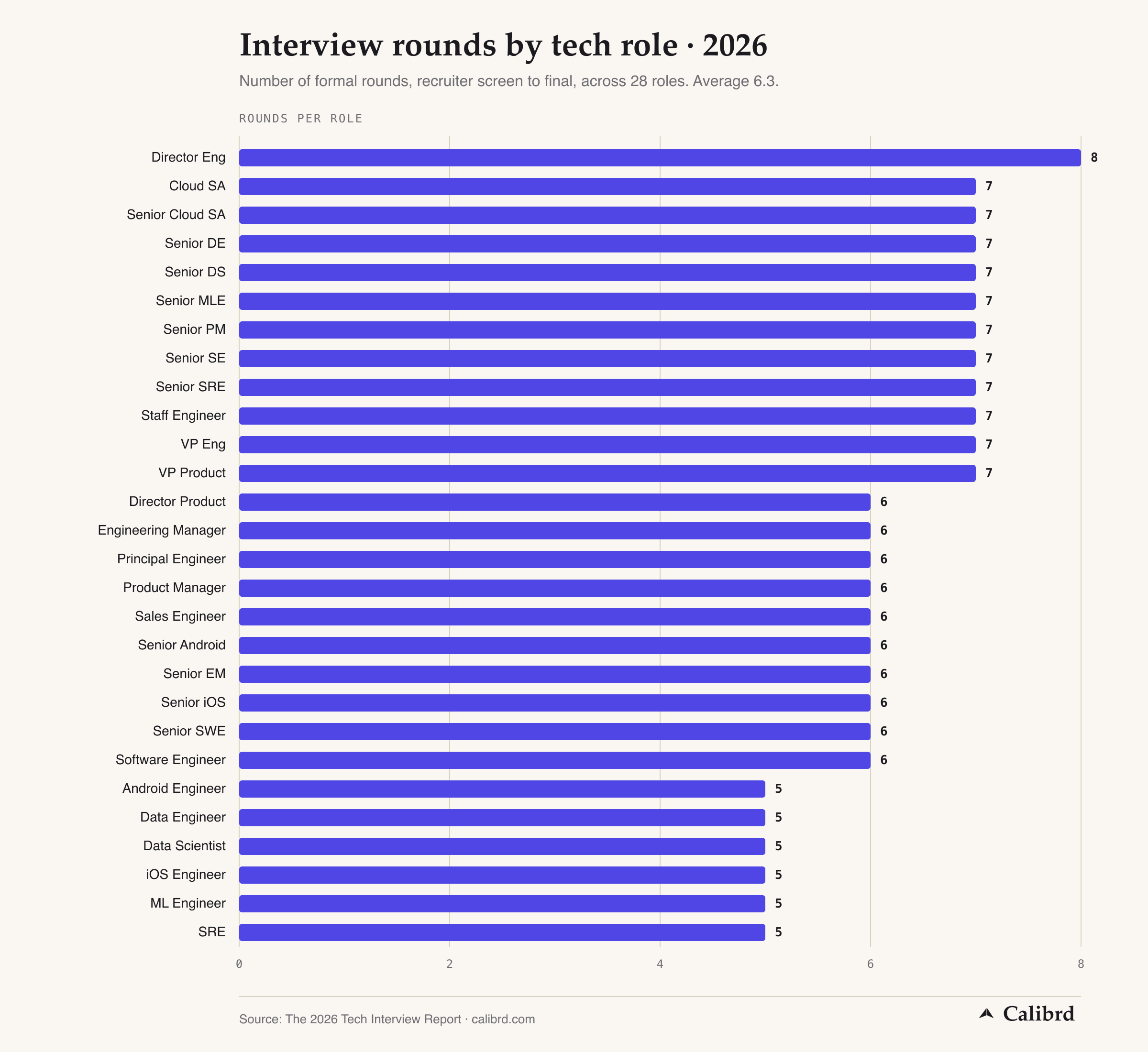
6 rounds · 4–6 weeksMost companies follow a similar pattern for Engineering Manager interviews. Total calendar time is 4–6 weeks from recruiter screen to offer.
EM background, span of management, prior roles, motivation
Management philosophy, span vs depth trade-off, recent ICs hired and grown
Either a system design discussion or a code-walkthrough of your most recent IC project, calibration only
Performance management scenarios, coaching a struggling engineer, managing an L5 who wants L6, handling team conflict
Collaboration, prioritisation, conflict resolution with non-engineering peers
Strategic thinking, organisational design, hiring philosophy
Sample questions you should be ready for
8 of the ones that decide itRepresentative of what companies ask at this level. Every question here can be practised out loud, which is the fastest way to find out whether your answer holds up under follow-ups. Calibrd adds voice practice with coaching on every answer, and a full voice mock interview: a live round with an AI interviewer who has read the role and your CV, then an honest debrief.
- 01“Your team has shipped on time for 4 quarters but engagement is dropping. What do you do?”
- 02“You inherit a team where the lead engineer is technically excellent but creates conflict. Talk me through your first 90 days.”
- 03“Your PM and your tech lead disagree on the next quarter's priorities. How do you mediate?”
- 04“Tell me about an engineer you coached from senior to staff. What did the coaching look like specifically?”
- 05“Describe a time you had to manage out an underperformer. Walk through the timeline and the conversations.”
- 06“How do you balance feature work and technical-debt investment with your team? Give a concrete example from this quarter.”
- 07“Tell me about a hiring decision you regret. What did you change about your process afterwards?”
- 08“Describe a conflict between two of your direct reports. How did you resolve it?”
These are the general ones. Paste a real posting and Calibrd predicts the questions that company asks for that exact role, then interviews you on them.
Predict my questions →Compensation benchmark
US majors · USD · medianTypical pay for Engineering Manager at major US tech companies, headline numbers in USD. Typical pay in London, Berlin and Singapore is meaningfully lower, and equity varies a lot by company stage.
FAANG M1 / M2 total pay is typically $350–500k. EM pay closely tracks Senior+ Staff IC bands. London EM base ~£100–135k. Many companies expect 1+ year of formal management experience; some hire from senior IC roles directly.
How to prep
5 tactical tipsLead behavioural answers with the STAR method: Situation, Task, Action, Result. The tips below build on that structure for this specific role.
- 01Prepare 12–15 STAR stories explicitly tagged across people-management signals: hiring, growing, managing out, conflict, scope of org
- 02Have specific numbers ready: team size, retention rate, hires made, promotions you've sponsored
- 03Practice 1:1 simulation rounds, many companies role-play with you as the EM and an interviewer as the report
- 04Read 'The Manager's Path' (Camille Fournier), it's the lingua franca of EM interviews
- 05Have a clear management philosophy you can articulate in 90 seconds, with a concrete example backing each principle
Where do Engineering Manager candidates fail?
Spot it in a mock firstA few common mistakes that get Engineering Manager candidates rejected even when they are otherwise strong. Worth catching in a mock interview before they show up in a real one.
Answering "why do you want this job" with the layoff, or with something generic about the company's mission.
Why it fails
A layoff explains why you're looking. It doesn't explain why you want to manage this particular team, and hiring managers hear the generic version constantly. There's a second signal underneath it: someone who didn't research a team of eight before interviewing probably won't research a stakeholder either.
Fix
Write two sentences you could only say about this team: what it owns, and why that problem is one you want. Name the product surface, the stage, or the kind of engineers you'd be leading. Say the layoff plainly, then go straight to those two sentences.
Presenting as a people leader and steering every technical question back to process, delivery, or what the team decided.
Why it fails
An EM still owns technical execution. An interviewer who can't tell whether you could hold a technical direction will assume you can't, and the bar here has risen over the last two years. This isn't about coding daily. It's about whether you can be accountable for what ships.
Fix
Pick two systems your team owned and be ready to draw them: the pieces, the trade-off, what you'd change now. Have one example where you overruled or redirected a technical decision, and one where you deliberately stayed out of it.
Answering "tell me about an engineer you coached" with examples that sound like tech-lead mentoring: code review, design feedback, project pairing.
Why it fails
Tech-lead mentoring isn't management. EM interviewers are listening for performance conversations, growth plans, the time you sat down with someone underperforming and laid out what had to change. Coaching examples with no hard conversation in them sound like someone still thinking like a senior IC.
Fix
Prep at least one story per category: someone you grew from senior to staff (with the specific bottleneck you helped them clear), someone you put on a PIP, someone you decided not to put on a PIP and why. Each story should include the hard conversation, not only the supportive parts.
Handling "tell me about an underperformer" with general phrases like "I gave them clear feedback" and "we set goals together", with no specifics on the conversation.
Why it fails
EM interviewers are checking whether you've actually had the conversation. Abstract answers usually mean the candidate has avoided it. The signal is the specific language you used, when, in what cadence, and how you decided enough was enough. Generalities sound like someone who manages around the problem rather than into it.
Fix
Pick a real case and walk through the timeline: three weeks of weekly 1:1s focused on X, written feedback in our shared doc on these dates, here's what I said in the PIP conversation. If you've never had the conversation, say so honestly. That's a calibration data point at M1, not a disqualifier.
Going into the technical deep dive without revising the systems on your own CV.
Why it fails
Interviewers pick the thing you claim to have led and push on it. Hesitating on a system you owned for two years costs you more than getting a detail wrong, because it suggests you were further from the work than the CV implies. Plenty of EM loops still add a coding screen or a system design round on top of this.
Fix
Re-read your own designs and postmortems the week before. For each system on your CV, be able to say what it does, why it was built that way, what broke, and what you'd change now. If there's a coding round, practise talking through your reasoning out loud; they're testing how you think under pressure, not whether you remember the syntax.
Describing the year as "we shipped a lot" or "we improved velocity", and letting every achievement stay a team achievement.
Why it fails
EM rounds need numbers before anyone can calibrate your scope: team size, retention, hires, promotions sponsored, delivery against the plan. And when a CV claims a large win the candidate can't go deep on, the interviewer starts wondering who drove it. Sharing credit is good leadership; being unable to say what your own part was is a different problem.
Fix
Before the loop, write down five numbers from the last twelve months: team size, retention, hires made, promotions you sponsored, one delivery metric. Rough beats vague ("about 90% on-time on quarterly OKRs", "zero attrition last year"). Then take the biggest achievement on your CV and rehearse the version that says what you decided and what would have happened without you.
More on this: the six most common ways EM candidates fail interviews.
Recommended resources
No affiliate linksBooks, courses, and tools that come up most often in Engineering Manager prep.
- 01The Manager's Path (Camille Fournier) →
The lingua franca of EM interviews. Read cover-to-cover before the loop, especially chapters on managing individuals and managing teams.
- 02An Elegant Puzzle: Systems of Engineering Management (Will Larson) →
Practical playbook for the operating mechanics of management. Chapters on hiring, performance management, and team structure surface in scenario rounds.
- 03High Output Management (Andy Grove) →
Foundational text on management. Older but the concepts (output vs activity, 1:1 cadence, task-relevant maturity) come up directly in EM rounds.
- 04Lara Hogan, Resilient Management →
Practical patterns for 1:1s, feedback frameworks, performance conversations. Highest-leverage for the people-management scenario rounds.
- 05LeadDev articles + community →
Practitioner-written essays on real EM challenges. Helpful for the cross-functional and team-conflict scenarios.
- 06Become an Effective Software Engineering Manager (James Stanier) →
The most concrete how-to for the first-line job. Stanier's core frame — your output is now your team's output — plus the chapters on 1:1s, delegation, and managing projects versus people map directly onto the people-management rounds.
Frequently asked questions
I'm a Senior IC considering a move to EM. Does this guide apply to first-time managers?
Yes, most companies hire first-time EMs from the senior IC ranks, and the bar described here is the first-time-EM bar (1–3 years of management experience including 'manager of nobody' adjacent leadership). Your IC track record is still relevant; what's new is the explicit people-management probing, performance scenarios, hiring instincts, conflict resolution. Drill the people-management sample questions before anything else.
How long should I prep before my Engineering Manager onsite?
The process takes 4–6 weeks. Add 4–6 weeks of prep, STAR stories on management situations are the highest-leverage prep. 12–15 stories tagged across hiring, growing, managing out, conflict, and scope of org.
What's the most common mistake candidates make at the Engineering Manager bar?
Showing you still want to be an IC. EM interviewers worry first-time managers will neglect people work for coding. Make explicit you've made the transition: you might miss IC work occasionally, but you don't regret the move and have specific people-management wins to point to.
What if my interview process is different from what's listed?
Most variation is at the edges. Major tech companies (FAANG, scale-ups, mid-size SaaS) follow processes within 1–2 rounds of what's described. Smaller startups often run fewer rounds (3–4) but the bar at each round is similar; less-tech-mature companies sometimes skip system design or behavioural rounds entirely. Read the posting and ask the recruiter on the screening call; they'll tell you what's coming.
How does this guide compare to running a free scan?
This guide covers the general bar at M1 / M2. The free scan reads one real posting and opens the report right here: the questions that role and company will ask, a pay benchmark matched to the level and, with your CV, the gaps an interviewer will probe and a CV score. No account or email first; the report is on screen in about a minute.
Walk in ready
Walk into your Engineering Manager interview ready.
Paste your actual job and Calibrd predicts what that company asks for this role, where your CV is thin, and what it should pay. Then rehearse the round out loud with honest feedback until you're confident. Free to start.
Free to start · No card · Encrypted at rest, never used to train AI, remove anytime