2026 update
A few things have changed in 2026. AI is now allowed in coding rounds at Canva and Meta, detection has improved at companies that still ban it, pay has split at staff+, and the post-onsite wait got longer. Read what changed in 2026 →
What you'll be expected to do
What they're grading- Manage 15–25 engineers, typically including managing 1–3 first-line managers
- Own multi-team OKRs spanning a product area or platform group
- Drive hiring strategy, define roles, calibrate bars, build the bench
- Represent engineering in director-level planning conversations
- Set technical direction for the org in partnership with staff / principal engineers
- Manage leveling and promotion calibration across multiple teams
What does the interview loop look like?
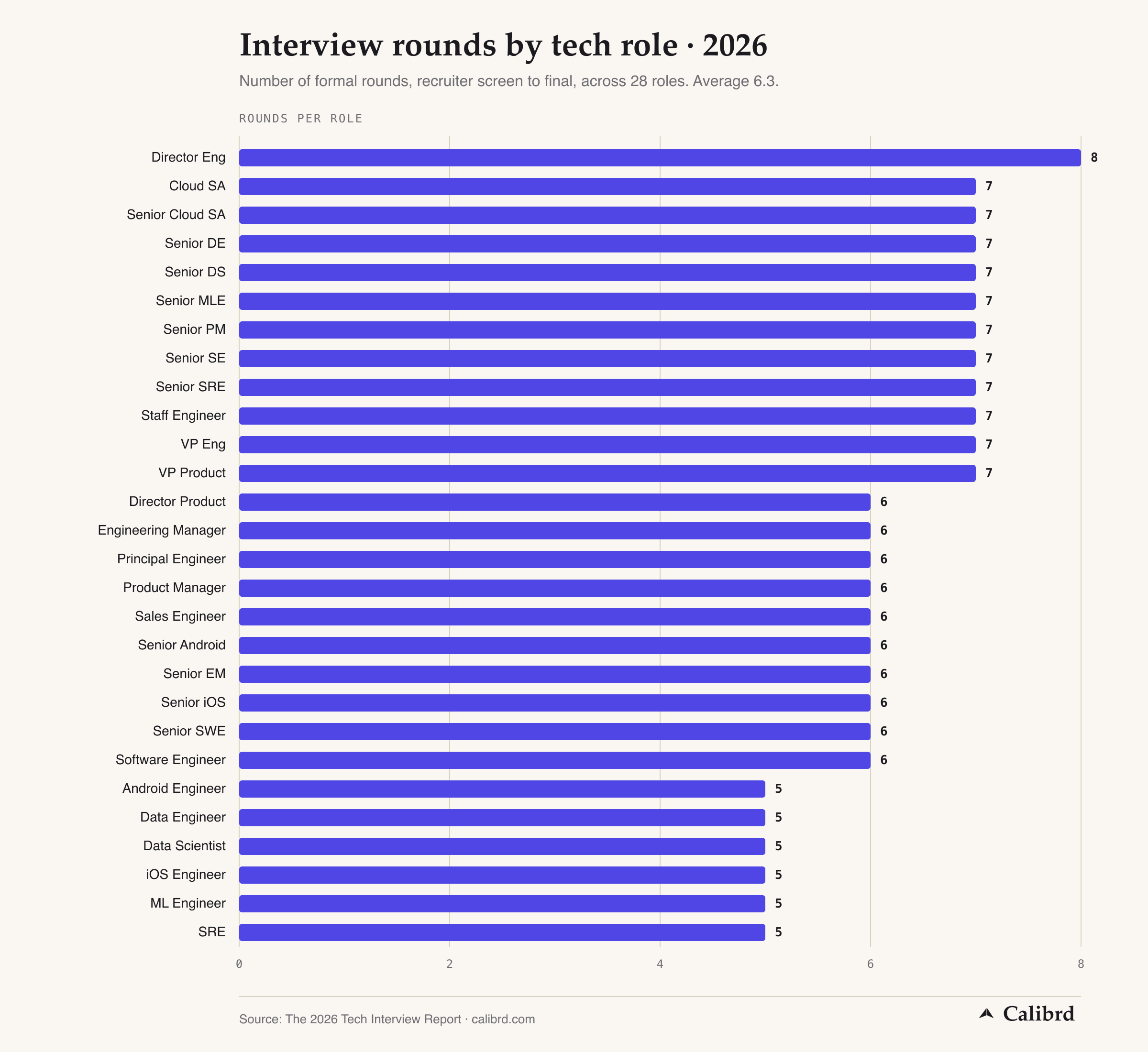
6 rounds · 5–8 weeksMost companies follow a similar pattern for Senior EM interviews. Total calendar time is 5–8 weeks from recruiter screen to offer.
Span of org managed, level of reports, manager-of-managers experience
Operating philosophy, biggest org-level wins, why this role next
Walk through how you've shaped an org, splits, merges, leveling decisions, hiring plans
Coaching an underperforming first-line EM; calibrating performance across teams; mediating conflict between managers
Operating in a peer group at director level, influence, alignment, conflict
Multi-year org strategy, talent investment, headcount allocation
Sample questions you should be ready for
7 of the ones that decide itRepresentative of what companies ask at this level. Every question here can be practised out loud, which is the fastest way to find out whether your answer holds up under follow-ups. Calibrd adds voice practice with coaching on every answer, and a full voice mock interview: a live round with an AI interviewer who has read the role and your CV, then an honest debrief.
- 01“You inherit an org of 20 engineers shipping reliably but with low ambition. What's your 6-month plan?”
- 02“Headcount for next year just got cut by 30%. How do you reshape the team and the roadmap?”
- 03“Your skip-level director is leaving in 90 days. How do you operate during the transition?”
- 04“Walk me through a time you had to restructure a team. Why, how, and what happened in the 90 days after?”
- 05“Tell me about a manager you've coached from M1 to M2. What were the bottlenecks?”
- 06“Describe a time you advocated for a contentious org-design decision (split, merge, role change). How did you build alignment?”
- 07“Tell me about a director-level peer conflict you resolved. What was at stake?”
These are the general ones. Paste a real posting and Calibrd predicts the questions that company asks for that exact role, then interviews you on them.
Predict my questions →Compensation benchmark
US majors · USD · medianTypical pay for Senior EM at major US tech companies, headline numbers in USD. Typical pay in London, Berlin and Singapore is meaningfully lower, and equity varies a lot by company stage.
FAANG M2 / M3 total pay is typically $500–700k. Pay scales heavily with span of org. Manager-of-managers role typically commands $50–100k more in total pay than first-line EM at the same company.
How to prep
5 tactical tipsLead behavioural answers with the STAR method: Situation, Task, Action, Result. The tips below build on that structure for this specific role.
- 01Have specific org metrics ready: headcount, retention, manager-to-IC ratio, promotion rate, hiring funnel conversion
- 02Prepare 2–3 detailed org-design case studies with org-charts you can sketch
- 03Read 'High Output Management' (Andy Grove) and 'An Elegant Puzzle' (Will Larson), both come up in interviews
- 04Practice articulating your management-of-managers philosophy distinct from your IC-management philosophy
- 05Be ready to discuss talent strategy at the org level: what kinds of engineers you optimise for, what your senior bench looks like
Where do Senior EM candidates fail?
Spot it in a mock firstA few common mistakes that get Senior EM candidates rejected even when they are otherwise strong. Worth catching in a mock interview before they show up in a real one.
Answering manager-of-managers questions with examples of senior ICs you coached or grew.
Why it fails
The Senior EM bar is explicitly about how you grow first-line EMs, calibrate performance across squads, and shape hiring at the org level. IC-coaching examples sound like first-line EM work, which gets you hired a level down. The interviewer is listening for "I coached an M1 through their first PIP conversation", not "I coached a senior IC through promotion".
Fix
Prep three stories explicitly at the EM-of-EM level: an M1 you grew, a manager you put on a performance plan, a calibration conversation where you pushed back on a peer EM's leveling. If you don't have these, signal where you've operated in the gray zone (managing tech leads, dotted-line responsibility), but don't pretend the EM-of-EM rep is there if it isn't.
Talking through an org-design decision in abstractions, without ever sketching the before-and-after on the whiteboard.
Why it fails
Senior EM interviewers want to see you think about org design spatially: who reports to whom, where the team boundaries sit, what shifts when you split. Verbal descriptions of org changes usually lose the interviewer in the second sentence. The candidates who sketch an org chart get remembered.
Fix
Practice drawing 2-3 org charts cold: the one you inherited, the one you shaped 6 months in, the rationale for each box and arrow. Bring them to mind in the round: "let me sketch this, here was the before, here's where I split the platform team, here's why".
Answering bench and hiring strategy with generic phrases like "I have a high bar" or "I hire for slope, not intercept".
Why it fails
These phrases land in M1 interviews. At Senior EM they read as platitudes. The interviewer wants to know what your bench actually looks like: how many ready-now M1s on your team, what kinds of senior ICs you've struggled to hire, where you compromise on level vs domain experience. Slogans without the data behind them sound performative.
Fix
Walk in with the inventory: "I have 18 engineers and 3 managers; 2 of the seniors are ready for staff if we open a role; we struggled to hire a senior platform engineer for 9 months and ended up promoting internally". Numbers feel honest in a way slogans don't.
Recommended resources
No affiliate linksBooks, courses, and tools that come up most often in Senior EM prep.
- 01An Elegant Puzzle (Will Larson) →
Re-read for the manager-of-managers level. Chapters on org design, team structure, and growing senior managers are the highest-leverage.
- 02High Output Management (Andy Grove) →
Foundational for operating-philosophy questions at M2. Read the chapters on managing teams of teams.
- 03Resilient Management (Lara Hogan) →
Best practical book on managing through change. Org-design scenarios at the Senior EM level often pull from this.
- 04The Manager's Path (Camille Fournier) →
Re-read the manager-of-managers and director chapters. Useful frame for the M1 → M2 step calibration.
- 05lethain.com (Will Larson's blog) →
The reference blog for engineering leadership. Useful pattern library for the org-design and talent-strategy rounds.
- 06Become a Great Engineering Leader (James Stanier) →
Written for exactly the step this role is: leading leaders instead of engineers. The material on coaching managers, observing work through proxies, and running an org rhythm covers the manager-of-managers rounds.
Frequently asked questions
I'm currently a Engineering Manager (M1 / M2). Should I read this guide or the Engineering Manager guide first?
Read the Engineering Manager guide first. Companies calibrate M2 / M3 candidates against the M1 / M2 bar with a clear scope-gap lens, they want to see where you stand today, then probe the gap up to M2 / M3. Read this guide AFTER you understand the M1 / M2 baseline, so you know exactly which signals you need to demonstrate for the step-up.
How long should I prep before my Senior EM onsite?
The process takes 5–8 weeks. Add 6–8 weeks of prep, org design and manager-of-managers stories take the longest to articulate well. Sketch 2–3 org-charts you can walk through cold.
What's the most common mistake candidates make at the Senior EM bar?
Speaking only about your direct team. The bar at this level is org-level: how you grow first-line EMs, calibrate performance across multiple squads, shape hiring across teams. Direct-team examples sound junior at this level.
What if my interview process is different from what's listed?
Most variation is at the edges. Major tech companies (FAANG, scale-ups, mid-size SaaS) follow processes within 1–2 rounds of what's described. Smaller startups often run fewer rounds (3–4) but the bar at each round is similar; less-tech-mature companies sometimes skip system design or behavioural rounds entirely. Read the posting and ask the recruiter on the screening call; they'll tell you what's coming.
How does this guide compare to running a free scan?
This guide covers the general bar at M2 / M3. The free scan reads one real posting and opens the report right here: the questions that role and company will ask, a pay benchmark matched to the level and, with your CV, the gaps an interviewer will probe and a CV score. No account or email first; the report is on screen in about a minute.
Walk in ready
Walk into your Senior EM interview ready.
Paste your actual job and Calibrd predicts what that company asks for this role, where your CV is thin, and what it should pay. Then rehearse the round out loud with honest feedback until you're confident. Free to start.
Free to start · No card · Encrypted at rest, never used to train AI, remove anytime