2026 update
A few things have changed in 2026. AI is now allowed in coding rounds at Canva and Meta, detection has improved at companies that still ban it, pay has split at staff+, and the post-onsite wait got longer. Read what changed in 2026 →
What you'll be expected to do
What they're grading- Run an engineering organisation of 30–80 engineers across 4–8 teams
- Manage a leadership bench of 4–8 managers (mix of EM and Senior EM)
- Own annual planning, headcount allocation, and the relationship with finance / HR
- Be accountable for business outcomes, revenue, growth, reliability, or platform velocity
- Represent engineering in executive forums; partner with VP Product and VP Design as a peer
- Set 3-year technical and organisational strategy for your scope
What does the interview loop look like?
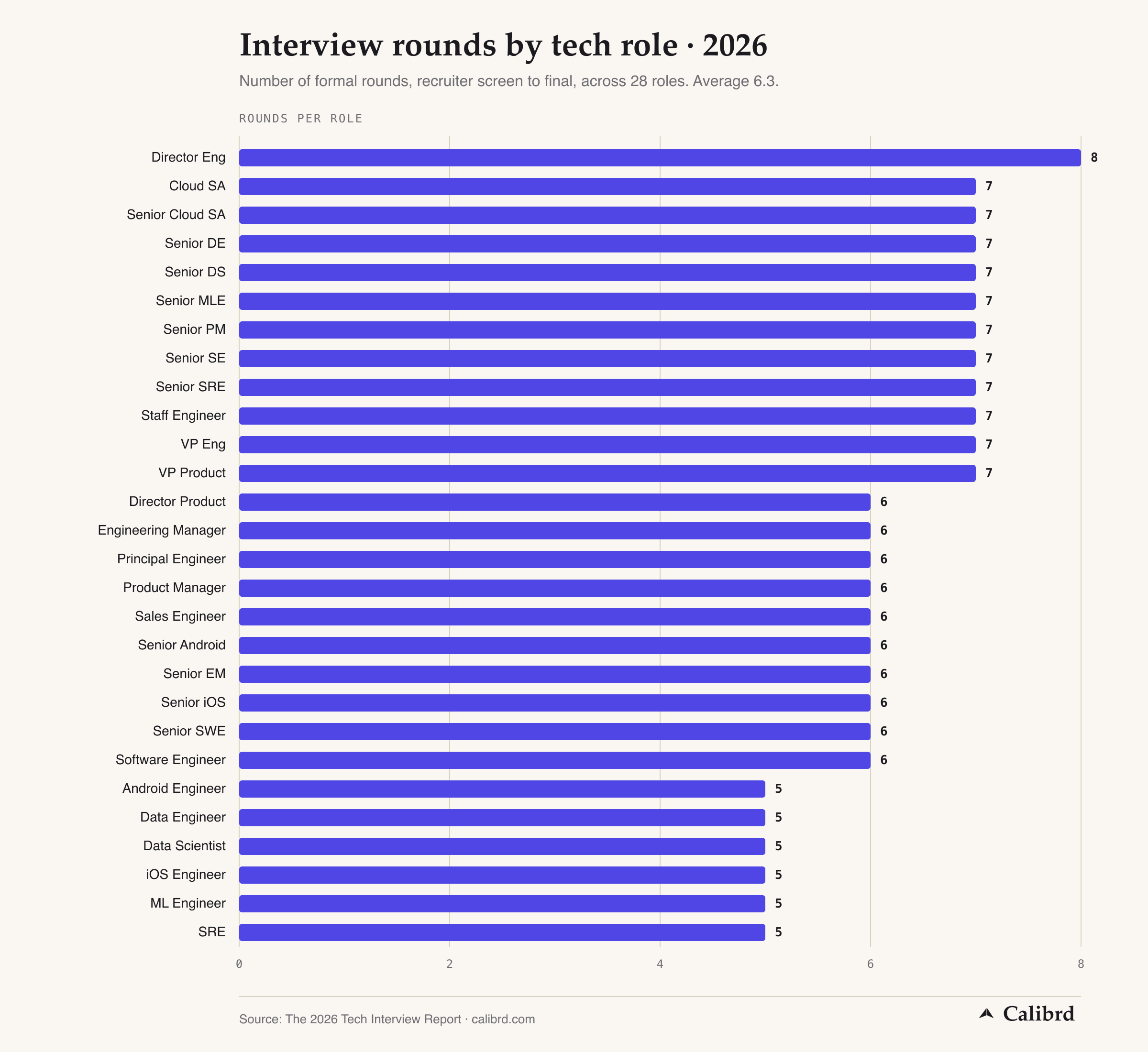
8 rounds · 8–14 weeksMost companies follow a similar pattern for Director Eng interviews. Total calendar time is 8–14 weeks from recruiter screen to offer.
Calibration to director level, span of org, business outcomes owned
What they're scoring
- Span check: 30+ engineers, real manager-of-managers years, and named business outcomes, before any partner spends time on you
- Level calibration: candidates who lead with single-team or hands-on wins get filtered here
Operating philosophy, why this scope, why this company
What they're scoring
- A coherent operating system: how you run planning, performance and escalations, described in your own words
- Whether your reasons for wanting this scope survive two follow-up questions
- This person is deciding if they can trust you with a third of their org
Business judgment, ambition, what you'd push back on
What they're scoring
- Business judgment with no engineering safety net: margins, bets, sequencing
- Whether you push back with a real position when they float a questionable idea
- Ambition: they are deciding if you will build the next phase or maintain the current one
Bring a 90-day plan; defend it. Discussion of past org-shaping decisions
What they're scoring
- The quality of your 90-day priorities, and how you defend them under pushback
- Evidence you have shaped an org on purpose, with the reasoning still legible
- Whether your strategy starts from a business outcome or from an engineering preference
Walk through a system or architecture you owned in a recent role. Probing on design choices, trade-offs, and how you'd react to the company's published architecture. Signal is technical credibility, not whiteboard system design from scratch
What they're scoring
- Whether you can defend every major choice on a system you owned, including the ones you would change today
- How you reason about a design you didn't build, when they walk you through theirs
- The staff engineers' verdict: would they accept your call on a hard technical dispute
Operating as a peer at the VP table, influence, conflict, alignment
What they're scoring
- Peer behaviour: whether you talk like an equal at the VP table or like a service provider
- Named conflicts with product and design, and how each one actually resolved
- The quiet question behind the round: do they want you in their Monday exec meeting
How you build a leadership bench: hiring, growing, managing out at the manager level
What they're scoring
- A real bench philosophy: how you hire, grow and exit managers, with specifics
- Proof you have managed a manager out, humanely and on time
- Succession: someone you grew who now runs something bigger than they did under you
Independent verification of judgment, scope, and operating style
What they're scoring
- Consistency: references should describe the same scope and operating style you claimed
- Your failure modes, from the people who reported to you
- Whether past peers would choose to work with you again
Sample questions you should be ready for
8 of the ones that decide itRepresentative of what companies ask at this level. Every question here can be practised out loud, which is the fastest way to find out whether your answer holds up under follow-ups. Calibrd adds voice practice with coaching on every answer, and a full voice mock interview: a live round with an AI interviewer who has read the role and your CV, then an honest debrief.
- 01“What's your view of our engineering org's biggest strategic gap? How would you address it in the first year?”
- 02“Walk us through a 30/60/90/180-day plan for this role.”
- 03“Where would you spend $20M of incremental engineering budget at our company?”
- 04“Tell me about a multi-year strategic bet you made. What was the bet, what did it cost, did it pay off?”
- 05“Describe an org-design decision you made that 18 months later you'd reverse. Why, and what did you learn?”
- 06“Tell me about a business outcome you owned at the director level. What was the engineering contribution specifically?”
- 07“Walk through how you've let go a Senior EM or Director who reported to you. Timeline, conversations, transition.”
- 08“Describe a time you advocated for a contentious budget or headcount decision with the CFO or COO.”
These are the general ones. Paste a real posting and Calibrd predicts the questions that company asks for that exact role, then interviews you on them.
Predict my questions →How to answer the hardest ones
Worked approachesThe structure and the level of detail interviewers expect on the questions that decide this loop. The numbers are placeholders, so swap in your own.
“Where would you spend $20M of incremental engineering budget at our company?”
Anchor in their strategy before you spend a dollar: name the business priority you read in their earnings call or product moves, and check it with the interviewer. Then offer two or three candidate bets with rough sizes, say $12M on the one you believe in and $5M on the second, and name one obvious-sounding option you would skip, with the reason. Commit to the lead bet with an expected return in business terms: revenue protected, cost removed, or a market unlocked. Interviewers grade the shape of the reasoning, so a wrong-but-defended allocation beats a safe list of initiatives with no numbers attached.
“Describe an org-design decision you made that 18 months later you'd reverse. Why, and what did you learn?”
Pick a real reversal, and spend most of your time on the reasoning at decision time: what you knew, what you weighted too heavily, who disagreed and why you overrode them. Then give the cost, in attrition, velocity or a delayed launch, with one number. Close with the operating change it produced in how you make org calls today. The trap is choosing a fake weakness, or a decision that quietly worked out. Interviewers ask this to see whether you can audit your own judgment, and a candid post-mortem on a genuine miss lands stronger than any success story in this round.
Compensation benchmark
US majors · USD · medianTypical pay for Director Eng at major US tech companies, headline numbers in USD. Typical pay in London, Berlin and Singapore is meaningfully lower, and equity varies a lot by company stage.
FAANG director total pay is typically $900k–1.5M. Director hires at scale-ups often come with 0.25–1% equity. Compensation tracks span of org and revenue / business impact owned.
How to prep
6 tactical tipsLead behavioural answers with the STAR method: Situation, Task, Action, Result. The tips below build on that structure for this specific role.
- 01Build a 90-day plan slide deck for the specific company you're interviewing at, many companies will ask you to present it
- 02Have 3 detailed business-outcome case studies: revenue impact, reliability transformation, or platform investment
- 03Prepare an architecture you've owned cold, every design choice, every trade-off, what you'd do differently now. Director loops increasingly include a 60-minute technical deep-dive with senior engineers, even when the recruiter's agenda doesn't flag it
- 04Read the company's annual report, recent earnings call transcripts (if public), and every published engineering blog post
- 05Prepare answers on talent strategy at the director level: how you build a leadership bench, your view on internal vs external hiring
- 06Be ready for the 'why are you applying to this director role and not a VP role somewhere smaller' question
The 90-day plan they'll ask you to present
Bring this to the roundMost Director loops ask for a 90-day plan outright, and the org design round grades how you defend it. Bring a written one-pager tailored to the company. The shape below is what interviewers expect; the content has to be yours.
Days 1–30, listen and map. Name who you'd meet (every manager, the staff engineers, your VP peers in product and design, finance), what you'd read (planning docs, incident history, the last promotion cycle), and the numbers you'd pull: delivery cadence, attrition, cloud spend, on-call load. Commit to changing nothing yet, and say that out loud.
Days 31–60, one visible decision. Pick the smallest decision that shows your operating bar: a stuck hiring loop you close, a standing meeting you kill, an escalation path you fix. Interviewers listen for judgment in what you choose to touch first, and for restraint in what you leave alone.
Days 61–90, the plan you defend. Present the org and investment thesis: where the teams are misshapen, which bet gets funded next planning cycle, what you'll stop doing. Tie each priority to a business outcome the CEO round would recognise, and expect every line to be challenged.
Day 91 onward, the bet. Name the one multi-quarter bet you'd stake the first year on, and the metric that proves it out. A plan that ends at day 90 says you operate quarter to quarter; directors are hired for the year after that.
Where do Director Eng candidates fail?
Spot it in a mock firstA few common mistakes that get Director Eng candidates rejected even when they are otherwise strong. Worth catching in a mock interview before they show up in a real one.
Getting asked a business or revenue question and pivoting back to a technical story within a sentence or two.
Why it fails
Director rounds are explicitly checking whether you can hold a business conversation without leaning on technical anchors. If "tell me about a business outcome you owned" becomes a story about a system you scaled, you've signaled that you can't operate at the VP table without an engineer translating for you. That's a disqualifier at this level.
The losing answer
“Our biggest win was the platform migration. We moved 40 services to Kubernetes and took deploys from an hour to eight minutes.”
The winning answer
“My org owned checkout reliability. We cut failed payments from 1.8% to 0.4%, which recovered about $6M a year in completed orders. The platform work was how we got there, and I can go as deep on it as you like.”
Fix
Prep three stories framed entirely as business outcomes: revenue lifted by X%, retention up by Y points, cost reduced by $Z. The engineering work is the how, not the headline. If your most recent role didn't include business ownership, say so directly. At Director level that's a real gap to discuss, not paper over.
Knowing your headcount and retention rate cold, but stumbling on questions about the revenue or cost the org influenced.
Why it fails
Director-level interviews assume you operated as a business owner, not just an engineering operator. If you can name your team size to the engineer but can't name the revenue your platform supports or the cost line you owned, the interviewer pegs you as a Senior EM with a Director title. The gap is real and visible in the answers.
The losing answer
“I ran 46 engineers across six teams, and we held retention above 90% for two years.”
The winning answer
“I ran 46 engineers supporting the subscriptions line, about $120M in ARR. I owned a $4.2M cloud budget and held it flat through a year where traffic doubled.”
Fix
Even at one remove, get the numbers: which revenue line your org's work supports, how much cloud spend rolls up under you, what the COGS impact of your platform is. These should sit next to your team-size numbers in your prep doc, ready to surface without thinking.
Answering peer-influence questions with general claims about cross-functional partnership rather than specific peers and conflicts.
Why it fails
Generic alignment language sounds like LinkedIn-bio copy. Director peers are listening for the texture of how you actually operate with VP Product or VP Design: when you escalated, when you ate a loss to keep the relationship, when you went around them. Without that texture, the answer doesn't land at this level.
The losing answer
“I partner closely with product and design. We don't always agree, but we talk it through and reach alignment.”
The winning answer
“Our VP Product wanted the CRM rebuild shipped in Q2. I thought shipping before the data migration was reckless, and I said so in writing with a two-phase plan. I took the slip publicly at the exec review, and she defended the phased date with me.”
Fix
Prep 2-3 stories that name the partner ("our VP Product, Sarah, had a different read on the prioritization") and walk through the actual conversation: who pushed back, what you compromised on, what the outcome was. Specificity here separates real director-level partnership from "we collaborate well".
Going into the Director loop without seriously prepping the technical rounds, assuming they're a credibility check rather than an evaluation.
Why it fails
The staff engineers in the loop will ask sharp questions about architectures you've owned and compare your answers against other candidates. A vague technical round leaves the loop with "strong on org and strategy, but the staff engineers weren't sold", which is enough to lose offers at most tech companies. Engineering bench feedback carries real weight in the final decision.
The losing answer
“My staff engineers own the technical detail. My job is to give them air cover and stay out of the design reviews.”
The winning answer
“We rebuilt the event pipeline on Kafka in 2023. I can defend the ordering trade-off, exactly-once wasn't worth the latency for analytics events, and I'll tell you what I'd change now: the schema registry should have come first.”
Fix
Pick 1-2 architectures from your CV and rehearse them cold: every design choice, every trade-off, what you'd do differently now. Treat the technical round at Director level with the same prep rigor a Staff IC would for a deep-dive. If your recent roles have been one remove from the technical work, surface a system from a few years back rather than hand-waving the current org's work.
Recommended resources
No affiliate linksBooks, courses, and tools that come up most often in Director Eng prep.
- 01The Engineering Executive's Primer (Will Larson) →
The reference book for engineering directors. Chapters on the executive operating model, scope ownership, and 90-day plans are the highest-leverage.
- 02An Elegant Puzzle (Will Larson) →
Re-read for multi-team scope. Especially the chapters on org evolution, leveling calibration, and executive influence.
- 03High Output Management (Andy Grove) →
Foundational. Re-read the chapters on dual-tracking team management with cross-functional influence.
- 04First Round Review, Engineering Management →
Practitioner writing from successful directors and VPs. Useful for the 90-day plan + business-outcome case-study prep.
- 05Become a Great Engineering Leader (James Stanier) →
The director-level companion to Stanier's EM book. Use the strategy material and the org-operating-rhythm chapters to build the 90-day plan and defend it in the org design round.
- 06The Manager's Path (Camille Fournier) →
The definitive ladder text. Read the Managing Managers chapter as the level definition for this role: debugging teams through their managers, developing new managers deliberately, and giving up hands-on work for good.
Frequently asked questions
I'm currently a Senior EM (M2 / M3). Should I read this guide or the Senior EM guide first?
Read the Senior EM guide first. Companies calibrate M3 / M4 candidates against the M2 / M3 bar with a clear scope-gap lens, they want to see where you stand today, then probe the gap up to M3 / M4. Read this guide AFTER you understand the M2 / M3 baseline, so you know exactly which signals you need to demonstrate for the step-up.
How long should I prep before my Director Eng onsite?
The process takes 8–14 weeks. Add 8–12 weeks of prep, the 90-day plan and three business-outcome case studies are the highest-leverage prep. Write them down, rehearse with a peer, expect to defend each priority.
What's the most common mistake candidates make at the Director Eng bar?
Walking in without a 90-day plan. Most Director rounds explicitly ask 'how would you operate in your first 90 days here?', many candidates haven't drafted one. Bring a written outline tailored to the company; expect to defend each priority.
What if my interview process is different from what's listed?
Most variation is at the edges. Major tech companies (FAANG, scale-ups, mid-size SaaS) follow processes within 1–2 rounds of what's described. Smaller startups often run fewer rounds (3–4) but the bar at each round is similar; less-tech-mature companies sometimes skip system design or behavioural rounds entirely. Read the posting and ask the recruiter on the screening call; they'll tell you what's coming.
How does this guide compare to running a free scan?
This guide covers the general bar at M3 / M4. The free scan reads one real posting and opens the report right here: the questions that role and company will ask, a pay benchmark matched to the level and, with your CV, the gaps an interviewer will probe and a CV score. No account or email first; the report is on screen in about a minute.
Walk in ready
Walk into your Director Eng interview ready.
Paste your actual job and Calibrd predicts what that company asks for this role, where your CV is thin, and what it should pay. Then rehearse the round out loud with honest feedback until you're confident. Free to start.
Free to start · No card · Encrypted at rest, never used to train AI, remove anytime