2026 update
A few things have changed in 2026. AI is now allowed in coding rounds at Canva and Meta, detection has improved at companies that still ban it, pay has split at staff+, and the post-onsite wait got longer. Read what changed in 2026 →
What you'll be expected to do
What they're grading- Own a production ML system component (ranking platform, fraud platform, recommendation infra), design, implementation, operational health
- Lead 2–4 MLEs or DSs technically without being their manager
- Take part in cross-team technical decisions on training infrastructure, feature stores, model serving
- Mentor mid-level MLEs and DSs; participate in ML interview loops as a regular interviewer
- Set the bar for production ML excellence: monitoring, retraining, on-call practices for ML systems
- Influence ML platform direction across product teams; collaborate with research on what's deployable
What does the interview loop look like?
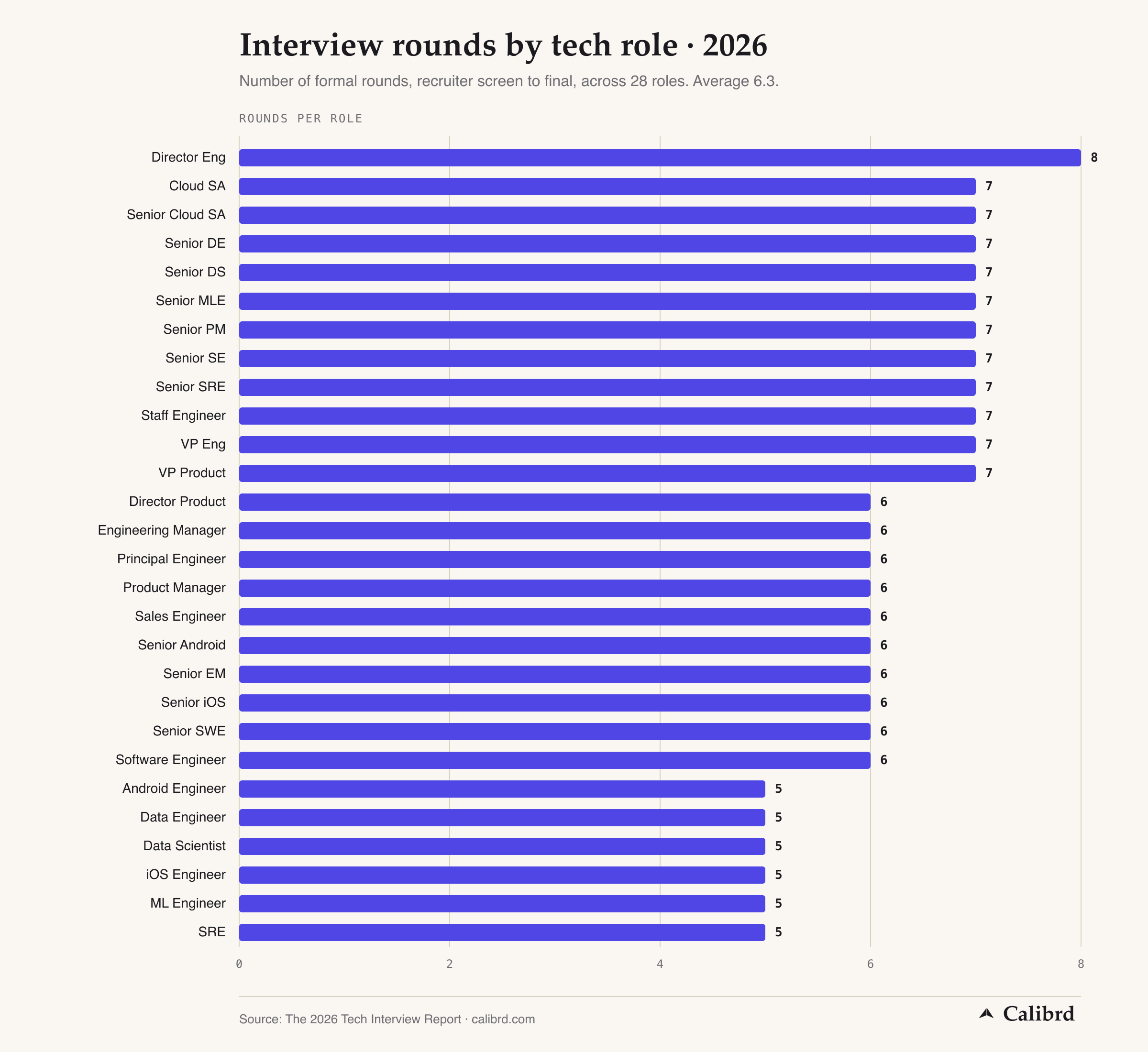
7 rounds · 5–7 weeksMost companies follow a similar pattern for Senior MLE interviews. Total calendar time is 5–7 weeks from recruiter screen to offer.
Career narrative, level calibration, scope of past ML systems owned
Harder coding or a project deep-dive, depends on company. If retained: ML coding + applied-ML depth combined
Large-scale ML system with explicit trade-offs, multi-model, latency budgets, retraining cadence, online / offline parity
Either a second design problem OR you walk through a real ML platform you architected, the company's existing platform, possibly
Pick an ML project from your CV; spend an hour explaining design, trade-offs, what went wrong in production, what you'd change. Bar: staff engineers grilling you on every choice
Operating with senior partners, ambiguity, prioritisation, trading off model quality vs. production constraints
Team-level technical leadership, mentoring, ML platform philosophy
Sample questions you should be ready for
10 of the ones that decide itRepresentative of what companies ask at this level. Every question here can be practised out loud, which is the fastest way to find out whether your answer holds up under follow-ups. Calibrd adds voice practice with coaching on every answer, and a full voice mock interview: a live round with an AI interviewer who has read the role and your CV, then an honest debrief.
- 01“Walk me through how you'd train a model across 4 GPUs with PyTorch DDP. What changes when you switch to FSDP, and when would you reach for it?”
- 02“Your model's offline AUC dropped 3 points after the last training run. Walk through how you'd diagnose whether the cause is the data, the code, the training infrastructure, or the model itself.”
- 03“Implement gradient clipping in a training loop. Walk through when you'd reach for it and how it interacts with learning rate scheduling.”
- 04“Design a ranking platform for our home feed that serves 100M users with sub-100ms latency. Cover candidate generation, ranking, and the retraining loop.”
- 05“Design an online / offline feature store for a 200-engineer ML org. Walk through schema, latency, and how you'd handle online / offline skew.”
- 06“Design the ML monitoring and observability for a fraud-detection system. What metrics, what alerts, what's your on-call runbook?”
- 07“Tell me about a multi-quarter ML platform initiative you led. What changed about how the org shipped ML afterwards?”
- 08“Describe a production ML incident you led the response on. What was the root cause and what did you change in your team's practices?”
- 09“Walk through a model you decided not to deploy. What was the signal that told you not to?”
- 10“Tell me about a disagreement with a data scientist or research peer on a modelling approach. How did you operate through it?”
These are the general ones. Paste a real posting and Calibrd predicts the questions that company asks for that exact role, then interviews you on them.
Predict my questions →Compensation benchmark
US majors · USD · medianTypical pay for Senior MLE at major US tech companies, headline numbers in USD. Typical pay in London, Berlin and Singapore is meaningfully lower, and equity varies a lot by company stage.
FAANG L5 Senior MLE total pay is typically $400–550k. AI-first companies (Anthropic, OpenAI, xAI, Mistral) often pay 40–80% above FAANG band with heavily equity-weighted packages; some staff-level offers at frontier labs exceed $1M TC.
How to prep
5 tactical tipsLead behavioural answers with the STAR method: Situation, Task, Action, Result. The tips below build on that structure for this specific role.
- Pick 1–2 ML platforms or systems you've owned and rehearse the deep-dive cold, every design choice, every production incident, every counterfactual
- Master 4–5 ML system design canonical problems at scale: ranking, recommendation, fraud / abuse, search, ad targeting. Pattern-match from there
- Have 8–10 STAR stories tagged across senior signals: production incidents, multi-quarter platform investments, cross-functional influence with DS / DE / research
- Read recent ML-systems blog posts from the company you're interviewing at, study their architecture choices
- Prepare a 30/60/90 plan answer, what you'd own and ship in your first 90 days at this specific company's ML platform
Where do Senior MLE candidates fail?
Spot it in a mock firstA few common mistakes that get Senior MLE candidates rejected even when they are otherwise strong. Worth catching in a mock interview before they show up in a real one.
Walking through past ML work as "I trained a model that did X" without saying what production constraints shaped the design.
Why it fails
Senior MLE interviews are calibrated against production ownership, not just model quality. "I trained a model with 0.92 AUC" is a mid-level story; "I traded 1.5 AUC points for a 10× throughput improvement because the serving budget was 8ms" is a senior story. The senior signal is the trade-off, not the metric.
Fix
For each major project, rehearse the production constraints first: latency budget, throughput, training cost, retraining cadence, infra spend. Then talk about what you optimised for and what you gave up. The constraints are the senior frame.
Doing ML system design without sizing anything, no QPS, no model size, no training cost, no latency budget.
Why it fails
L5 ML system design rounds grade explicitly on whether you reason about scale with numbers. An ML architecture that doesn't mention QPS or model size could be 1k users or 1B; the interviewer can't tell whether you've actually run anything at scale. The pattern note afterwards is usually "designed it well in the abstract, no idea if it would work in production."
Fix
Early in any ML system design, do the napkin math out loud. "10M DAUs, 200 requests per session, so around 50k QPS sustained. Model is 200MB, fits in single-GPU memory. Training set is 100B examples, takes 8 hours on 256 GPUs at $X/hour." Even rough numbers tell the interviewer you operate at production scale.
Treating the cross-functional partner round as a soft chat about collaboration.
Why it fails
Senior MLE cross-functional rounds probe specifically for how you handle the friction points: a DS who wants to ship a model you don't think is production-ready, a DE whose pipeline is breaking your training cadence, a product engineer whose latency budget shrinks every quarter. Generic "we collaborate well" answers signal you haven't operated at the senior partnership level.
Fix
Prep 2–3 stories where you held a position with a senior cross-functional partner. Name the partner role, the specific tension, what you compromised on, what the outcome was 6 months later. Specificity here separates senior MLE stories from L4 "team player" framings.
Recommended resources
No affiliate linksBooks, courses, and tools that come up most often in Senior MLE prep.
- 01Designing Machine Learning Systems (Chip Huyen) →
Re-read for the senior deep-dive round. Chapters 4–10 on production ML are the highest-leverage.
- 02Designing Data-Intensive Applications (Kleppmann) →
For the data-pipeline and storage sides of ML system design. Used as a reference across DE, MLE, and SWE staff-level loops.
- 03Stanford CS329S, Machine Learning Systems Design →
Free course materials. Reading list and lecture notes are well-cited in MLE staff loops.
- 04Eugene Yan's ML system writeups →
Practical writeups on production ML systems at Amazon. Useful pattern library for the senior system-design round.
- 05Uber Engineering ML blog →
Real-world senior MLE work at scale. Pattern-match their writeups before the project deep-dive round.
- 06Machine Learning System Design Interview (Aminian & Xu) →
The reference for the ML system design round: recommendation, ads, search, and feed problems worked end to end at the bar this loop grades.
Common scenarios
Situations that come up a lotI'm a research scientist with a strong Kaggle and paper-publication background, but limited production ML experience. How do I prep for a Senior MLE interview that emphasises production ownership?
The Senior MLE bar is specifically production ownership at scale, interview rounds will test for things research backgrounds don't naturally develop: serving latency budgets, retraining pipeline reliability, model rollout strategies, on-call ownership. Honest assessment: research → Senior MLE is a real risk of being hired a level down unless you actively flip the narrative. Three weeks before the interview, do this. First, take ownership of one production-flavoured project end-to-end, even at small scale. Open-source an MLOps tool, contribute to a serving infra library, or stand up a tiny model in production yourself with monitoring. The point isn't to fake experience; it's to have credible answers for "how would you handle a 99th-percentile latency spike at 3am". Second, drill the canonical MLE system design problems (feature store, recommender, online inference at scale) and practise putting numbers on every component (QPS, model size, GPU memory budget, latency). Third, in the behavioural round, lead with the trade-offs you've already made, even at research scale, "I traded 2% AUC for a 5× throughput improvement because…", that's the language senior MLEs use.
I'm a Senior backend engineer with 5 years experience trying to move into MLE at a Senior level. How do I tailor my prep when I've never trained a production model?
The honest path is ML platform / ML infra / ML serving rather than pure modelling, your backend depth maps directly. Feature stores, model serving infra, training pipeline reliability, online/offline parity, these are MLE Senior-level problems where strong backends actually do BETTER than people who came up purely on the modelling side. Frame your prep accordingly. Drill MLOps canonical problems (design a feature store, design online inference at scale, design a training pipeline with bisection capability) rather than spending 3 months trying to catch up on modelling theory. For the modelling rounds, learn the practical patterns (numpy/pandas, basic PyTorch, when to use which loss function, what early-stopping does) so you're not lost in the conversation, but don't try to compete with research backgrounds on model-architecture deep dives. In the behavioural round, your narrative is "I've worked on the systems that make ML reliable in production, which is the bottleneck for most ML teams". Companies with large ML platform teams (Netflix, Spotify, Uber, LinkedIn, Shopify) often value backend depth for MLE infra and serving roles. Pure-research labs (Anthropic, OpenAI) are a harder sell without published ML work to point at.
I'm applying to roles that work primarily on LLMs and foundation models (Anthropic, OpenAI, frontier labs). How does the prep differ from traditional ML interviews?
Big shifts: less classical ML modelling (you're rarely picking between XGBoost and Random Forest), more emphasis on distributed training at scale, RLHF/SFT/DPO pipelines, eval methodology, and inference-time techniques (KV caching, quantisation, speculative decoding). Three areas to drill specifically. First, distributed training: tensor parallelism, pipeline parallelism, data parallelism, ZeRO, FSDP, understand them at the conceptual level even if you haven't implemented them. Read the Megatron-LM and FSDP papers. Second, eval. Foundation-lab interviewers care deeply about eval methodology, they live and die by it. Prep examples of how you'd build an eval set for a specific model behaviour, how you'd handle eval contamination, how you'd avoid Goodhart's law on your benchmarks. Third, inference: know KV caching, batch/continuous batching, quantisation trade-offs (INT8/INT4/FP8), speculative decoding patterns. The behavioural round will probe for opinions on alignment, model safety, the lab's specific research bets. Don't be neutral, labs hire for conviction, not consensus. Have a specific take on one of their recent research directions.
I have interviews lined up at both an AI lab (Anthropic) and a FAANG company (Google) for Senior MLE roles. How does the prep differ between the two?
Treat them as different roles. FAANG Senior MLE is mostly production ML at scale: serving infra, A/B testing models, retraining pipelines, recommender systems, ad ranking. The interview loop will be heavy on ML system design + ML coding (PyTorch in a notebook) + standard behavioural rounds. Prep canonical problems (recommender, feature store, online inference) cold. AI lab Senior MLE skews research-adjacent: building/maintaining LLM training infrastructure, eval frameworks, RLHF pipelines, inference systems. The interview loop will be lighter on conventional FAANG product-ML problems and heavier on a deep-dive round where you walk through a specific past project for 60+ minutes with a staff researcher probing trade-offs. Prep means having one project you can speak to in extreme depth, what you tried, what failed, what you'd do differently. Comp also differs: FAANG L5 is ~$400–550k total pay at 50th percentile; AI labs often pay 40–80% above with heavier equity. Behavioural framing: at FAANG, lead with ship velocity and impact. At an AI lab, lead with technical curiosity and research taste.
How do I know if I'm ready for a Senior MLE (L5) interview or should I be targeting Staff (L6)? What's the real scope delta?
Senior MLE is production ownership of a model or system you've made better over time. Staff MLE is platform-level ownership where your decisions shape how other teams ship ML. The fastest test: think about your last 18 months of work. If your strongest examples are "I shipped/improved/scaled [a specific model or system]", Senior. If they're "I built the abstraction/framework/process that 5+ other teams now use", Staff. The L5-to-L6 leap at FAANG is specifically about influence beyond your direct team: writing the ML platform RFCs, leading cross-team migrations, being the technical reviewer other teams trust on ML decisions. If you're not yet doing those things, target Senior, you can re-level after building Staff signal in role. Some AI labs run a less rigid Senior/Staff distinction than FAANG, so at those companies the question becomes "what scope do you want next" rather than "what title", check the company's published levelling page or ask the recruiter directly. When unsure, interview for Senior first. Easier to upgrade from a Senior offer than to be hired a level down after a Staff rejection.
Frequently asked questions
I'm currently a ML Engineer (L4 / IC3). Should I read this guide or the ML Engineer guide first?
Read the ML Engineer guide first. Companies calibrate L5 / IC4 candidates against the L4 / IC3 bar with a clear scope-gap lens, they want to see where you stand today, then probe the gap up to L5 / IC4. Read this guide AFTER you understand the L4 / IC3 baseline, so you know exactly which signals you need to demonstrate for the step-up.
How long should I prep before my Senior MLE onsite?
The process takes 5–7 weeks. Add 8–12 weeks of prep, the ML system design and project deep-dive rounds are the highest-leverage. Pick 1–2 platforms you've owned and rehearse them cold: every design choice, every production incident, every counterfactual.
What's the most common mistake candidates make at the Senior MLE bar?
Describing model wins without production trade-offs. Senior MLE interviews are measured against latency budgets, retraining cost, monitoring, on-call. Strong L4 "model AUC" stories will get you hired a level down if you don't frame them against the production constraints that shaped the design.
What if my interview process is different from what's listed?
Most variation is at the edges. Major tech companies (FAANG, scale-ups, mid-size SaaS) follow processes within 1–2 rounds of what's described. Smaller startups often run fewer rounds (3–4) but the bar at each round is similar; less-tech-mature companies sometimes skip system design or behavioural rounds entirely. Read the posting and ask the recruiter on the screening call; they'll tell you what's coming.
How does this guide compare to running a free scan?
This guide covers the general bar at L5 / IC4. The free scan reads one real posting and opens the report right here: the questions that role and company will ask, a pay benchmark matched to the level and, with your CV, the gaps an interviewer will probe and a CV score. No account or email first; the report is on screen in about a minute.
Walk in ready
Walk into your Senior MLE interview ready.
Paste your actual job and Calibrd predicts what that company asks for this role, where your CV is thin, and what it should pay. Then rehearse the round out loud with honest feedback until you're confident. Free to start.
Free to start · No card · Encrypted at rest, never used to train AI, remove anytime