2026 update
A few things have changed in 2026. AI is now allowed in coding rounds at Canva and Meta, detection has improved at companies that still ban it, pay has split at staff+, and the post-onsite wait got longer. Read what changed in 2026 →
What you'll be expected to do
What they're grading- Own a feature or sub-product area; run its roadmap and know how it serves the wider product strategy
- Write specs and PRDs that engineering and design can build from without ambiguity
- Run cross-functional planning with engineering, design, data, and stakeholders
- Define success metrics and instrument launches to measure them
- Triage customer feedback, support escalations, and bug reports into prioritised work
- Communicate roadmap and progress upward to leadership and outward to customers
What does the interview loop look like?
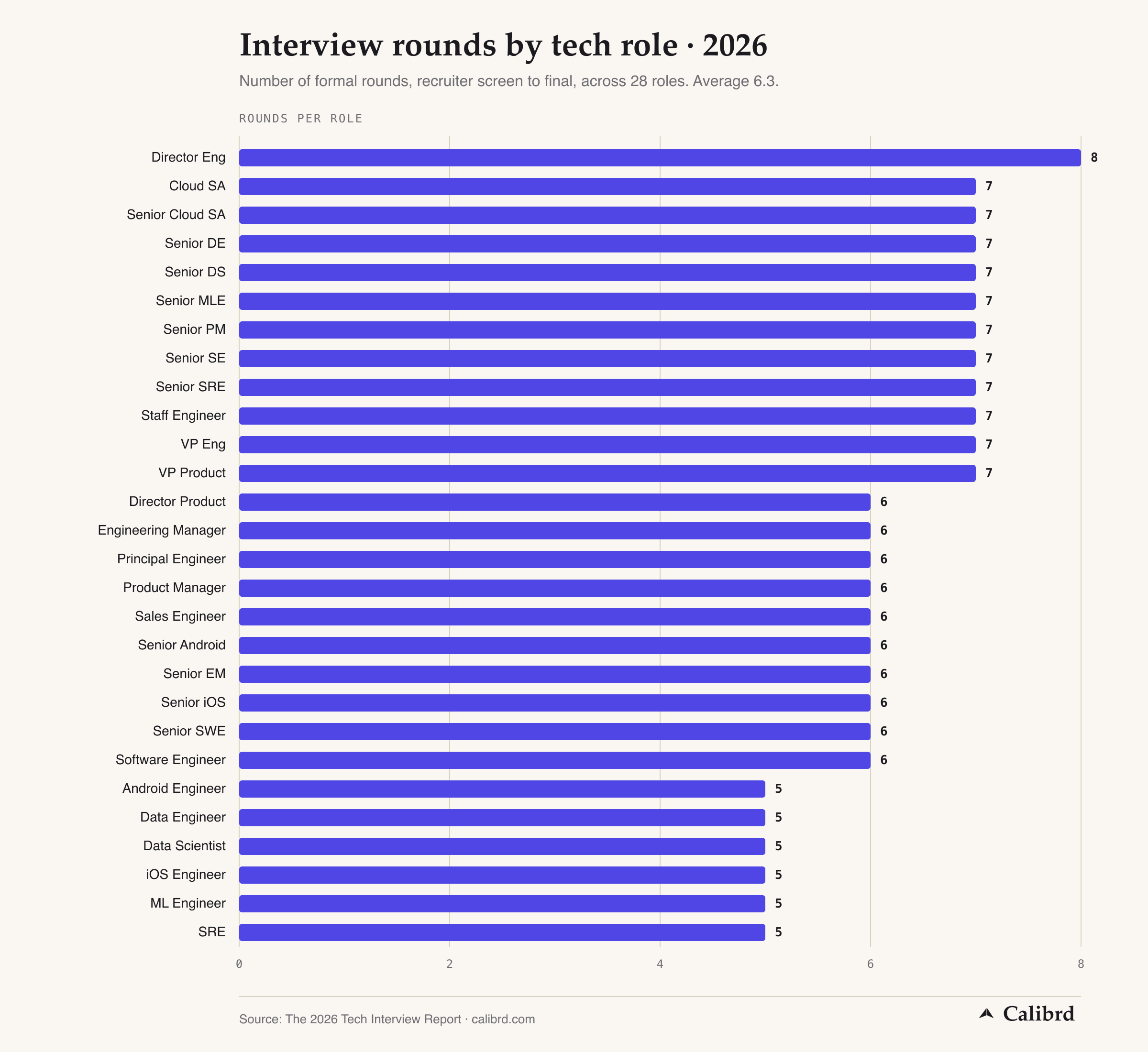
6 rounds · 4–6 weeksMost companies follow a similar pattern for Product Manager interviews. Total calendar time is 4–6 weeks from recruiter screen to offer.
Background, role calibration, motivation, comp
Past product wins, product philosophy, scope of past ownership
Design a product end-to-end, e.g. 'Design a product for retired teachers'. Probing on user empathy, segmentation, prioritisation
Define metrics for a product, diagnose a metric drop, do a data exercise
How you ship, specs, scoping, trade-offs, working with engineering
Conflict, leadership without authority, communication style
Sample questions you should be ready for
9 of the ones that decide itRepresentative of what companies ask at this level. Every question here can be practised out loud, which is the fastest way to find out whether your answer holds up under follow-ups. Calibrd adds voice practice with coaching on every answer, and a full voice mock interview: a live round with an AI interviewer who has read the role and your CV, then an honest debrief.
- 01“How would you improve YouTube for creators? Walk me through your full thought process.”
- 02“Design a product to help remote engineering teams collaborate better. Pick a target user.”
- 03“Imagine LinkedIn wants to build a feature for new graduates. What would it be?”
- 04“DAU on our messaging app dropped 8% last week. Walk through how you'd diagnose it.”
- 05“What's the right north-star metric for an AI coding assistant? Defend the choice.”
- 06“If you could only ship three features for our product next quarter, what would they be and why?”
- 07“Tell me about a feature you killed. Why, and how did you communicate the decision?”
- 08“Walk through a time you disagreed with engineering on prioritisation. How did you resolve it?”
- 09“Describe the product launch you're most proud of. What was your specific contribution?”
These are the general ones. Paste a real posting and Calibrd predicts the questions that company asks for that exact role, then interviews you on them.
Predict my questions →Compensation benchmark
US majors · USD · medianTypical pay for Product Manager at major US tech companies, headline numbers in USD. Typical pay in London, Berlin and Singapore is meaningfully lower, and equity varies a lot by company stage.
FAANG PM2 total pay is typically $250–350k. London PM base ~£75–100k. Tech PM pay is typically lower than equivalent SWE level, equity ratios catch up at senior+ levels.
How to prep
5 tactical tipsLead behavioural answers with the STAR method: Situation, Task, Action, Result. The tips below build on that structure for this specific role.
- 01Drill product sense questions using a consistent framework (clarify → user → JTBD → solutions → prioritise → trade-offs)
- 02Practise metrics questions with a structured approach: define the metric, diagnose drops with breakdowns, propose hypotheses + tests
- 03Read 'Cracking the PM Interview' and 'Decode and Conquer', both standard prep reading
- 04Prepare 8–10 STAR stories with specific numbers: launch impact, user reach, revenue / engagement lifts
- 05For execution rounds, have a template scenario in mind: a feature you scoped, the spec you wrote, the trade-offs you made
Where do Product Manager candidates fail?
Spot it in a mock firstA few common mistakes that get Product Manager candidates rejected even when they are otherwise strong. Worth catching in a mock interview before they show up in a real one.
Answering "how would you improve YouTube for creators" by listing features without first defining which creator segment you'd target.
Why it fails
Product sense rounds at PM2 grade on whether you scope before solving. Listing features without a target user reads as a shotgun approach. The same answer would work for any product, which is the opposite of what good PM looks like. The interviewer is waiting for you to say "I'd focus on mid-tier creators with 10k-100k subs" and defend the choice.
Fix
Open every product sense answer with target-user selection: "I'd focus on X user because Y". Defend the choice with a one-line tradeoff: "I'm picking power users over new users because retention is the bigger problem here". Even a rough choice beats no choice.
Getting asked "DAU dropped 8%, diagnose it" and going straight to hypotheses (an iOS bug, a feature regression) without segmenting the data.
Why it fails
Metrics rounds grade on whether you reach for the data first. Jumping to hypotheses without segmenting tells the interviewer you'd solve problems with intuition rather than evidence, which is fine at PM1, not at PM2. The signal is "split DAU by platform, geo, user cohort, signup date, then look for where the drop concentrates".
Fix
Before proposing causes, walk through 2-3 segmentations: "I'd split by platform first, then geo, then cohort. If the drop is concentrated on iOS in the US for users who signed up in the last 30 days, that tells me something different than a flat drop across all segments".
Describing the launch you're most proud of in terms of effort and ambition, with no numbers on what shipped or what changed.
Why it fails
PM interviewers are calibrating against IC2 scope, and they need numbers to do it. "We launched a feature users loved" tells them nothing. "We launched the export feature; 30% of paid users tried it in the first week, retention on those users was 1.4x" lets them peg you.
Fix
For your top 4-5 stories, write down three numbers each: scale, impact, retention or comparable. If you don't know the numbers, ask your old engineering or data partner before the loop. Rough numbers ("around 30% adoption") beat "users loved it".
Recommended resources
No affiliate linksBooks, courses, and tools that come up most often in Product Manager prep.
- 01Cracking the PM Interview (McDowell + Bavaro) →
The canonical PM interview prep book. Frameworks for product sense, metrics, and execution rounds, read cover-to-cover before the loop.
- 02Decode and Conquer (Lewis Lin) →
Companion to McDowell, heavier focus on product-sense frameworks (CIRCLES, AARM). Drill the frameworks on 10+ practice problems before the onsite.
- 03Lenny's Newsletter →
The reference newsletter for product management. Posts on metrics, A/B testing, and product strategy come up directly in PM interview prep.
- 04Inspired (Marty Cagan) →
Foundational PM book. Read for the product-discovery and team-operating-model frames, they come up in the cross-functional rounds.
- 05Reforge, Product courses →
Practitioner courses on PM specifics. The growth and retention programmes are particularly useful for product-sense interview prep.
- 06Cracking the PM Career (Bavaro & McDowell) →
The explicit PM ladder this guide's level bar comes from — what changes between PM, Senior PM, and product leadership, with the skills split per level.
Frequently asked questions
Is this guide useful if I'm a new PM, or transitioning from another function (engineering, design, marketing)?
Yes, the PM2 / IC2 bar described here applies whether you came up through PM-from-day-one or transitioned from another function. The interview tests product instinct and execution rigour, not credentials. The biggest delta for transition candidates is having 5+ STAR stories that map adjacent-function wins to PM-shaped outcomes, launching, measuring, iterating.
How long should I prep before my Product Manager onsite?
The process takes 4–6 weeks. Add 4–6 weeks of prep, drilling product sense framework + 8–10 STAR stories with concrete metrics is the priority order.
What's the most common mistake candidates make at the Product Manager bar?
Reciting frameworks without judgment. Walking through 'CIRCLES' or 'AARM' on autopilot makes you sound junior. Show that you know the framework, then bring opinion: pick a target user, defend the choice, name the trade-off you accepted.
What if my interview process is different from what's listed?
Most variation is at the edges. Major tech companies (FAANG, scale-ups, mid-size SaaS) follow processes within 1–2 rounds of what's described. Smaller startups often run fewer rounds (3–4) but the bar at each round is similar; less-tech-mature companies sometimes skip system design or behavioural rounds entirely. Read the posting and ask the recruiter on the screening call; they'll tell you what's coming.
How does this guide compare to running a free scan?
This guide covers the general bar at PM2 / IC2. The free scan reads one real posting and opens the report right here: the questions that role and company will ask, a pay benchmark matched to the level and, with your CV, the gaps an interviewer will probe and a CV score. No account or email first; the report is on screen in about a minute.
Walk in ready
Walk into your Product Manager interview ready.
Paste your actual job and Calibrd predicts what that company asks for this role, where your CV is thin, and what it should pay. Then rehearse the round out loud with honest feedback until you're confident. Free to start.
Free to start · No card · Encrypted at rest, never used to train AI, remove anytime