Data report · Updated 2026
The 2026 Tech Interview Report, 42 roles, one dataset
Use this dataset to estimate your interview loop, see what your role will test, and jump straight to the right prep guide. We broke the process for 42 tech roles, rounds, time-to-offer, competencies, and pay, into one comparable view, built on the same hand-curated research behind our per-role guides.
Key findings
What that means for how you prep:
- If your loop is 7+ rounds, expect 6–8 weeks and at least one behavioural round, that's the senior/leadership shape (see Staff Software Engineer or Director of Engineering interview prep).
- Targeting Staff+ or manager roles? System design and strategy outweigh coding, so drill design and stakeholder stories over LeetCode (see Engineering Manager interview prep).
- Mid-level IC loops are the leanest, around 4 rounds and coding-led (see Software Engineer interview prep).
- Product and data roles swap LeetCode for product sense or applied ML/SQL (see Product Manager and ML Engineer interview prep).
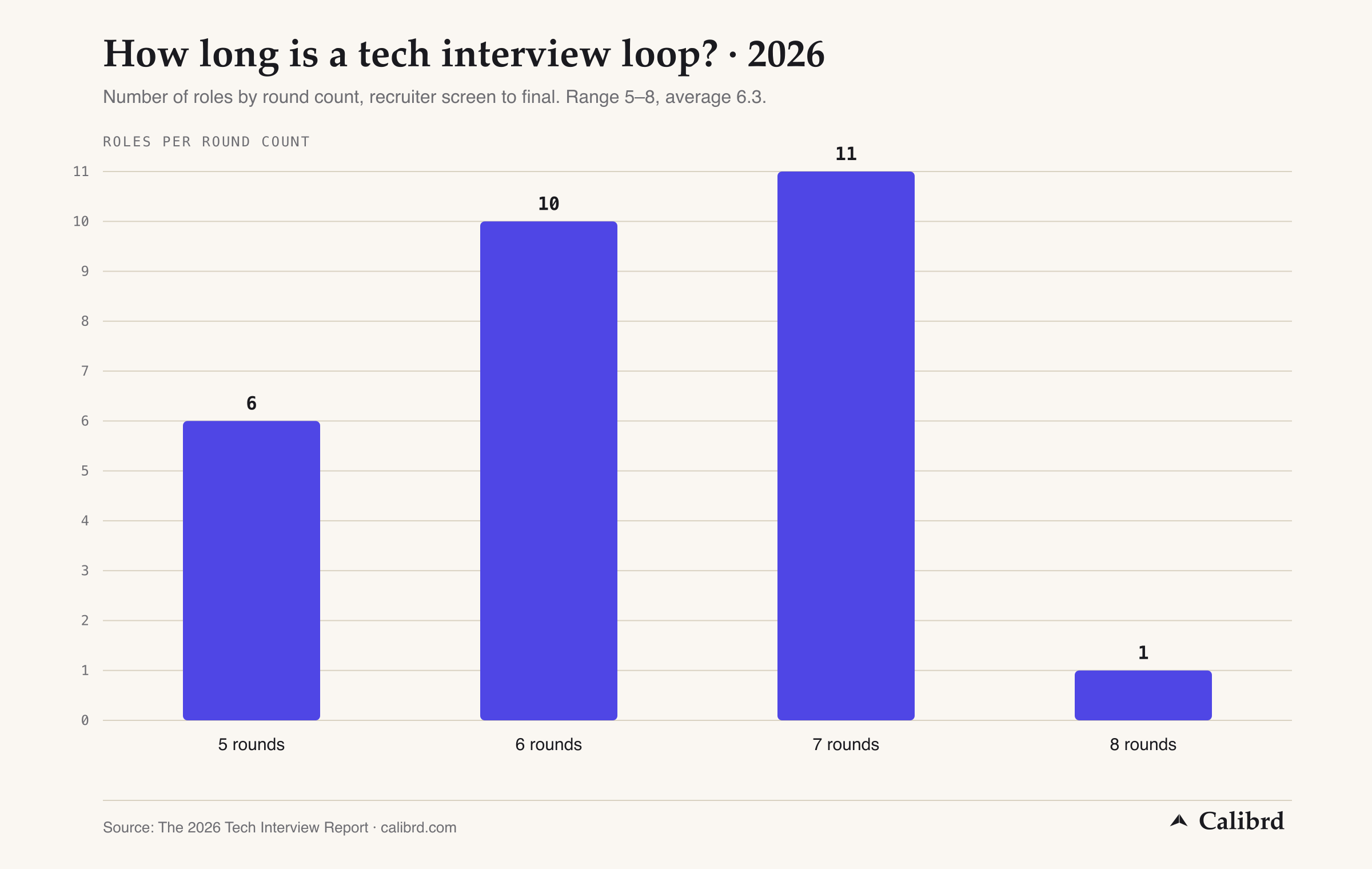
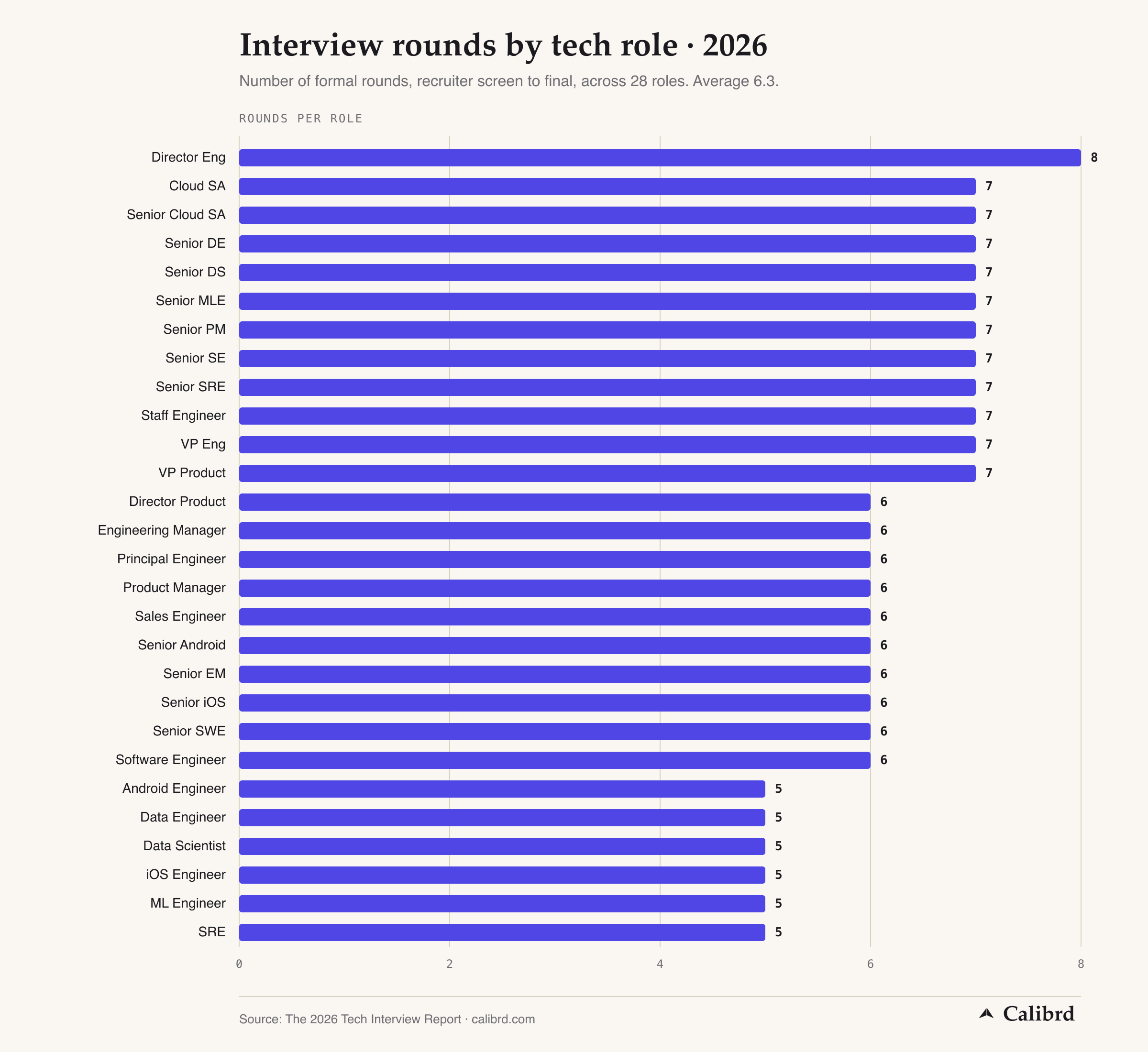
See every role · embed / cite this chart
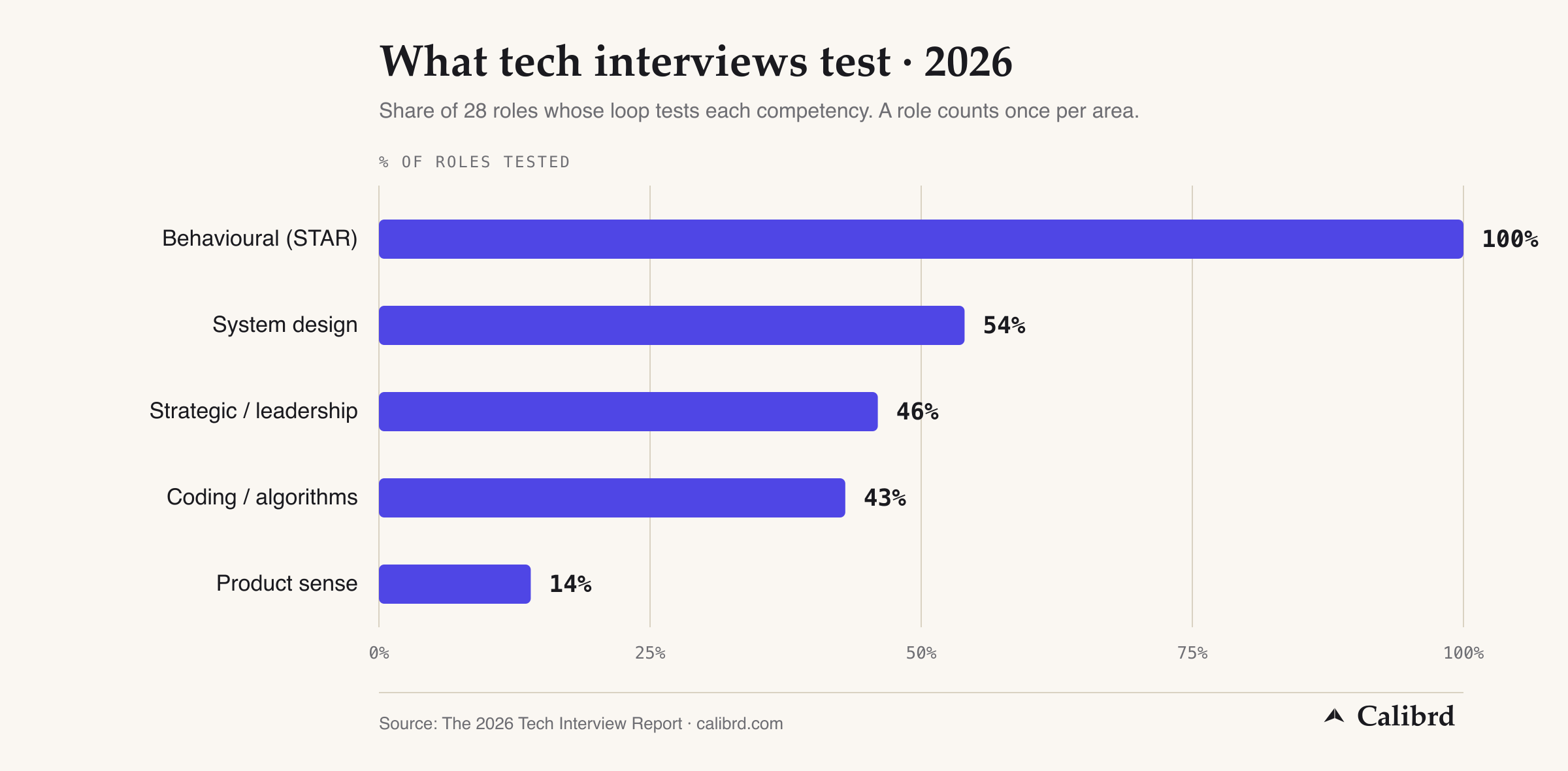
What tech interviews actually test
Share of the 42 roles whose interview includes each competency area. The surprise: a behavioural component is universal, but only 50% are coding-led, most senior, leadership, product and data roles are evaluated on design, strategy or product judgement instead. The emphasis shifts up the ladder.
Find your role, loops, pay & why candidates fail
Jump to your track, see your loop length, what it tests, time-to-offer and pay, then read the single most common reason strong candidates get rejected at that bar, and open the round-by-round prep guide to drill the fix. (We don't publish made-up “fail rates”; no one can source those per role and per stage honestly.)
Software Engineering
Software Engineer roles · internship → IC6 · 4–7 rounds
| Role & prep guide | Level | Rounds | Main test focus | Time to offer | Base | Equity / yr | Bonus |
|---|---|---|---|---|---|---|---|
| Staff Software Engineer interview prep | L6 / IC5 | 7 | System design | 5–8 weeks | $200–240k (SF/NYC) | $300–500k/yr | 20–25% |
| Principal Software Engineer interview prep | L7 / IC6 | 6 | Strategy / leadership | 8–12 weeks | $240–290k (SF/NYC) | $700k–1.5M/yr | 25–30% |
| Senior Software Engineer interview prep | L5 / IC4 | 6 | Coding + system design | 4–6 weeks | $155–185k (SF/NYC) | $80–150k/yr | 15–20% |
| Software Engineer interview prep | L4 / IC3 | 6 | Coding + system design | 3–5 weeks | $140–180k (SF/NYC) | $50–120k/yr | 10–15% |
| New Grad Software Engineer interview prep | New grad · L3 / E3 / SDE I | 5 | Coding | 2–4 weeks | $110–145k (US, new grad) | $10–40k/yr | $5–20k sign-on |
| Software Engineer Intern interview prep | Internship · student | 4 | Coding | 1–3 weeks | $7,000–11,000 / month (US) | None (interns rarely receive equity) | Housing stipend or corporate housing common |
Why Software Engineering candidates lose the offer
Describing technical work without org-level impact. The Staff bar is about how a 30+ person org operated differently because of you, not whether you shipped a hard system. Frame every story around what shipped at the org level, not the project level.
Being too tactical. Principal interviewers expect strategic and capital-allocation thinking, multi-year bets, executive influence, where to invest $10M of engineering. Strong Staff IC answers will get you downleveled here.
Treating system design as a Q&A. The signal at L5 is whether you DRIVE the conversation, propose, justify, evolve under pressure. Senior candidates who wait passively for the interviewer to lead get marked down hard, even with technically correct answers.
Coding in silence. Even with the correct answer, interviewers grade your thought process out loud. Narrate trade-offs, edge cases, and complexity as you go — that's the bar at this level.
Treating the online assessment as a formality. It's the biggest filter in the funnel — most new grads are cut there. Drill the timed format until a working solution is automatic before you touch the behavioural prep.
Treating the internship as a summer job instead of a 12-week interview. Most full-time offers are converted internships, so how you show up across those weeks — finishing the project, taking feedback, being someone the team wants back — is what actually decides the return offer.
Engineering Management
Manager and leadership roles · M1 → VP · 6–8 rounds
| Role & prep guide | Level | Rounds | Main test focus | Time to offer | Base | Equity / yr | Bonus |
|---|---|---|---|---|---|---|---|
| Director of Engineering interview prep | M3 / M4 | 8 | Strategy / leadership | 8–14 weeks | $300–380k (SF/NYC) | $400–800k/yr | 25–30% |
| VP of Engineering interview prep | VP | 7 | Strategy / leadership | 12–24 weeks | $400–480k (SF/NYC) | $1M–3M/yr | 30–40% |
| Engineering Manager interview prep | M1 / M2 | 6 | Strategy / leadership | 4–6 weeks | $180–220k (SF/NYC) | $60–150k/yr | 15–20% |
| Senior Engineering Manager interview prep | M2 / M3 | 6 | Strategy / leadership | 5–8 weeks | $220–270k (SF/NYC) | $150–300k/yr | 20–25% |
Why Engineering Management candidates lose the offer
Walking in without a 90-day plan. Most Director rounds explicitly ask 'how would you operate in your first 90 days here?', many candidates haven't drafted one. Bring a written outline tailored to the company; expect to defend each priority.
Underestimating CEO and board fluency. VP rounds are political as much as technical. Practising executive communication, concise updates, strategic recommendations, comfort with ambiguity, matters more than technical depth at this level.
Showing you still want to be an IC. EM interviewers worry first-time managers will neglect people work for coding. Make explicit you've made the transition: you might miss IC work occasionally, but you don't regret the move and have specific people-management wins to point to.
Speaking only about your direct team. The bar at this level is org-level: how you grow first-line EMs, calibrate performance across multiple squads, shape hiring across teams. Direct-team examples sound junior at this level.
Data & ML
Data Science, ML, and Data Engineering · IC3 → IC4 · 5–7 rounds
| Role & prep guide | Level | Rounds | Main test focus | Time to offer | Base | Equity / yr | Bonus |
|---|---|---|---|---|---|---|---|
| Senior Data Engineer interview prep | L5 / IC4 | 7 | System design | 5–7 weeks | $180–215k (SF/NYC) | $150–300k/yr | 15–20% |
| Senior Data Scientist interview prep | L5 / IC4 | 7 | Product sense | 5–8 weeks | $180–220k (SF/NYC) | $150–280k/yr | 15–20% |
| Senior Machine Learning Engineer interview prep | L5 / IC4 | 7 | Coding + system design | 5–7 weeks | $190–230k (SF/NYC) | $200–400k/yr | 15–20% |
| Data Engineer interview prep | L4 / IC3 | 5 | Coding + system design | 3–5 weeks | $145–175k (SF/NYC) | $50–110k/yr | 10–15% |
| Data Scientist interview prep | L4 / IC3 | 5 | Product sense | 4–6 weeks | $150–180k (SF/NYC) | $60–120k/yr | 10–15% |
| Machine Learning Engineer interview prep | L4 / IC3 | 5 | Coding + system design | 4–6 weeks | $155–185k (SF/NYC) | $80–150k/yr | 10–15% |
Why Data & ML candidates lose the offer
Describing pipeline-level work without platform-level framing. Senior DE interviews are judged against multi-team platforms, schema-evolution decisions, and cross-team data contracts. Strong L4 "I built this pipeline" stories will get you hired a level down if you don't frame them around the platform decisions that mattered.
Answering at the same depth as a mid-level. Senior DS rounds need strategic framing on top of technical fluency: priorities across bets, decisions enabled by the work, cross-functional influence stories. Strong IC3-level answers will get you downleveled here.
Describing model wins without production trade-offs. Senior MLE interviews are measured against latency budgets, retraining cost, monitoring, on-call. Strong L4 "model AUC" stories will get you hired a level down if you don't frame them against the production constraints that shaped the design.
Under-investing in system design. Many candidates with strong SQL get filtered because they treat the pipeline design round as a casual chat instead of a 60-minute structured discussion. Practise the design framework: ingestion → schema → transformation → storage → monitoring, with explicit trade-offs at each step.
Prepping only for SQL when the loop has a Python or combined round. Many candidates with strong analysis skills get caught off-guard when the technical screen asks for pandas data manipulation or a simple algorithm in Python. Confirm the round breakdown with your recruiter and prep both.
Treating it like a DS interview. The MLE coding bar is closer to SWE than DS, and the system design round expects production thinking (latency, monitoring, retraining) not just modelling. DS-style answers focused on offline metrics get downleveled here.
AI research and LLM engineering
Research Engineer, Research Scientist, AI Engineer · IC3 → IC5 · 6–8 rounds
| Role & prep guide | Level | Rounds | Main test focus | Time to offer | Base | Equity / yr | Bonus |
|---|---|---|---|---|---|---|---|
| Research Engineer interview prep | IC4 / IC5 · lab L4 | 8 | Coding + system design | 3–8 weeks | $350–400k (frontier labs, US) | $600k/yr at OpenAI L4; Anthropic pays most of the package as salary | Usually none at the labs |
| AI Research Scientist interview prep | L5 / IC4 equivalent (lab RS) | 7 | Coding + system design | 4–8 weeks, plus 2–4 for team matching | $230–415k (US labs) | $150k–970k/yr | 0–10%; most labs pay none |
| AI Engineer interview prep | L4 / IC3 to IC4 | 6 | Product sense | 3–5 weeks | $140–210k (US, mid-level) | $20–50k/yr at product companies; far higher at AI labs | Usually folded into total; sources do not split it out |
Why AI research and LLM engineering candidates lose the offer
Preparing for a product-company MLE loop. LeetCode grinding buys nothing here. The rounds that decide are the paper discussion, the brainstorm and the values conversation, where candidates who solved every coding question still report rejections.
Preparing the talk and nothing else. The talk is where a strong record shows, and the rejections come from the rounds around it: a CodeSignal screen failed on correctness, an oral quiz on undergraduate mathematics answered with intuition, a safety question treated as a formality, and a known limitation defended instead of owned.
Describing components instead of failures. Candidates list vector databases and re-rankers and never say what breaks, how they detect it, or what it costs. Interviewers grade the trade-offs and the evaluation story, and a design with neither sounds like a tutorial.
Mobile
iOS and Android engineering · IC3 → IC4 · 5–6 rounds
| Role & prep guide | Level | Rounds | Main test focus | Time to offer | Base | Equity / yr | Bonus |
|---|---|---|---|---|---|---|---|
| Senior Android Engineer interview prep | L5 / IC4 | 6 | System design | 4–6 weeks | $185–220k (SF/NYC) | $180–350k/yr | 15–20% |
| Senior iOS Engineer interview prep | L5 / IC4 | 6 | System design | 4–6 weeks | $185–220k (SF/NYC) | $180–350k/yr | 15–20% |
| Android Engineer interview prep | L4 / IC3 | 5 | Coding + system design | 3–5 weeks | $150–180k (SF/NYC) | $80–150k/yr | 10–15% |
| iOS Engineer interview prep | L4 / IC3 | 5 | Coding + system design | 3–5 weeks | $150–180k (SF/NYC) | $80–150k/yr | 10–15% |
Why Mobile candidates lose the offer
Answering the platform questions as a generic mobile engineer. The Android-specific failures are the ones that sink loops: no number for clean-build time, a Compose migration described as finished, a design that ignores ANR and vitals, and background work planned as though the OS will let it run.
Describing implementation work as architecture work. Senior iOS interviews are judged against the choices you made, not the features you shipped. Strong L4 "I built X at scale" stories will get you hired a level down if you can't articulate the architectural trade-off behind X.
Treating Android coding rounds as algorithm tests. The interviewer is grading whether you write Kotlin like a production Android engineer, lifecycle-aware scopes, Compose state handling, process-death survival. Algorithmic correctness without that layer reads as a backend engineer playing Android.
Treating iOS coding rounds as algorithm tests. The interviewer is grading whether you write Swift like a production iOS engineer, value semantics, weak-self, MainActor, the lifecycle hooks. Algorithmic correctness without that layer reads as a backend engineer playing iOS.
Infrastructure
SRE and Platform Engineering · IC3 → IC4 · 5–7 rounds
| Role & prep guide | Level | Rounds | Main test focus | Time to offer | Base | Equity / yr | Bonus |
|---|---|---|---|---|---|---|---|
| Senior SRE / Platform Engineer interview prep | L5 / IC4 | 7 | System design | 5–7 weeks | $195–235k (SF/NYC) | $200–400k/yr | 15–20% |
| Site Reliability Engineer interview prep | L4 / IC3 | 5 | Coding + system design | 4–6 weeks | $160–195k (SF/NYC) | $80–160k/yr | 10–15% |
Why Infrastructure candidates lose the offer
Describing service-level reliability work without platform-level framing. Senior SRE interviews calibrate against organisational impact (services adopting your platform, error-budget policy you enforced, incidents that didn't recur because of process you changed). Strong L4 "I fixed this incident" stories will get you hired a level down if you don't frame them around platform decisions.
Under-investing in the coding round. Many candidates from DevOps backgrounds have great infra skills but get filtered at the coding screen because they assumed SRE = bash + Terraform. The coding bar is closer to SWE than DevOps; drill LeetCode mediums for 4+ weeks.
Games
Game Client, Game Backend, Game Design and Production · IC3 → IC4 · written for Stockholm · 5–6 rounds
| Role & prep guide | Level | Rounds | Main test focus | Time to offer | Base | Equity / yr | Bonus |
|---|---|---|---|---|---|---|---|
| Game Backend Developer interview prep | Mid to Senior | 6 | Coding + system design | 3–5 weeks | SEK 720–960k (Stockholm) | Small at independents; RSUs at the Microsoft, EA and Embracer studios | 0–10% |
| Game Client Developer interview prep | Mid to Senior | 6 | Coding + system design | 3–6 weeks | SEK 570k (Stockholm) | Little at independents; RSUs at the Microsoft, EA and Embracer studios | 0–10% |
| Game Designer interview prep | Mid to Senior | 6 | Product sense | 3–6 weeks | SEK 456k (Stockholm) | Small at independents; RSUs at the publisher-owned studios | 0–10% |
| Game Producer interview prep | Mid to Senior | 5 | Product sense | 3–6 weeks | SEK 600k (Stockholm, posted starting salary) | RSUs at the publisher-owned studios; little or none at independents | 0–15% |
Why Games candidates lose the offer
Answering the design round as if it were a generic web service. The interviewer is listening for the reset spike, the ledger and the cheater; an answer that scales horizontally and stops there has missed all three.
Preparing LeetCode. Studios rarely ask it; they read your take-home and ask about memory, the frame and how you work with a designer. Hours on algorithms are hours not spent on the code review that decides the loop.
Presenting ideas instead of reasoning. Design leads grade the line from player experience to rules to evidence; a test full of features with no experience behind them reads as someone who has not yet designed for a live audience.
Sounding like a project manager. Studios want a producer who helps make a good game: a view on the players and the game in every answer, with the plan and the tools in service of it.
Quality
QA and Test Automation · IC3 · 5 rounds
| Role & prep guide | Level | Rounds | Main test focus | Time to offer | Base | Equity / yr | Bonus |
|---|---|---|---|---|---|---|---|
| QA Engineer interview prep | L4 / IC3 | 5 | Coding + system design | 3–5 weeks | $135–165k (SF/NYC) | $40–110k/yr | 10–15% |
Why Quality candidates lose the offer
Underestimating the coding round. QA candidates prepare test theory, then get filtered by a LeetCode-medium, because at big tech the SDET coding bar sits just under SWE. Four weeks of drilling moves more than any amount of framework knowledge.
Product
Product and technical program manager roles · IC2 → VP · 6–7 rounds
| Role & prep guide | Level | Rounds | Main test focus | Time to offer | Base | Equity / yr | Bonus |
|---|---|---|---|---|---|---|---|
| Senior Product Manager interview prep | PM3 / IC4 | 7 | Product sense | 5–8 weeks | $170–210k (SF/NYC) | $120–250k/yr | 15–20% |
| Technical Program Manager interview prep | L5–L6 / IC4–IC5 | 7 | Strategy / leadership | 4–8 weeks | Varies by company; see totals | Large share of total at big tech | Company standard |
| VP of Product interview prep | VP | 7 | Strategy / leadership | 12–24 weeks | $380–460k (SF/NYC) | $1M–3M/yr | 30–40% |
| Director of Product interview prep | PM4 / M3 | 6 | Strategy / leadership | 8–14 weeks | $280–340k (SF/NYC) | $300–600k/yr | 25–30% |
| Product Manager interview prep | PM2 / IC2 | 6 | Product sense | 4–6 weeks | $140–175k (SF/NYC) | $50–120k/yr | 10–15% |
Why Product candidates lose the offer
Not having a strategic point of view on the company. Senior+ PM interviews assume you've researched their business deeply, top-3 strategic moves, ranked, defended. Generic frameworks fail at this level.
Sounding like a project manager: timelines, meetings and status, with no depth on the system. Candidates report being told they'd suit a non-technical PM role after exactly this.
Underestimating CEO and board fluency. VP rounds are political as much as product-strategic. Practising executive communication, concise updates, strategic recommendations, comfort with ambiguity, matters more than product depth at this level.
Walking in without a written 90-day plan. The director-track interview is fundamentally executive, you need a clear plan you can present and defend, with reasoning tied to the company's actual product, market, and team.
Reciting frameworks without judgment. Walking through 'CIRCLES' or 'AARM' on autopilot makes you sound junior. Show that you know the framework, then bring opinion: pick a target user, defend the choice, name the trade-off you accepted.
Solutions
Forward Deployed, Sales Engineering and Solutions Architecture · IC3 → IC4 · 6–7 rounds
| Role & prep guide | Level | Rounds | Main test focus | Time to offer | Base | Equity / yr | Bonus |
|---|---|---|---|---|---|---|---|
| Cloud Solutions Architect interview prep | L4 / IC3 | 7 | Coding + system design | 5–8 weeks | $150–185k (SF/NYC) | $60–120k/yr | Variable: $20–60k OTE on-target |
| Senior Cloud Solutions Architect interview prep | L5 / IC4 | 7 | Strategy / leadership | 6–10 weeks | $190–240k (SF/NYC) | $200–400k/yr | Variable: $30–80k OTE on-target |
| Senior Sales Engineer interview prep | L5 / IC4 | 7 | Strategy / leadership | 4–6 weeks | $160–200k (SF/NYC) | $60–150k/yr | Variable: $100–160k OTE on-target |
| Forward Deployed Engineer interview prep | L4–L5 / IC3–IC4 | 6 | Coding + system design | 3–5 weeks | $140–210k (US) | $50–200k/yr | Varies; some FDE roles carry deployment or utilisation bonuses |
| Sales Engineer interview prep | L4 / IC3 | 6 | Strategy / leadership | 3–5 weeks | $130–160k (SF/NYC) | $30–80k/yr | Variable: $60–100k OTE on-target |
Why Solutions candidates lose the offer
Treating the architecture review as a system-design interview. Cloud SA architecture rounds are about customer-engagement design, discovery first, requirements before solution, cost as a first-class constraint. Strong system-design answers without the customer-centric framing read as SWE candidates playing SA.
Describing tactical architecture work as strategic. Senior Cloud SA interviews calibrate against the customer relationship and multi-year planning, not the technical artefact. Strong L4 "I designed this reference architecture" stories will get you hired a level down if you can't articulate the enterprise-customer politics and cost-strategy work behind them.
Describing tactical deal work as strategic. Senior SE interviews calibrate against the insights you brought, not the deals you closed. Strong L4 "I worked the deal hard" stories will get you hired a level down if you can't articulate the strategic shape behind the work.
Preparing it like a pure SWE loop. Clean code with no customer instinct fails the decomposition and scenario rounds — the panel is hiring the person they can drop into a hostile conference room, not just a strong pull request.
Treating SE interviews as technical interviews with customer fluff. The technical depth is necessary but not sufficient. The customer-centric framing, discovery first, problem before solution, composure under objection, is what separates strong SE candidates from strong engineers playing SE.
Sales
SDR, BDR and Account Executive · entry → mid-level · 5 rounds
| Role & prep guide | Level | Rounds | Main test focus | Time to offer | Base | Equity / yr | Bonus |
|---|---|---|---|---|---|---|---|
| Account Executive interview prep | Mid-market AE · closing quota | 5 | Product sense | 2–5 weeks | $80–110k (US mid-market) | Small or none at most SaaS companies; some grant RSUs or options at hire | Commission: about half of OTE, paid on closed revenue |
| Sales Development Representative interview prep | Entry level | 5 | Strategy / leadership | 1–3 weeks | $55k median (US) | Small or none at this level | Variable: about $25k at target, paid against a monthly meeting or opportunity quota |
Why Sales candidates lose the offer
Pitching in the discovery role play. Candidates who start showing the product before they've found the pain and its cost usually fail that round, however polished the pitch. The interviewer is scoring your questions and whether you end with a next step.
Treating the interview like a general graduate interview. Polished answers matter less than the role-play: a candidate who asks for the meeting clearly and gets better after feedback beats a candidate with a perfect 'tell me about yourself'.
Found your role?
The tables above are the market average. To prep for your actual interview, open your role's guide for the round-by-round breakdown, or paste a specific JD into a free scan and get predicted questions, a comp benchmark, and (with your resume) your experience gaps for that exact company.
How to use this report
- Find your role in the family tables above (or jump via your track).
- Note your loop shape, round count, main test focus, and time-to-offer tell you how long to plan and what to drill first.
- Open your prep guide for the exact round-by-round process, sample questions, level calibration, and where strong candidates still lose the offer.
Methodology
- Source. 42 tech roles, each researched and hand-curated for our per-role interview-prep guides, not scraped or AI-generated. The aggregates on this page are computed directly from that dataset at build time.
- Round counts include the recruiter screen and every formal evaluative round through the final loop. Informal chats, team match calls, and references are excluded.
- Main test focus & competency mix reflect which evaluation areas each role's interview includes, coding, system design, strategic/leadership, product sense, behavioural, taken directly from each role's tagged question set, not inferred from round names. A role counts once toward an area whether it tests it in one round or several.
- Role families use the same grouping as our interview-prep hub, so the two pages always agree on which roles belong together.
- Compensation targets the 50th percentile at major US tech employers (SF/NYC calibration), in USD. Pay in markets like London, Berlin and Singapore tends to run meaningfully lower in base, and equity ratios vary by company stage. Use the figures as relative benchmarks between roles rather than absolute local quotes.
- Updated. Published 2026-06-03; the charts were last redrawn on 15 October 2026, from 42 roles. Figures track the 2026 hiring market; see what changed in tech interviews in 2026 for the shifts behind them.
Reusing this data? It's free under CC BY 4.0, please credit Calibrd with a link to this page.
Be ready for your actual interview
The dataset is the average. Yours isn't.
Walk into your interview knowing exactly what's coming. Paste your real job and Calibrd shows what that company and level asks, where your resume is thin, and what the role should pay. Rehearse every predicted question out loud, then run a full voice mock interview: a live round that presses where a real interviewer would, then gives you an honest debrief. Any tech role. PDF emailed. Reports are free; full access from $9.99 for 7 days.
Free to start · No card · Encrypted at rest, never used to train AI, remove anytime
Common questions
How many rounds does a tech interview have in 2026?
Across the 42 tech roles in this report, the interview loop runs 4–8 rounds, averaging 6.1. More senior and leadership roles cluster at the top of that range; mid-level IC roles at the bottom. Counts include the recruiter screen but exclude informal coffee chats.
Do all tech interviews include a coding round in 2026?
No. Across the 42 roles in this report, only 50% include a coding/algorithms round. A behavioural component is universal (100% of roles), system design appears in 55%, strategic/leadership in 38%, and product sense in 19%. The emphasis shifts up the ladder: mid-level IC loops are coding-led, senior IC roles lean system design, and leadership roles lean strategic. Check the specific role's guide before assuming a LeetCode-style round.
How long does it take to get a tech offer in 2026?
Most processes in this dataset run 4–8 weeks from recruiter screen to offer, with senior and leadership loops at the longer end. The slowest stretch is usually the decision phase after the final round rather than the interviews themselves, so keep two or three processes running in parallel.
Are the compensation figures US-based?
Yes. Headline base/equity/bonus figures target the 50th percentile at major US tech employers (SF/NYC calibration). Pay in markets like London, Berlin and Singapore tends to run meaningfully lower in base terms, with equity ratios varying by company stage. Treat the numbers as relative benchmarks between roles rather than absolute local quotes.