2026 update
A few things have changed in 2026. AI is now allowed in coding rounds at Canva and Meta, detection has improved at companies that still ban it, pay has split at staff+, and the post-onsite wait got longer. Read what changed in 2026 →
What you'll be expected to do
What they're grading- Lead technical demos and discovery sessions with prospective customers
- Build proof-of-concept (POC) deployments to validate fit for medium-complexity accounts
- Translate customer requirements into product-team feedback; influence the roadmap from the field
- Handle technical objections during the sales cycle; coordinate with engineering on edge cases
- Partner with the Account Executive on deal strategy and competitive positioning
- Stay current on product changes, competitor moves, and customer-segment technical norms
What does the interview loop look like?
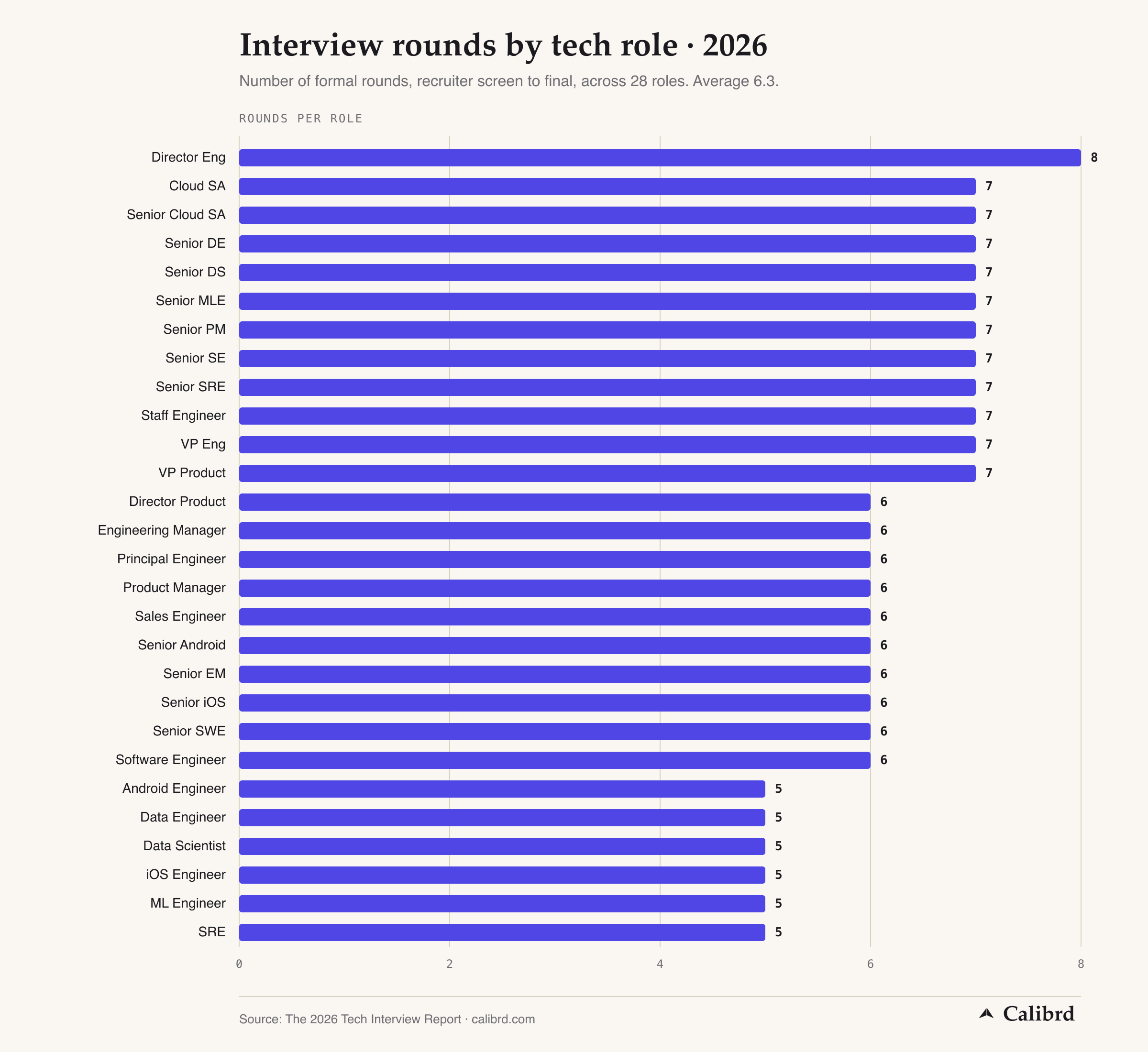
6 rounds · 3–5 weeksMost companies follow a similar pattern for Sales Engineer interviews. Total calendar time is 3–5 weeks from recruiter screen to offer.
Background, role calibration, motivation, pay expectations
SE philosophy, deal-cycle ownership, recent wins and losses
You present the product to the panel as if they were a target customer. The panel asks discovery questions, technical questions, and tries common objections
Role-play: a customer raises a tough technical objection or asks for a feature that doesn't exist. How you handle it
Working with AE on deal strategy, escalating to engineering, internal partnership
Past deal stories, hard-won customer relationships, what you'd change in your previous SE role
Sample questions you should be ready for
9 of the ones that decide itRepresentative of what companies ask at this level. Every question here can be practised out loud, which is the fastest way to find out whether your answer holds up under follow-ups. Calibrd adds voice practice with coaching on every answer, and a full voice mock interview: a live round with an AI interviewer who has read the role and your CV, then an honest debrief.
- 01“Walk me through how you'd architect a deployment for a customer with 500GB/day of event data and strict EU data-residency requirements.”
- 02“A customer says our product can't integrate with their existing identity provider. Walk me through how you'd diagnose whether that's true and what you'd propose.”
- 03“Explain how our product handles failover. Now explain it again as if I'm a CIO who doesn't write code.”
- 04“A prospect with $2M ACV is evaluating us against Competitor X. Walk me through the discovery questions you'd ask in the first call.”
- 05“How do you decide whether to push back on a customer who's asking for something off-product, vs. agreeing to chase it with engineering?”
- 06“Tell me about a customer-segment trend you noticed before the rest of the team. How did you act on it?”
- 07“Tell me about a deal you lost. What was the technical objection, and what did you change in your approach afterwards?”
- 08“Describe a customer who pushed for a feature we didn't have. How did you handle the conversation, and what did you bring back internally?”
- 09“Walk me through a POC you led that didn't convert. What signal told you it wasn't going to close?”
These are the general ones. Paste a real posting and Calibrd predicts the questions that company asks for that exact role, then interviews you on them.
Predict my questions →Compensation benchmark
US majors · USD · medianTypical pay for Sales Engineer at major US tech companies, headline numbers in USD. Typical pay in London, Berlin and Singapore is meaningfully lower, and equity varies a lot by company stage.
FAANG-tier and infra-SaaS L4 SE total OTE is typically $220–290k. Snowflake / Databricks / MongoDB / Confluent / Stripe pay at the top of this band; smaller SaaS startups at the bottom. Variable pay ties to individual + team quota attainment. London SE OTE ~£140–180k.
How to prep
5 tactical tipsLead behavioural answers with the STAR method: Situation, Task, Action, Result. The tips below build on that structure for this specific role.
- Practise demoing the product cold, 5 times before the loop. The technical demo dry-run is the round most candidates under-prepare for
- Drill discovery questions: pain, pain quantification, process around the pain, decision criteria, timeline, competition, budget
- Be ready for one trap-objection in the scenario round, the panel will ask about a feature gap, a competitor's advantage, or a regulatory concern. Handle it without defensiveness
- Have 5–6 specific deal stories: a win, a loss, a POC that didn't convert, a competitive displacement, a customer who became a reference
- Know one competitor's product cold, the panel often asks how you'd position against them
Where do Sales Engineer candidates fail?
Spot it in a mock firstA few common mistakes that get Sales Engineer candidates rejected even when they are otherwise strong. Worth catching in a mock interview before they show up in a real one.
Walking into the technical demo dry-run and pitching the product feature-by-feature instead of tying every feature to a customer problem.
Why it fails
SE interviewers grade the demo on customer-centric framing, not product knowledge. Feature-walks read as "this person will bore my prospects." The senior pattern is to start with the customer's job-to-be-done, name the pain you've heard, and only then show how the product handles it. A demo that opens with "and here's our admin panel" loses the room in 30 seconds.
Fix
Reframe your demo as a story: the customer's problem → why they need to solve it → how the product helps → what changes for them. Practise the opening 90 seconds cold. The first impression shapes the rest of the round.
Handling the customer scenario round defensively, explaining why the objection is wrong instead of acknowledging it.
Why it fails
Customer-scenario rounds test composure and partnership instinct, not product mastery. A candidate who immediately counter-argues sounds like they'd alienate prospects. The senior pattern is to repeat the objection back in plain words, ask the discovery question that's behind it, and only then bring in the technical answer.
Fix
When the scenario panel raises an objection, take a breath and restate it: "So you're concerned about X, can I ask what's behind that?" The pause and the discovery question separate composed candidates from anxious ones.
Describing past SE work without naming the deal sizes, win rates, or POC conversion rates.
Why it fails
SE interviewers calibrate against revenue impact, not just activity. "I supported deals at my last company" tells them nothing. "I owned the technical side of 14 deals last year, $4.2M closed ACV, 71% win rate on deals I demoed; POCs converted at 65%, 12 points above the team average" lets them peg you immediately.
Fix
For your top 4-5 stories, attach three numbers each: deal size (ACV), win or conversion rate, and an operational detail (POC duration, competitor faced, customer segment). Rough numbers beat no numbers.
Recommended resources
No affiliate linksBooks, courses, and tools that come up most often in Sales Engineer prep.
- 01The Pre-Sales Collective →
The largest practitioner community for sales engineering. The interview-prep threads in their Slack are gold. Free to join.
- 02Mastering Technical Sales (Care + Bohlig) →
The reference book for SE practice. The discovery and demo chapters come up directly in interview prep.
- 03The Challenger Sale (Dixon + Adamson) →
Foundational text on consultative selling. The Challenger framework comes up in scenario-round behavioural questions.
- 04Sales Engineer Hub (newsletter) →
Practitioner newsletter covering current SE patterns, tooling, and career moves. Skim recent issues before interviews.
- 05MEDDIC / MEDDPICC sales-methodology reference →
The enterprise sales-qualification framework. Discovery rounds at major SaaS companies often probe whether you think in MEDDIC terms.
- 06Great Demo! (Peter Cohan) →
The canonical demo-construction method — do the last thing first. Read it before the demo dry-run, the most under-prepared round in SE loops.
Frequently asked questions
Is this guide useful if I'm a software engineer moving into sales engineering?
Yes, the L4 / IC3 SE bar described here applies whether you came from SWE, customer success, or directly through SE. SWE-to-SE transitions usually have the technical depth but need to drill discovery skills and customer-centric framing. The technical demo round is the most common rejection point for SWE candidates because the demo reads as a feature-walk, not a problem narrative. Practise that round cold.
How long should I prep before my Sales Engineer onsite?
The process takes 3–5 weeks. Add 3–4 weeks of prep, the technical demo dry-run is the highest-leverage round. Practise the product demo cold 5 times before the loop; have 5–6 specific deal stories with numbers attached.
What's the most common mistake candidates make at the Sales Engineer bar?
Treating SE interviews as technical interviews with customer fluff. The technical depth is necessary but not sufficient. The customer-centric framing, discovery first, problem before solution, composure under objection, is what separates strong SE candidates from strong engineers playing SE.
What if my interview process is different from what's listed?
Most variation is at the edges. Major tech companies (FAANG, scale-ups, mid-size SaaS) follow processes within 1–2 rounds of what's described. Smaller startups often run fewer rounds (3–4) but the bar at each round is similar; less-tech-mature companies sometimes skip system design or behavioural rounds entirely. Read the posting and ask the recruiter on the screening call; they'll tell you what's coming.
How does this guide compare to running a free scan?
This guide covers the general bar at L4 / IC3. The free scan reads one real posting and opens the report right here: the questions that role and company will ask, a pay benchmark matched to the level and, with your CV, the gaps an interviewer will probe and a CV score. No account or email first; the report is on screen in about a minute.
Walk in ready
Walk into your Sales Engineer interview ready.
Paste your actual job and Calibrd predicts what that company asks for this role, where your CV is thin, and what it should pay. Then rehearse the round out loud with honest feedback until you're confident. Free to start.
Free to start · No card · Encrypted at rest, never used to train AI, remove anytime