2026 update
A few things have changed in 2026. AI is now allowed in coding rounds at Canva and Meta, detection has improved at companies that still ban it, pay has split at staff+, and the post-onsite wait got longer. Read what changed in 2026 →
What you'll be expected to do
What they're grading- Own technical leadership on strategic / enterprise accounts ($1M+ ACV, multi-stakeholder, 6+ month cycles)
- Run technical bid responses and architecture reviews for enterprise procurement
- Mentor 3–5 mid-level SEs technically; review their demos and POC plans
- Drive feedback from the field to product: which feature gaps cost deals, which segments are converting well
- Partner with senior AEs and customer-success leadership on account strategy and renewal motion
- Represent the SE function in cross-functional planning with sales leadership and product
What does the interview loop look like?
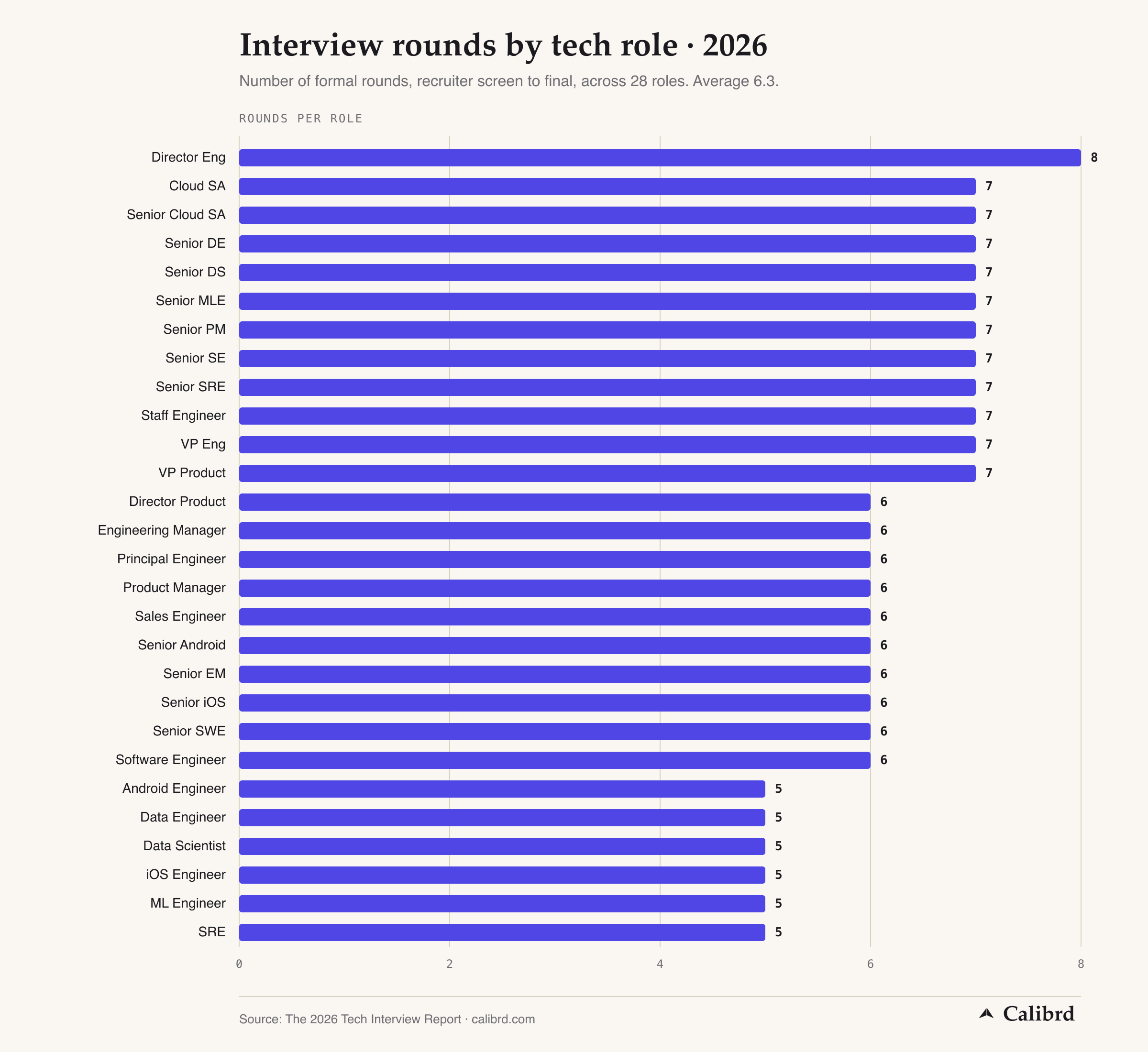
7 rounds · 4–6 weeksMost companies follow a similar pattern for Senior SE interviews. Total calendar time is 4–6 weeks from recruiter screen to offer.
Calibration to senior level, scope of past deals owned, pay expectations
Recent wins / losses, philosophy on enterprise deal cycles, why this company / product next
Walk through a strategic deal you ran. The panel grills on discovery, competitive positioning, technical objections you handled, and what you'd do differently
A panel role-plays a complex prospect: multi-stakeholder, conflicting requirements, competitor in late-stage eval. You scope the situation and propose your approach
How you operate with senior partners, escalating feature gaps, balancing field reality with roadmap
How you'd coach a mid-level SE through their first failed POC; how you raise the SE bar across the org
Strategic judgment at senior+ level, executive presence in customer settings, long-term career arc
Sample questions you should be ready for
10 of the ones that decide itRepresentative of what companies ask at this level. Every question here can be practised out loud, which is the fastest way to find out whether your answer holds up under follow-ups. Calibrd adds voice practice with coaching on every answer, and a full voice mock interview: a live round with an AI interviewer who has read the role and your CV, then an honest debrief.
- 01“Design the deployment architecture for a Fortune 500 prospect: 50TB/day ingestion, multi-region failover, FedRAMP compliance, single-pane management. Walk me through what you'd propose and where the gaps are with our current product.”
- 02“A late-stage prospect is comparing us against an in-house build. Walk me through the TCO argument you'd structure to win the deal.”
- 03“Explain how you'd integrate our product into a customer's existing data pipeline (Snowflake + Airflow + dbt). Cover the failure modes you'd ask the panel to validate.”
- 04“Our competitor just shipped a feature that closes one of our biggest gaps. Walk me through how you'd brief the field on positioning and what you'd push product to prioritise.”
- 05“How do you decide which feature requests from the field are worth escalating to product leadership vs. handling locally?”
- 06“If you ran SE strategy at this company for a quarter, what would you change first and why?”
- 07“Walk me through the most strategic deal you've owned. What was the discovery insight that unlocked it, and what would you do differently with hindsight?”
- 08“Tell me about a deal you lost late in the cycle. What was the root cause, and what changed in your approach afterwards?”
- 09“Describe a time you pushed back on a product team about a feature gap you saw costing deals. How did the conversation go, and what shipped because of it?”
- 10“Tell me about mentoring a mid-level SE through a tough deal. What was the specific thing you taught, and how did you know it landed?”
These are the general ones. Paste a real posting and Calibrd predicts the questions that company asks for that exact role, then interviews you on them.
Predict my questions →Compensation benchmark
US majors · USD · medianTypical pay for Senior SE at major US tech companies, headline numbers in USD. Typical pay in London, Berlin and Singapore is meaningfully lower, and equity varies a lot by company stage.
Infra-SaaS L5 Senior SE total OTE is typically $300–410k. Snowflake / Databricks / Stripe / MongoDB / Confluent at the top of the band. Variable pay ties to quota attainment plus team-leverage bonuses at senior level. London Senior SE OTE ~£170–220k.
How to prep
5 tactical tipsLead behavioural answers with the STAR method: Situation, Task, Action, Result. The tips below build on that structure for this specific role.
- Pick 1–2 strategic deals you've owned and rehearse the deep-dive cold, every discovery insight, every objection, every counterfactual
- Have 8–10 STAR stories tagged across senior signals: strategic deal owned, deal lost, feature gap escalated, SE mentored, competitive displacement
- Read recent product, engineering, and field blog posts from the company you're interviewing at, study their positioning
- Know two competitors cold, most senior SE loops include a competitive-positioning question, and "we're better" without specifics is a downlevel
- Prepare a 30/60/90 plan answer, what you'd own and ship in your first 90 days at this specific company's SE function
Where do Senior SE candidates fail?
Spot it in a mock firstA few common mistakes that get Senior SE candidates rejected even when they are otherwise strong. Worth catching in a mock interview before they show up in a real one.
Walking through past deals as "I closed X" without naming the strategic insight that won them.
Why it fails
Senior SE interviews calibrate against strategic ownership, not activity. "I closed a $3M ACV deal" is a mid-level story. "We were behind on a $3M ACV deal in late-stage eval because the prospect had standardised on a competitor's identity provider. I ran a discovery loop with their CISO, surfaced a compliance concern they hadn't fully scoped, and reframed the eval around that, we won" is a senior story. The senior signal is the insight, not the size.
Fix
For each major deal story, push past "I closed it" to "what was the insight that turned the deal?" If you can't name a specific moment or discovery, the deal didn't have strategic shape, pick a different story.
Treating the customer scenario round as a chance to demonstrate product knowledge instead of scoping the situation.
Why it fails
Senior SE scenarios are open-ended on purpose. The panel is grading how you frame the problem, not how fast you reach for a feature answer. A candidate who jumps straight to "I'd show them our admin console" without asking about decision criteria, stakeholders, or timeline reads as a strong mid-level SE who hasn't yet learned to scope.
Fix
Within the first 5 minutes of any scenario, ask: who are the decision makers, what's the timeline, what's the budget gate, who's the incumbent (if any), what's the trigger event that started this evaluation. The discovery questions ARE the senior signal, don't skip them to get to the technical answer faster.
Defending an SE practice (POC framework, discovery method, demo script) by saying "that's how our team does it" instead of giving the trade-off rationale.
Why it fails
Senior SE interviews probe whether you've thought about why your team's practice works for your team. The practice itself is rarely the point, the senior signal is whether you understand its trade-offs against alternatives, and would adapt if the trade-offs changed. Cargo-culting a framework from a sales-methodology book is a downlevel.
Fix
Prep a 60-second defence of one practice your team uses: what it optimises for, what it gives up, what would make you reconsider. Even if the interviewer prefers a different practice, the reasoning shows senior-level thinking.
Recommended resources
No affiliate linksBooks, courses, and tools that come up most often in Senior SE prep.
- 01The Pre-Sales Collective →
Practitioner Slack + content for SE. Re-engage with the senior-track conversations before final-round interviews.
- 02Mastering Technical Sales (Care + Bohlig) →
Re-read for the senior chapters on enterprise deal cycles, stakeholder mapping, and account strategy.
- 03The Challenger Sale + The Challenger Customer (Dixon) →
Re-read both. The Customer book covers consensus selling, a recurring theme in senior SE scenario rounds.
- 04MEDDIC / MEDDPICC reference →
Enterprise sales-qualification framework. Senior SE rounds at major SaaS companies expect MEDDIC-style discovery rigour.
- 05First Round Review, Sales & Customer Success →
Practitioner writing from successful sales / SE leaders. Useful for the strategic-positioning rounds.
- 06The Trusted Advisor (Maister, Green & Galford) →
The canonical book on earning enterprise-executive trust — the exact bar the senior rounds probe. The trust equation is worth quoting in the account deep-dive.
Frequently asked questions
I'm currently a Sales Engineer (L4 / IC3). Should I read this guide or the Sales Engineer guide first?
Read the Sales Engineer guide first. Companies calibrate L5 / IC4 candidates against the L4 / IC3 bar with a clear scope-gap lens, they want to see where you stand today, then probe the gap up to L5 / IC4. Read this guide AFTER you understand the L4 / IC3 baseline, so you know exactly which signals you need to demonstrate for the step-up.
How long should I prep before my Senior SE onsite?
The process takes 4–6 weeks. Add 6–8 weeks of prep, the strategic deal deep-dive is the highest-leverage round. Pick 1–2 deals you've owned at the $1M+ ACV level and rehearse them cold.
What's the most common mistake candidates make at the Senior SE bar?
Describing tactical deal work as strategic. Senior SE interviews calibrate against the insights you brought, not the deals you closed. Strong L4 "I worked the deal hard" stories will get you hired a level down if you can't articulate the strategic shape behind the work.
What if my interview process is different from what's listed?
Most variation is at the edges. Major tech companies (FAANG, scale-ups, mid-size SaaS) follow processes within 1–2 rounds of what's described. Smaller startups often run fewer rounds (3–4) but the bar at each round is similar; less-tech-mature companies sometimes skip system design or behavioural rounds entirely. Read the posting and ask the recruiter on the screening call; they'll tell you what's coming.
How does this guide compare to running a free scan?
This guide covers the general bar at L5 / IC4. The free scan reads one real posting and opens the report right here: the questions that role and company will ask, a pay benchmark matched to the level and, with your CV, the gaps an interviewer will probe and a CV score. No account or email first; the report is on screen in about a minute.
Walk in ready
Walk into your Senior SE interview ready.
Paste your actual job and Calibrd predicts what that company asks for this role, where your CV is thin, and what it should pay. Then rehearse the round out loud with honest feedback until you're confident. Free to start.
Free to start · No card · Encrypted at rest, never used to train AI, remove anytime