2026 update
A few things have changed in 2026. AI is now allowed in coding rounds at Canva and Meta, detection has improved at companies that still ban it, pay has split at staff+, and the post-onsite wait got longer. Read what changed in 2026 →
What you'll be expected to do
What they're grading- Lead technical architecture reviews and reference-design proposals for prospective customers
- Build proof-of-concept deployments to validate cloud architecture fit for medium-complexity workloads
- Translate customer requirements into platform feedback; influence the cloud product roadmap from the field
- Handle technical objections during eval cycles; partner with cloud engineering teams on edge-case integrations
- Partner with the Account Manager and Customer Success on account architecture and growth strategy
- Stay current on cloud platform changes, competitor cloud-product moves, and customer-segment architecture trends
What does the interview loop look like?
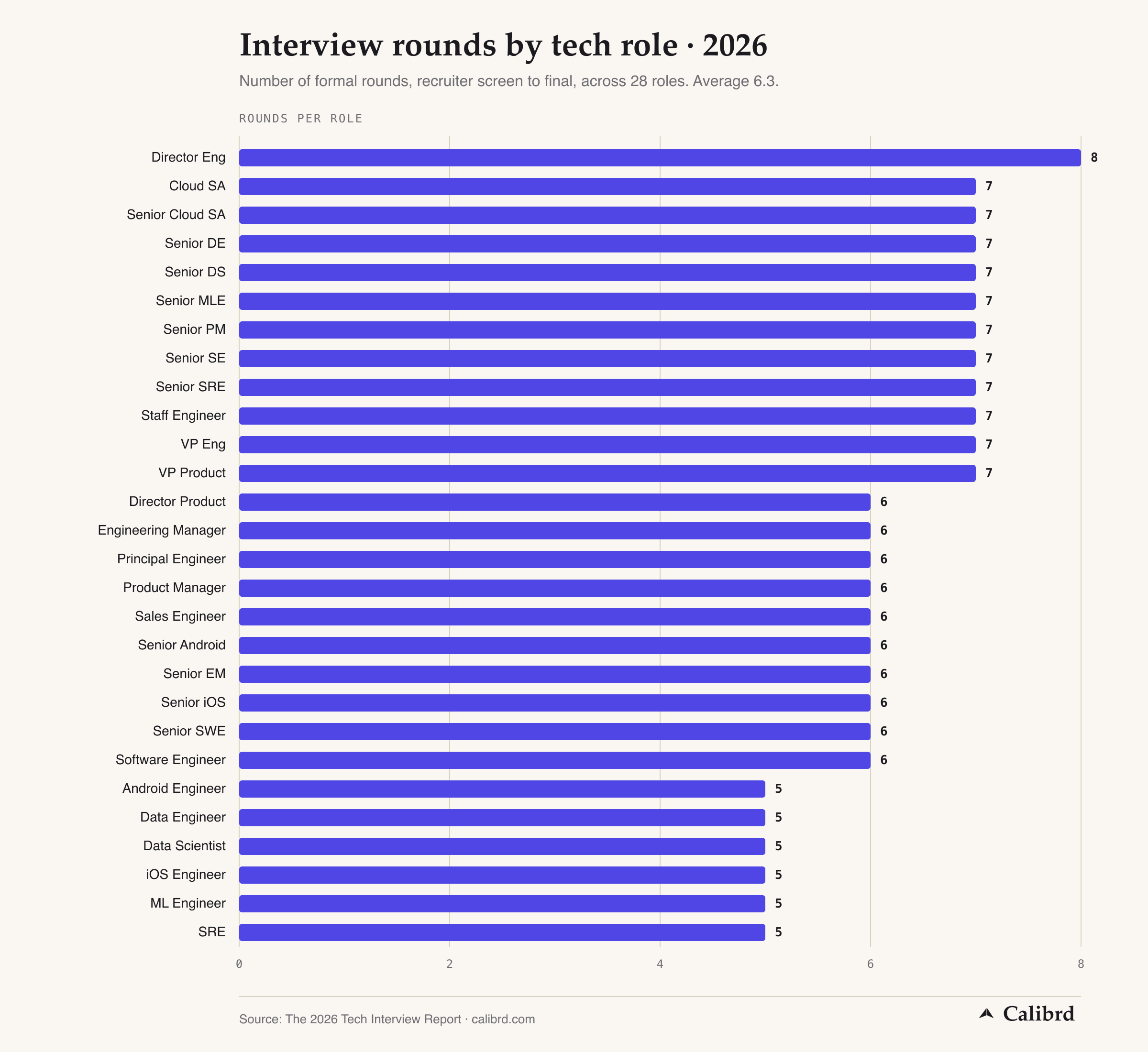
7 rounds · 5–8 weeksMost companies follow a similar pattern for Cloud SA interviews. Total calendar time is 5–8 weeks from recruiter screen to offer.
Background, role calibration, motivation, pay expectations
Past architecture wins, customer-facing experience, why this cloud platform
Networking, compute, storage, security fundamentals at the cloud-platform level. Some coding (Python or bash scripting) for automation tasks
You propose a reference architecture for a customer scenario the panel describes. They probe scale, cost, failure modes, security, compliance, and how you'd defend it to the customer
Role-play: a customer raises a tough architectural objection or asks for a specific cloud-product gap. How you handle the technical and business conversation simultaneously
AWS runs 1–2 LP rounds for every candidate; Azure and GCP have their own variants. STAR-formatted answers grounded in real customer or team stories
Hiring manager's manager probes leadership, scope ambition, and fit for the SA discipline at scale
Sample questions you should be ready for
9 of the ones that decide itRepresentative of what companies ask at this level. Every question here can be practised out loud, which is the fastest way to find out whether your answer holds up under follow-ups. Calibrd adds voice practice with coaching on every answer, and a full voice mock interview: a live round with an AI interviewer who has read the role and your CV, then an honest debrief.
- 01“Walk me through how you'd design a multi-region active-active deployment for a customer running ~50k QPS sustained, with sub-100ms p99 latency across three geographic regions. Cover failover, data consistency, and the cost trade-off.”
- 02“A customer asks how to migrate their on-prem Oracle database to your cloud platform with zero downtime. Walk me through the discovery questions, the migration strategy, and the rollback plan.”
- 03“Explain how you'd implement defence-in-depth security for a healthcare customer running HIPAA workloads on your platform. Cover network, identity, data, and operational controls.”
- 04“Design a reference architecture for a financial-services customer running real-time fraud detection. 100M events/day, sub-50ms decision latency, regulatory requirements for audit and explainability.”
- 05“Design a data lakehouse architecture for a media customer with 5PB of analytics data, mixed batch and streaming workloads, and a 30-engineer analytics team that needs self-service.”
- 06“Design a cost-optimised architecture for a SaaS customer with bursty workloads (2x traffic during launches, idle the rest of the time). Cover compute, storage, and where you'd push them toward serverless.”
- 07“Tell me about an architecture review where the customer pushed back on your recommendation. How did you handle it?”
- 08“Describe a POC you led that didn't convert. What was the technical or political signal you missed?”
- 09“Walk me through a customer who became a reference because of architectural work you led. What was the project, and what did you do that earned the reference relationship?”
These are the general ones. Paste a real posting and Calibrd predicts the questions that company asks for that exact role, then interviews you on them.
Predict my questions →Compensation benchmark
US majors · USD · medianTypical pay for Cloud SA at major US tech companies, headline numbers in USD. Typical pay in London, Berlin and Singapore is meaningfully lower, and equity varies a lot by company stage.
AWS L5 Cloud SA total pay is typically $240–320k. Azure Senior SE / GCP SA equivalent. Snowflake and Databricks Solutions Architects pay $260–340k OTE at L4. Variable pay at AWS is smaller than pure-SE roles (less quota-driven). London Cloud SA total pay ~£135–180k.
How to prep
5 tactical tipsLead behavioural answers with the STAR method: Situation, Task, Action, Result. The tips below build on that structure for this specific role.
- Get the platform's core architect cert (AWS Solutions Architect Associate, Azure Architect Expert, GCP Professional Cloud Architect), the certs are recruiter signals and they cover the technical-screen surface area
- Read the platform's well-architected framework cover-to-cover, AWS Well-Architected, Azure Architecture Center, GCP Architecture Framework. These show up directly in architecture-review rounds
- Practise 2–3 reference architectures cold: multi-region active-active, data lakehouse, hybrid migration. Pattern-match the rest
- For AWS specifically: drill the 16 Leadership Principles. Have 12–15 STAR stories mapped to specific LPs. AWS LP rounds reject more candidates than the technical ones
- Read the platform's customer case studies, every cloud vendor publishes them, and architecture reviews often resemble these in shape
Where do Cloud SA candidates fail?
Spot it in a mock firstA few common mistakes that get Cloud SA candidates rejected even when they are otherwise strong. Worth catching in a mock interview before they show up in a real one.
Jumping into a reference architecture without asking discovery questions about the customer's actual requirements.
Why it fails
Cloud SA architecture rounds grade on whether you treat the prompt as a real customer engagement, not a textbook design problem. A candidate who hears "design a fraud-detection system" and immediately starts drawing boxes signals "I'd design before listening to the customer in a real engagement." The senior pattern is to ask about scale, regulatory constraints, existing investments, and decision timeline before proposing anything.
Fix
Open every architecture-review answer with a 60-second discovery: "Before I propose, let me ask, what's the existing footprint, what's the compliance surface, what's the timeline for go-live, and what's the budget envelope?" Even compressing this to two minutes telegraphs that you operate like a real Cloud SA, not a whiteboard exercise.
Designing the perfect architecture without ever mentioning cost.
Why it fails
Cloud SAs are calibrated against TCO (total cost of ownership) thinking, not just technical correctness. An architecture review that doesn't cover monthly compute spend, storage cost, bandwidth egress, or licensing implications signals "I'd lose the customer at the budget conversation." Every cloud customer asks about cost; every architecture review tests whether you do.
Fix
After laying out the architecture, do the napkin math: "This setup would run roughly $X/month for compute at the projected load, $Y/month for storage, with cost-control levers being [reserved instances / committed-use discounts / auto-scaling / data-tier transitions]." Rough numbers earn the signal.
Handling customer-scenario objections by defending the cloud platform instead of acknowledging the concern.
Why it fails
Customer-scenario rounds grade composure and customer-centricity. A candidate who immediately counter-argues an objection ("actually our platform handles that fine because…") sounds like they'd alienate prospects. The senior pattern is to acknowledge the concern, ask what's behind it, and only then bring in the technical answer with appropriate framing.
Fix
When the scenario panel raises an objection, restate it: "So you're concerned about [specific worry], can I ask what's behind that?" Then bring the technical answer back as a way to address the underlying concern, not to rebut.
Recommended resources
No affiliate linksBooks, courses, and tools that come up most often in Cloud SA prep.
- 01AWS Well-Architected Framework →
Canonical reference for cloud architecture rounds at AWS. Know the 6 pillars (operational excellence, security, reliability, performance efficiency, cost optimisation, sustainability) cold before any AWS Cloud SA loop.
- 02Azure Architecture Center →
Microsoft's equivalent. Reference architectures for canonical scenarios (e-commerce, AI/ML, IoT, hybrid) come up in architecture-review prompts.
- 03GCP Architecture Framework →
Google's equivalent. Read the security and operational excellence sections before any GCP Cloud SA round.
- 04AWS Leadership Principles, practice prompts →
If you're interviewing at AWS, the 16 LPs are non-negotiable prep. Pair the official site with STAR stories from your career.
- 05Designing Data-Intensive Applications (Kleppmann) →
Foundational reference for cloud system-design rounds. Chapters on partitioning, replication, and consistency map directly to architecture-review topics.
- 06The Software Architect Elevator (Gregor Hohpe) →
Hohpe's book on architects who ride between the engine room and the boardroom — this role's exact job. Read it for the customer-scenario and cross-functional rounds.
Frequently asked questions
Is this guide useful if I'm a SWE / SRE moving into a Cloud Solutions Architect role?
Yes, the L4 / IC3 Cloud SA bar described here applies whether you came from SWE, SRE, customer success, or directly through SA. SWE / SRE transitions usually have the technical depth but need to drill discovery skills and customer-centric framing. The architecture-review round is the most common rejection point for SWE candidates because the review reads as system design instead of customer-engagement design. Practise that round cold.
How long should I prep before my Cloud SA onsite?
The process takes 5–8 weeks. Add 4–6 weeks of prep if you're rusty on the platform's services; 8–12 weeks if you're transitioning from SWE / SRE without prior customer-facing experience. The platform certification + Well-Architected Framework cover most of the technical surface; AWS Leadership Principles (if applying to AWS) need their own dedicated prep.
What's the most common mistake candidates make at the Cloud SA bar?
Treating the architecture review as a system-design interview. Cloud SA architecture rounds are about customer-engagement design, discovery first, requirements before solution, cost as a first-class constraint. Strong system-design answers without the customer-centric framing read as SWE candidates playing SA.
What if my interview process is different from what's listed?
Most variation is at the edges. Major tech companies (FAANG, scale-ups, mid-size SaaS) follow processes within 1–2 rounds of what's described. Smaller startups often run fewer rounds (3–4) but the bar at each round is similar; less-tech-mature companies sometimes skip system design or behavioural rounds entirely. Read the posting and ask the recruiter on the screening call; they'll tell you what's coming.
How does this guide compare to running a free scan?
This guide covers the general bar at L4 / IC3. The free scan reads one real posting and opens the report right here: the questions that role and company will ask, a pay benchmark matched to the level and, with your CV, the gaps an interviewer will probe and a CV score. No account or email first; the report is on screen in about a minute.
Walk in ready
Walk into your Cloud SA interview ready.
Paste your actual job and Calibrd predicts what that company asks for this role, where your CV is thin, and what it should pay. Then rehearse the round out loud with honest feedback until you're confident. Free to start.
Free to start · No card · Encrypted at rest, never used to train AI, remove anytime