2026 update
A few things have changed in 2026. AI is now allowed in coding rounds at Canva and Meta, detection has improved at companies that still ban it, pay has split at staff+, and the post-onsite wait got longer. Read what changed in 2026 →
What you'll be expected to do
What they're grading- Own a surface across releases: its module, its vitals budget, and the decision to ship or halt when the numbers move
- Lead 2–4 mid-level Android engineers technically; own the lint rules, the module boundaries and the review bar others inherit
- Drive the Gradle module graph and the shared libraries under it (networking, image loading, analytics), including what a change does to clean-build time
- Set the bar for production Android quality: crash-free targets, ANR rate budgets, startup time budgets
- Mentor mid-level Android engineers; participate in Android interview loops as a regular interviewer
- Hold the release: staged rollouts, halt criteria, and the remote kill switch for a feature that regresses vitals in the field
What does the interview loop look like?
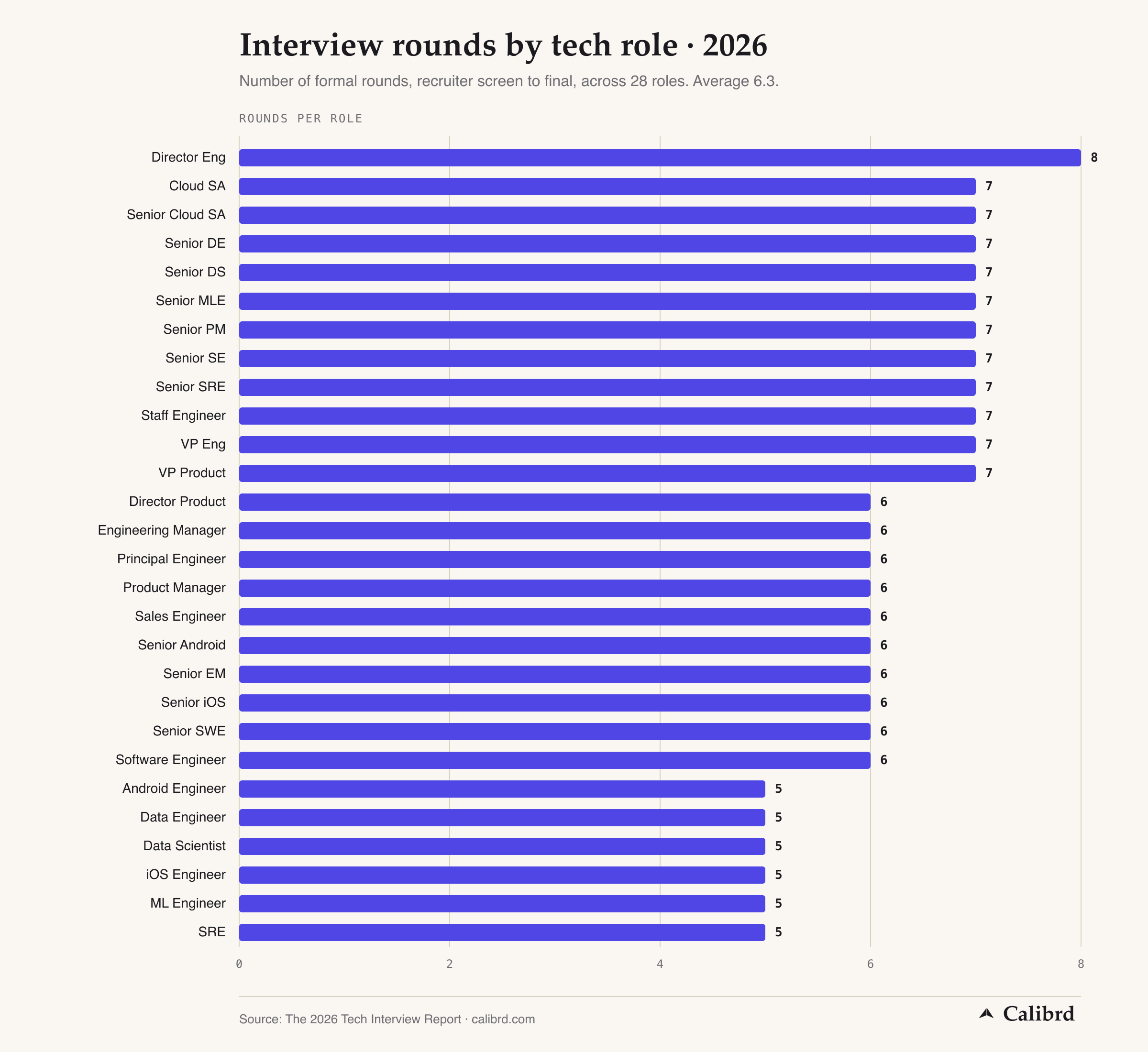
6 rounds · 4–6 weeksMost companies follow a similar pattern for Senior Android interviews. Total calendar time is 4–6 weeks from recruiter screen to offer.
Career narrative, level calibration, surface ownership, pay expectations
Harder problem than L4, usually involves coroutines / Flow composition or a small subsystem (image cache, dependency graph). Production-grade Kotlin expected
Design at sub-app or fleet scale, modularised feature with Gradle structure, large-scale image / video pipeline, on-device personalisation, push at 100M+ devices. Probing on build system, app-size impact, baseline profiles
A surface you own, decision by decision, with a staff engineer pressing hardest on the migration you are halfway through. Views to Compose, LiveData to Flow, one module to many: what you moved first, what you left, and how you kept both alive in the same release
The Android-specific arguments: an API that forces a chatty client on a metered connection, a launch date that lands inside a Play review, a feature that needs a permission the product team has not priced
The rollout you halted, the vitals regression you owned, the junior engineer you took through their first module extraction, and the platform decision you would now reverse
Sample questions you should be ready for
7 of the ones that decide itRepresentative of what companies ask at this level. Every question here can be practised out loud, which is the fastest way to find out whether your answer holds up under follow-ups. Calibrd adds voice practice with coaching on every answer, and a full voice mock interview: a live round with an AI interviewer who has read the role and your CV, then an honest debrief.
- 01“A 200-engineer codebase takes 25 minutes to build clean and every team is blocked on one release train. Restructure it: module granularity, the navigation boundary between features, what you do about the shared UI module everyone edits, and what you expect the build time to be afterwards.”
- 02“Design how you'd integrate and ship an on-device ML model for a feature that needs sub-200ms response time on Pixel 6+. Cover TensorFlow Lite / ML Kit integration, model size against app-size budget, cold-start cost, and how you'd push updated models without a Play Store release.”
- 03“Ship a feature to 100M devices that you may need to switch off within the hour. Cover the config fetch that cannot block cold start, the value you serve on first run offline, how the kill switch reaches a device that has not opened the app, and how this interacts with a staged Play rollout you might halt anyway.”
- 04“Tell me about a migration you led that is still unfinished. What made you start it, and what convinced you to stop where you did?”
- 05“Describe an ANR or vitals regression that reached the field. How did you find it, what did the staged rollout let you do, and what changed in the release process afterwards?”
- 06“Walk me through an argument with a backend team about an API that was cheap on the server and expensive on a phone. How did it end?”
- 07“Tell me about a build-time or app-size problem you owned. What was the number before, what is it now, and who else had to change what they did?”
These are the general ones. Paste a real posting and Calibrd predicts the questions that company asks for that exact role, then interviews you on them.
Predict my questions →Compensation benchmark
US majors · USD · medianTypical pay for Senior Android at major US tech companies, headline numbers in USD. Typical pay in London, Berlin and Singapore is meaningfully lower, and equity varies a lot by company stage.
FAANG L5 Android total pay is typically $400–550k. Tracks the Senior SWE pay range closely. Google L5 Android pays the same band; Meta E5 Android is equivalent to E5 backend.
How to prep
5 tactical tipsLead behavioural answers with the STAR method: Situation, Task, Action, Result. The tips below build on that structure for this specific role.
- Pick 1–2 Android surfaces you've architected and rehearse the deep-dive cold, every design choice, every trade-off, what you'd do differently now
- Be able to draw your app's Gradle module graph from memory and say what a new feature module costs in clean-build time, because the build-system round starts there
- Have the migration stories ready with their numbers: Views to Compose, LiveData to Flow, a monolith to modules. Where you started, what you left behind, and why that was the right place to stop
- Catch up on Now in Android for the last 18 months, Compose, baseline profiles, build-system improvements, Predictive Back
- Read the company's Android engineering blog posts, every senior Android loop has at least one round that benefits from naming patterns the team has shipped
Where do Senior Android candidates fail?
Spot it in a mock firstA few common mistakes that get Senior Android candidates rejected even when they are otherwise strong. Worth catching in a mock interview before they show up in a real one.
Walking through past Android work as "I built X" without naming the architectural decisions that mattered.
Why it fails
The Android bar is ownership of a surface over time, and features are the least of it. "I built the new feed" is mid-level. "The feed dropped frames on mid-range devices because our list was recomposing the whole item on every scroll event, so I moved the state read into the row and the jank disappeared, and that pattern is now the lint rule" is senior: a measurement, a cause, a fix, and something the team kept.
Fix
Take each story to the fork in the road: the library you did not adopt, the module boundary you drew somewhere unpopular, the Compose screen you shipped behind a flag while the Views version stayed. If the only trade-off you can name is that it was faster to build, that was implementation work, so pick a different story.
Talking about Compose as a finished migration, or as a decision somebody else made.
Why it fails
Almost every Android team of any age is part way through: some screens in Compose, some in Views, an interop layer nobody loves, and a recomposition bug that took a week to find. Interviewers know this, and the answer that claims a clean migration reads as either a small app or a story told second-hand. The senior signal is the sequencing: which screens went first and why, what you measured before and after, what you deliberately left in Views, and how the two coexisted in one release without doubling the QA matrix.
Fix
Prepare the migration as a plan rather than a badge: the order you chose, the reason (churn, complexity, test coverage), the interop cost you accepted, the recomposition problem you hit and how you found it with the layout inspector or a trace, and the screens still in Views today because moving them buys nothing.
Doing Android system design without ever mentioning app size, startup time, ANR rate, or Play Store rollout constraints.
Why it fails
L5 Android system design grades on production constraints, not just abstract architecture. A design that doesn't acknowledge APK / AAB size, cold-start budget, ANR risk, or the staged-rollout / kill-switch story signals "thinks like a backend architect who happens to design for Android." The senior pattern is to surface these as first-class constraints.
Fix
In any Android system design at senior bar, name the production constraints up front: app size impact, cold-start budget, ANR risk, Play Store rollout surface (staged %, Play Console regression checks), and the kill-switch / remote-config path. Even 60 seconds on these earns the senior signal.
Recommended resources
No affiliate linksBooks, courses, and tools that come up most often in Senior Android prep.
- 01Android Developers, Architecture Guide →
Official architecture guidance from Google. Re-read the Modularisation and Architecture sections before any senior Android architecture round.
- 02Now in Android sample app + podcast →
Google's reference for current Android architecture patterns at scale. The architecture-decision records (ADRs) in the repo are the highest-leverage.
- 03Gradle build performance guide →
The build-system round's source material: configuration cache, module granularity, and what actually moves clean-build time on a large codebase.
- 04Effective Kotlin (Marcin Moskała) →
Re-read for the senior coding round. Chapters on concurrency and API design are the highest-leverage.
- 05Android Weekly newsletter →
Where the platform argues with itself week to week. Skim the last month before a final round so the Compose, KMP and build-tooling debates are ones you have an opinion in.
- 06Android vitals documentation →
The canonical reference for the crash-free and ANR budgets this guide keeps invoking — including the thresholds where Play starts punishing discoverability.
Frequently asked questions
I'm currently a Android Engineer (L4 / IC3). Should I read this guide or the Android Engineer guide first?
Read the Android Engineer guide first. Companies calibrate L5 / IC4 candidates against the L4 / IC3 bar with a clear scope-gap lens, they want to see where you stand today, then probe the gap up to L5 / IC4. Read this guide AFTER you understand the L4 / IC3 baseline, so you know exactly which signals you need to demonstrate for the step-up.
How long should I prep before my Senior Android onsite?
Four to six weeks of loop, six to eight of prep. Spend most of it on two things the Android bar is actually made of: the module graph of an app you own, drawn from memory with build times attached, and your Compose migration told as a sequence of decisions. Then catch up on Now in Android, because a senior candidate who has not noticed the last eighteen months of the platform is a tell.
What's the most common mistake candidates make at the Senior Android bar?
Answering the platform questions as a generic mobile engineer. The Android-specific failures are the ones that sink loops: no number for clean-build time, a Compose migration described as finished, a design that ignores ANR and vitals, and background work planned as though the OS will let it run.
What if my interview process is different from what's listed?
Most variation is at the edges. Major tech companies (FAANG, scale-ups, mid-size SaaS) follow processes within 1–2 rounds of what's described. Smaller startups often run fewer rounds (3–4) but the bar at each round is similar; less-tech-mature companies sometimes skip system design or behavioural rounds entirely. Read the posting and ask the recruiter on the screening call; they'll tell you what's coming.
How does this guide compare to running a free scan?
This guide covers the general bar at L5 / IC4. The free scan reads one real posting and opens the report right here: the questions that role and company will ask, a pay benchmark matched to the level and, with your CV, the gaps an interviewer will probe and a CV score. No account or email first; the report is on screen in about a minute.
Walk in ready
Walk into your Senior Android interview ready.
Paste your actual job and Calibrd predicts what that company asks for this role, where your CV is thin, and what it should pay. Then rehearse the round out loud with honest feedback until you're confident. Free to start.
Free to start · No card · Encrypted at rest, never used to train AI, remove anytime