2026 update
A few things have changed in 2026. AI is now allowed in coding rounds at Canva and Meta, detection has improved at companies that still ban it, pay has split at staff+, and the post-onsite wait got longer. Read what changed in 2026 →
What you'll be expected to do
What they're grading- Own a feature surface or sub-app end-to-end: architecture, performance budget, release cadence
- Lead 2–4 mid-level iOS engineers technically; review designs, write the conventions others follow
- Drive cross-team decisions on shared modules (networking, image loading, analytics) and SPM packages
- Set the bar for production iOS quality: crash rate targets, performance budgets, App Store review readiness
- Mentor mid-level iOS engineers; participate in iOS interview loops as a regular interviewer
- Partner with backend, design, and product on multi-quarter feature work; influence API design upstream
What does the interview loop look like?
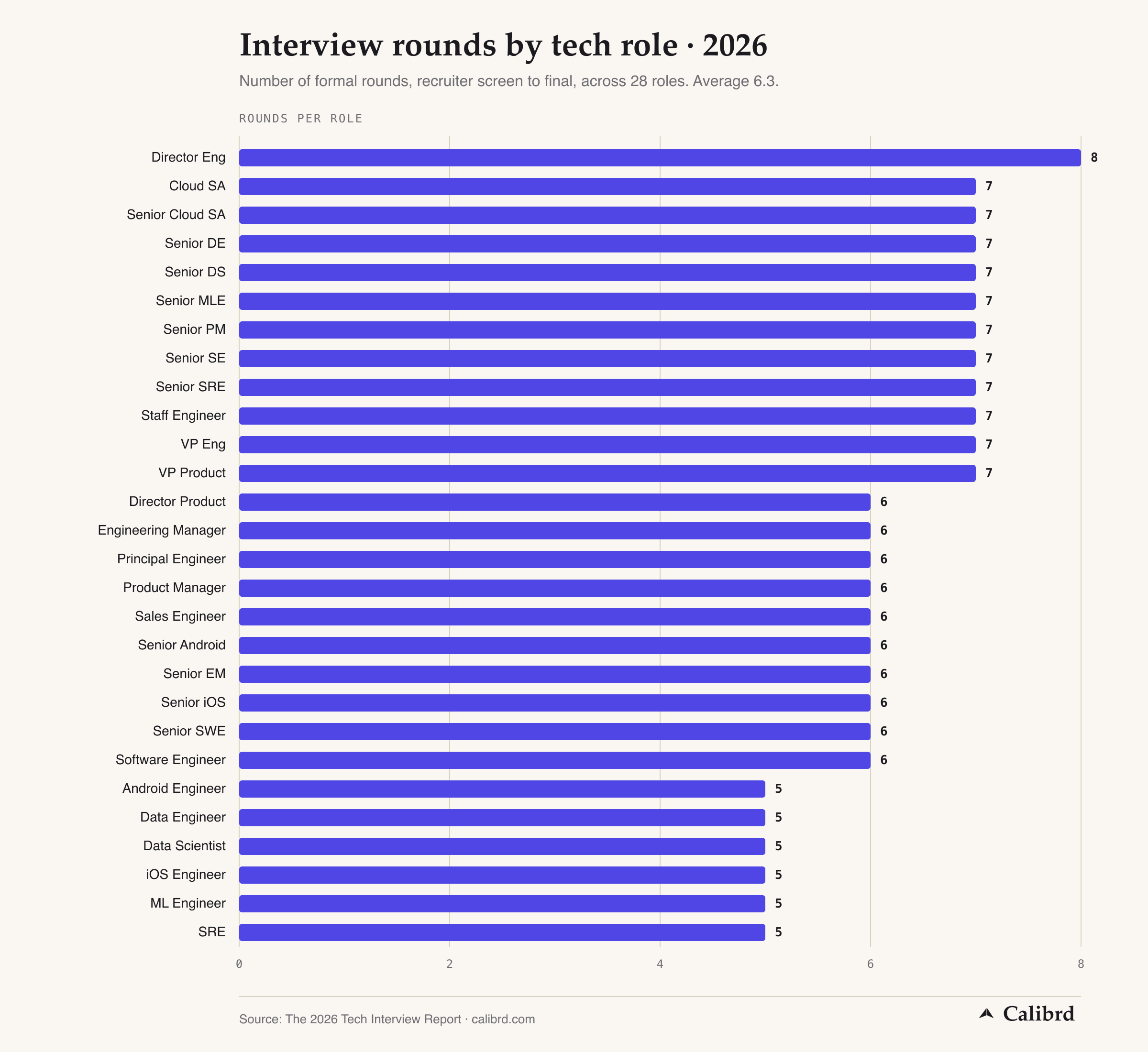
6 rounds · 4–6 weeksMost companies follow a similar pattern for Senior iOS interviews. Total calendar time is 4–6 weeks from recruiter screen to offer.
Career narrative, level calibration, surface ownership, pay expectations
Harder problem than L4, usually involves concurrency or a small subsystem (image cache, dependency graph). Production-grade Swift expected
Design at sub-app or fleet scale, modularised feature module, large-scale image / video pipeline, on-device personalisation, push at 50M+ devices. Probing on build system, app-size impact, A/B framework integration
Pick a feature you've architected; walk through every decision. Bar: staff iOS engineers grilling on choices that look defensible and choices that look like cargo-culting
Operating with senior partners, conflict on API design or rollout strategy, prioritisation under shipping pressure
Architectural reversals, production incidents you led, mentorship, team-level iOS leadership
Sample questions you should be ready for
7 of the ones that decide itRepresentative of what companies ask at this level. Every question here can be practised out loud, which is the fastest way to find out whether your answer holds up under follow-ups. Calibrd adds voice practice with coaching on every answer, and a full voice mock interview: a live round with an AI interviewer who has read the role and your CV, then an honest debrief.
- 01“Design the architecture for a 200-engineer iOS codebase that wants to ship features independently per team. Cover SPM modularisation, build-time impact, and how you'd handle cross-module navigation.”
- 02“Design how you'd integrate and ship an on-device ML model for a feature that needs sub-200ms response time on iPhone 13+. Cover Core ML integration, model size against app-size budget, cold-start cost, and how you'd push updated models without an App Store release.”
- 03“Design a feature-flag and remote-config system for our app, 50M MAUs, needs to handle offline, support gradual rollout, and not block app start. Walk through storage, fetch strategy, and the fallback path.”
- 04“Tell me about an architectural decision you led that you'd reverse 18 months later. What signal told you to revisit it?”
- 05“Describe a production iOS incident you led the response on, crash spike, performance regression, or App Store rejection. Walk through detection, mitigation, and the postmortem.”
- 06“Walk through a time you pushed back on a backend API design. How did you operate through it?”
- 07“Tell me about how you raised the iOS quality bar in your team, performance budgets, lint rules, code-review standards, anything systemic.”
These are the general ones. Paste a real posting and Calibrd predicts the questions that company asks for that exact role, then interviews you on them.
Predict my questions →Compensation benchmark
US majors · USD · medianTypical pay for Senior iOS at major US tech companies, headline numbers in USD. Typical pay in London, Berlin and Singapore is meaningfully lower, and equity varies a lot by company stage.
FAANG L5 iOS total pay is typically $400–550k. Tracks the Senior SWE pay range closely. Apple ICT4 iOS pays slightly above this with a different equity structure; AI-focused mobile work (on-device LLMs, ML features) at frontier companies pays at the higher end.
How to prep
5 tactical tipsLead behavioural answers with the STAR method: Situation, Task, Action, Result. The tips below build on that structure for this specific role.
- Pick 1–2 iOS surfaces you've architected and rehearse the deep-dive cold, every design choice, every trade-off, what you'd do differently now
- Master 3–4 iOS system-design canonical problems at scale: modularisation, on-device ML, feature flags, image / video pipeline. Pattern-match the rest
- Have 6–8 STAR stories tagged across senior signals: architectural reversal, production incident, cross-functional conflict, mentorship, performance work
- Watch the last 3 years of WWDC sessions for the platform features the company uses heavily, interview rounds often probe whether you've kept current
- Read the company's iOS engineering blog posts, every senior iOS loop has at least one round that benefits from naming patterns the team has shipped
Where do Senior iOS candidates fail?
Spot it in a mock firstA few common mistakes that get Senior iOS candidates rejected even when they are otherwise strong. Worth catching in a mock interview before they show up in a real one.
Walking through past iOS work as "I built X" without naming the architectural decisions that mattered.
Why it fails
Senior iOS interviews are calibrated against architectural ownership, not feature counts. "I built the new feed" is a mid-level story. "I argued for a paged data source over reactive recompute because Combine couldn't hit our 16ms frame budget on iPhone 12, and that decision unblocked the team's adoption of SwiftUI for the feed" is a senior story. The senior signal is the choice, not the build.
Fix
For each architecture story, push past "what you built" to "what choice you made and why." If you can't name a specific trade-off, performance vs developer ergonomics, type-safety vs build time, MVVM vs TCA, the project was implementation work, not architecture work. Pick a different story.
Defending an architecture pattern (MVVM, TCA, MVI-style) by saying "that's what the team uses" instead of giving the trade-off rationale.
Why it fails
Senior iOS interviews probe whether you've thought about why your team's pattern works for your team. The pattern itself is rarely the point, the senior signal is whether you understand its trade-offs against alternatives, and would push back if the trade-offs changed. Cargo-culting MVVM "because Apple does" is a downlevel.
Fix
Prep a 60-second defence of your architecture: what it optimises for (testability, build speed, team scalability), what it gives up (boilerplate, learning curve, runtime overhead), and what would make you reconsider. Even if the interviewer prefers a different pattern, the reasoning shows senior-level thinking.
Doing iOS system design without ever mentioning app size, battery, or App Store rollout constraints.
Why it fails
L5 iOS system design grades on production constraints, not just abstract architecture. A design that doesn't acknowledge app size budget, battery drain, App Store review timing, or the staged-rollout / kill-switch story signals "thinks like a backend architect who happens to design for iOS." The senior pattern is to surface these as first-class constraints.
Fix
In any iOS system design at senior bar, name the production constraints up front: app size impact, battery profile (CPU + network + background), App Store review surface (does this need a new entitlement?), and the kill-switch / staged-rollout path. Even 60 seconds on these earns the senior signal.
Recommended resources
No affiliate linksBooks, courses, and tools that come up most often in Senior iOS prep.
- 01WWDC video archive (Apple Developer) →
Re-watch the Performance, Concurrency, and Build System sessions for the last 2 WWDCs, senior iOS rounds probe whether you've kept current on platform changes.
- 02Point-Free (Composable Architecture + Swift deep-dives) →
Best practitioner-led content on advanced Swift and TCA. Useful for the architecture defence in system design rounds, even if you don't use TCA at work, knowing the alternative is the senior signal.
- 03objc.io, Advanced Swift →
Reference for the Swift language details senior iOS rounds probe: generics, protocol witnesses, value semantics, memory layout.
- 04Pragmatic Engineer Newsletter (mobile-engineering issues) →
Cross-company mobile engineering pieces. Useful pattern library for the architecture and modularisation rounds.
- 05iOS Dev Weekly →
Curated weekly newsletter. Skim recent issues before final-stage interviews to be current on platform discourse.
- 06MetricKit documentation (Apple) →
How crash rates, hangs, and launch times are actually measured in production — the numbers behind the performance budgets this level owns.
Frequently asked questions
I'm currently a iOS Engineer (L4 / IC3). Should I read this guide or the iOS Engineer guide first?
Read the iOS Engineer guide first. Companies calibrate L5 / IC4 candidates against the L4 / IC3 bar with a clear scope-gap lens, they want to see where you stand today, then probe the gap up to L5 / IC4. Read this guide AFTER you understand the L4 / IC3 baseline, so you know exactly which signals you need to demonstrate for the step-up.
How long should I prep before my Senior iOS onsite?
The process takes 4–6 weeks. Add 6–8 weeks of prep, the architecture deep-dive is the highest-leverage round. Pick 1–2 surfaces you've owned and rehearse them cold: every choice, every trade-off, every counterfactual. Don't skip the WWDC catch-up.
What's the most common mistake candidates make at the Senior iOS bar?
Describing implementation work as architecture work. Senior iOS interviews are judged against the choices you made, not the features you shipped. Strong L4 "I built X at scale" stories will get you hired a level down if you can't articulate the architectural trade-off behind X.
What if my interview process is different from what's listed?
Most variation is at the edges. Major tech companies (FAANG, scale-ups, mid-size SaaS) follow processes within 1–2 rounds of what's described. Smaller startups often run fewer rounds (3–4) but the bar at each round is similar; less-tech-mature companies sometimes skip system design or behavioural rounds entirely. Read the posting and ask the recruiter on the screening call; they'll tell you what's coming.
How does this guide compare to running a free scan?
This guide covers the general bar at L5 / IC4. The free scan reads one real posting and opens the report right here: the questions that role and company will ask, a pay benchmark matched to the level and, with your CV, the gaps an interviewer will probe and a CV score. No account or email first; the report is on screen in about a minute.
Walk in ready
Walk into your Senior iOS interview ready.
Paste your actual job and Calibrd predicts what that company asks for this role, where your CV is thin, and what it should pay. Then rehearse the round out loud with honest feedback until you're confident. Free to start.
Free to start · No card · Encrypted at rest, never used to train AI, remove anytime