2026 update
A few things have changed in 2026. AI is now allowed in coding rounds at Canva and Meta, detection has improved at companies that still ban it, pay has split at staff+, and the post-onsite wait got longer. Read what changed in 2026 →
What you'll be expected to do
What they're grading- Own a reliability or platform component end-to-end, observability, deploy infrastructure, multi-region failover, the on-call programme itself
- Lead 2–4 SREs or platform engineers technically; review designs, write the docs others align to
- Drive cross-team decisions on incident response, postmortem culture, error-budget policy
- Mentor mid-level SREs; participate in SRE interview loops as a regular interviewer
- Set the bar for production excellence across the org, reliability standards, deployment safety, observability conventions
- Partner peer-to-peer with senior product engineering leadership on architecture decisions
What does the interview loop look like?
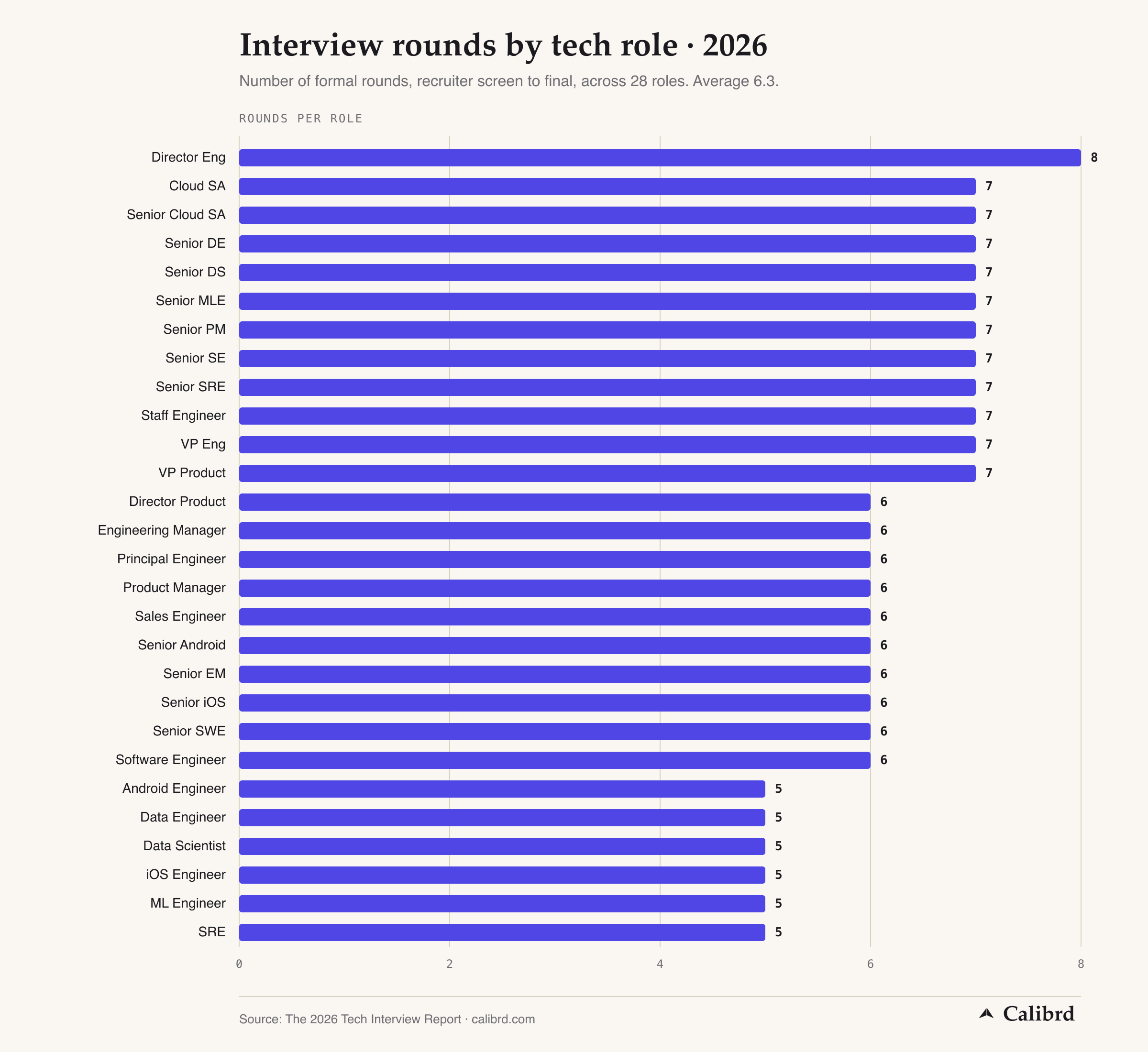
7 rounds · 5–7 weeksMost companies follow a similar pattern for Senior SRE interviews. Total calendar time is 5–7 weeks from recruiter screen to offer.
Career narrative, level calibration, scope of past platforms owned, on-call leadership
Harder coding or a debugging deep-dive, depends on company. Some loops do a project deep-dive instead
Large-scale reliability or platform problem with explicit trade-offs, multi-region active-active, deployment infra for hundreds of services, observability at 1M metrics/second
Either a second design problem OR you walk through a real platform you've architected, the company's existing platform, possibly
Pick a platform project from your CV; spend an hour explaining design, trade-offs, what went wrong in production, what you'd change. Staff engineers will grill every choice
Operating with senior product engineering as a peer, mediating reliability vs feature velocity, error-budget policy enforcement
Team-level technical leadership, on-call programme philosophy, mentoring
Sample questions you should be ready for
7 of the ones that decide itRepresentative of what companies ask at this level. Every question here can be practised out loud, which is the fastest way to find out whether your answer holds up under follow-ups. Calibrd adds voice practice with coaching on every answer, and a full voice mock interview: a live round with an AI interviewer who has read the role and your CV, then an honest debrief.
- 01“Design the observability platform for an organisation with 500 services. Cover metrics, logs, traces, alerting, and how you'd handle the cardinality problem.”
- 02“Design a multi-region active-active platform with eventual consistency and sub-100ms cross-region failover. Walk through replication, conflict resolution, and what your incident response looks like.”
- 03“Design the deployment platform that lets 500 engineers ship to prod 5,000 times a day safely. Cover the canary infrastructure, error-budget enforcement, and the path from commit to prod.”
- 04“Tell me about a multi-quarter platform initiative you led. What changed about how the org operated afterwards?”
- 05“Describe a major production incident you led the response on. What was the org-level impact, and what did you change in postmortem practice afterwards?”
- 06“Walk through an error-budget policy decision you made that froze feature work for a team. How did the conversation with the product VP go?”
- 07“Tell me about a platform technical decision you reversed 18 months later. What signal told you to revisit it?”
These are the general ones. Paste a real posting and Calibrd predicts the questions that company asks for that exact role, then interviews you on them.
Predict my questions →Compensation benchmark
US majors · USD · medianTypical pay for Senior SRE at major US tech companies, headline numbers in USD. Typical pay in London, Berlin and Singapore is meaningfully lower, and equity varies a lot by company stage.
FAANG L5 Senior SRE / Platform total pay is typically $410–560k. Some companies (Google especially) treat SRE as a co-equal ladder with SWE and pay equivalently; at others SRE tracks SWE band closely with a small premium for on-call scope.
How to prep
5 tactical tipsLead behavioural answers with the STAR method: Situation, Task, Action, Result. The tips below build on that structure for this specific role.
- Pick 1–2 platform projects you've owned and rehearse the deep-dive cold, every design choice, every production incident, every counterfactual
- Master 4–5 reliability / platform system design canonical problems at scale: observability, multi-region failover, deploy platform, on-call automation, capacity planning
- Read recent reliability blog posts from the company you're interviewing at, study their incident-response patterns and SLO philosophy
- Have 8–10 STAR stories tagged across senior signals: production incidents, multi-quarter platform investments, error-budget enforcement, cross-functional negotiation
- Prepare a 30/60/90 plan answer, what you'd own and ship in your first 90 days at this specific company's platform
Where do Senior SRE candidates fail?
Spot it in a mock firstA few common mistakes that get Senior SRE candidates rejected even when they are otherwise strong. Worth catching in a mock interview before they show up in a real one.
Walking through past platform work as "I built this observability stack" without naming what changed about how product teams operated.
Why it fails
Senior SRE / Platform interviews are calibrated against organisational impact, not just technical artefacts. "I built a platform" is a mid-level story. "I built the observability platform, and as a result the median time-to-detection across 200 services dropped from 12 minutes to 90 seconds, and three product orgs adopted it within six months" is a senior story. The senior signal is what shipped at the org level, not the platform level.
Fix
For each platform project, push the story past "I built X" to "and as a result, the org did Y differently." If you can't answer what changed organisationally, the project was technical work, not platform leadership. Pick a different story.
Doing system design at staff scale without sizing or naming the cost.
Why it fails
L5 reliability system design rounds grade on whether you reason about scale and cost. A multi-region active-active design that doesn't mention requests/second, data volume, replication lag, or monthly infra spend signals "thinks like a senior IC, hasn't actually rolled anything out at this scale." The pattern note is usually "designed it well in the abstract, no idea if it would be financially viable at our scale."
Fix
Within the first 5 minutes of any platform system design, do the napkin math: services × instances × requests/second, GB/day of telemetry, monthly infra spend, replication lag budget. "500 services × 10 instances × 100 RPS = 500k RPS sustained; 10TB/day of metrics at $X/TB-month." Rough numbers earn senior signal.
Treating the cross-functional product-engineering round as a soft conversation about partnership.
Why it fails
Senior SRE cross-functional rounds probe specifically for friction: a product VP who wants to ship despite the error budget being exhausted, a tech lead whose service repeatedly fails its SLO, a team that wants to bypass the platform's deploy safety mechanisms. Generic "we work well with product" answers signal you haven't operated at the senior level where these conflicts are real.
Fix
Prep 2–3 stories where you held a position with senior product engineering: an error-budget freeze you enforced over their objection, a platform mandate you forced a refactor for, a deployment block you put in place that delayed a launch. Specificity separates senior SRE stories from mid-level "team player" framings.
Recommended resources
No affiliate linksBooks, courses, and tools that come up most often in Senior SRE prep.
- 01Google SRE Workbook →
Re-read for the senior round. Chapters on SLO engineering, alerting, and on-call programme design are the highest-leverage.
- 02Designing Data-Intensive Applications (Kleppmann) →
For multi-region replication, consistency, and partitioning, staple of the senior reliability system design round.
- 03Charity Majors, observability writings →
The most-cited practitioner blog on observability at platform scale. Worth reading before any senior observability design round.
- 04Increment Magazine, On-call issue →
Practitioner-written essays on running modern on-call programmes. Useful for the cross-functional and platform-philosophy rounds.
- 05The Phoenix Project / The Unicorn Project (Kim) →
Narrative on the operating model of high-velocity engineering orgs. Often referenced in senior hiring-manager rounds.
- 06Google SRE Book →
The house reference at every SRE level. Chapter 3 (Embracing Risk) is a senior-round staple: error budgets as an org policy you enforce, not a dashboard you watch.
Frequently asked questions
I'm currently a SRE (L4 / IC3). Should I read this guide or the SRE guide first?
Read the SRE guide first. Companies calibrate L5 / IC4 candidates against the L4 / IC3 bar with a clear scope-gap lens, they want to see where you stand today, then probe the gap up to L5 / IC4. Read this guide AFTER you understand the L4 / IC3 baseline, so you know exactly which signals you need to demonstrate for the step-up.
How long should I prep before my Senior SRE onsite?
The process takes 5–7 weeks. Add 8–12 weeks of prep, the platform system design and project deep-dive rounds are the highest-leverage. Pick 1–2 platforms you've owned and rehearse them cold: every design choice, every production incident, every counterfactual.
What's the most common mistake candidates make at the Senior SRE bar?
Describing service-level reliability work without platform-level framing. Senior SRE interviews calibrate against organisational impact (services adopting your platform, error-budget policy you enforced, incidents that didn't recur because of process you changed). Strong L4 "I fixed this incident" stories will get you hired a level down if you don't frame them around platform decisions.
What if my interview process is different from what's listed?
Most variation is at the edges. Major tech companies (FAANG, scale-ups, mid-size SaaS) follow processes within 1–2 rounds of what's described. Smaller startups often run fewer rounds (3–4) but the bar at each round is similar; less-tech-mature companies sometimes skip system design or behavioural rounds entirely. Read the posting and ask the recruiter on the screening call; they'll tell you what's coming.
How does this guide compare to running a free scan?
This guide covers the general bar at L5 / IC4. The free scan reads one real posting and opens the report right here: the questions that role and company will ask, a pay benchmark matched to the level and, with your CV, the gaps an interviewer will probe and a CV score. No account or email first; the report is on screen in about a minute.
Walk in ready
Walk into your Senior SRE interview ready.
Paste your actual job and Calibrd predicts what that company asks for this role, where your CV is thin, and what it should pay. Then rehearse the round out loud with honest feedback until you're confident. Free to start.
Free to start · No card · Encrypted at rest, never used to train AI, remove anytime