2026 update
A few things have changed in 2026. AI is now allowed in coding rounds at Canva and Meta, detection has improved at companies that still ban it, pay has split at staff+, and the post-onsite wait got longer. Read what changed in 2026 →
What you'll be expected to do
What they're grading- Set technical direction for an engineering function (100+ engineers) or a business-critical platform
- Write the technical strategy docs that the CTO endorses to the board
- Drive multi-year initiatives; own the architecture across acquisitions, re-orgs, and platform shifts
- Represent engineering at the executive level on go/no-go decisions
- Identify multi-year technical risks (scalability ceilings, talent gaps, tech-debt sinkholes) and chart the response
- Be the named expert on a domain, distributed systems, ML infrastructure, security, etc.
What does the interview loop look like?
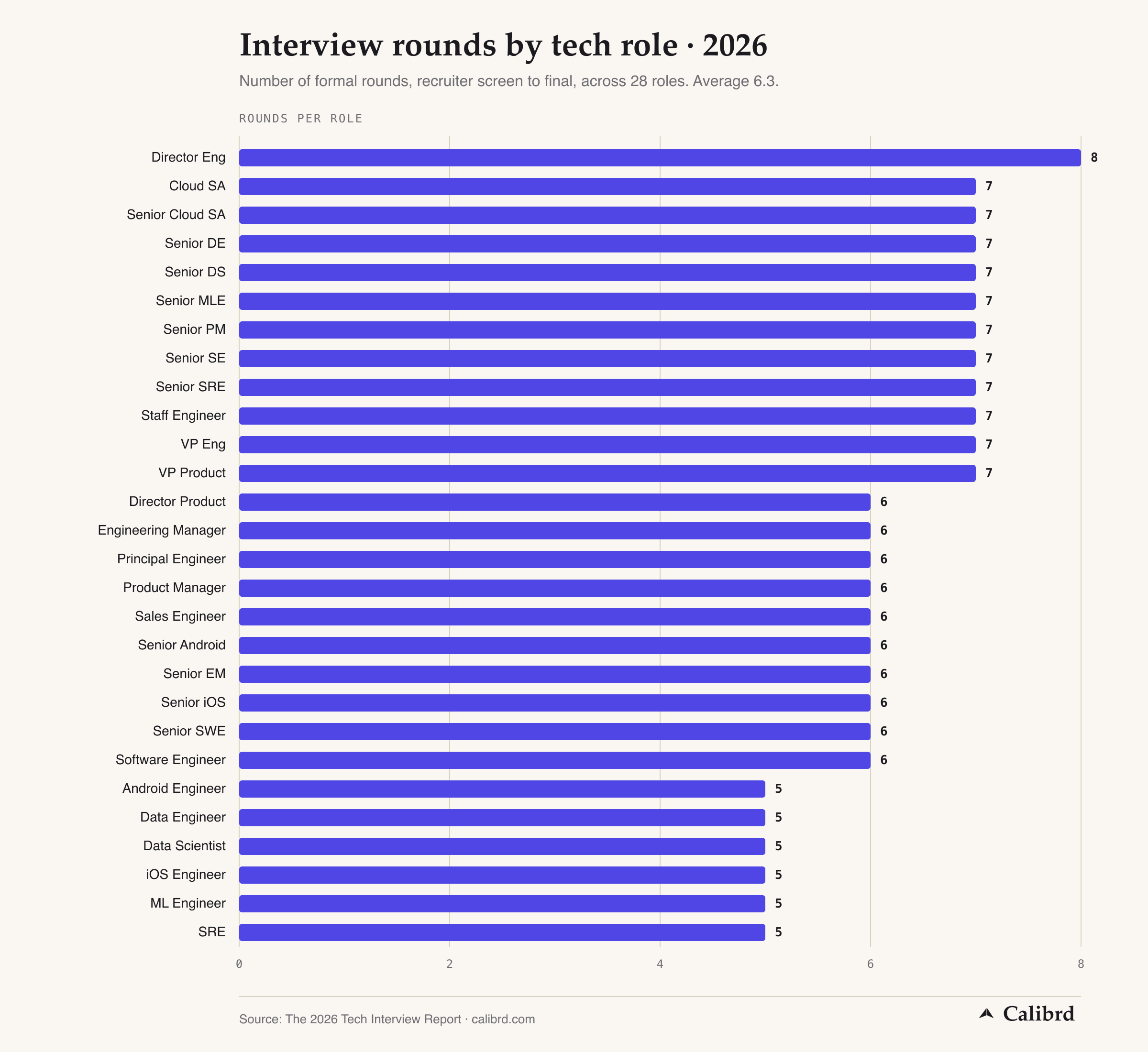
6 rounds · 8–12 weeksMost companies follow a similar pattern for Principal Engineer interviews. Total calendar time is 8–12 weeks from recruiter screen to offer.
Calibration to L7, most companies get warm intros for Principal hires
Why this company, why now, what's your technical vision in this domain
Walk through your most ambitious technical initiative, long-form, no slides constrained, peers grilling
Open-ended design with explicit scope ambiguity, you're being graded on how you scope as much as how you design
Multi-year technical strategy, business judgment, capital allocation
Influence, communication, operating philosophy
Sample questions you should be ready for
6 of the ones that decide itRepresentative of what companies ask at this level. Every question here can be practised out loud, which is the fastest way to find out whether your answer holds up under follow-ups. Calibrd adds voice practice with coaching on every answer, and a full voice mock interview: a live round with an AI interviewer who has read the role and your CV, then an honest debrief.
- 01“Where do you see the most under-invested technical opportunity in our company over the next 3 years?”
- 02“Walk through a technical investment you'd kill in our current architecture, and why.”
- 03“Tell me about a multi-year technical bet you made. How did you sell it internally? Did it pay off?”
- 04“Describe a time you set a technical direction the rest of the org disagreed with. How did you operate through that?”
- 05“Tell me about a business decision you influenced as a Principal Engineer that wasn't strictly technical.”
- 06“Walk through a technical strategy you owned that crossed three or more product organisations. What was the org-design challenge?”
These are the general ones. Paste a real posting and Calibrd predicts the questions that company asks for that exact role, then interviews you on them.
Predict my questions →Compensation benchmark
US majors · USD · medianTypical pay for Principal Engineer at major US tech companies, headline numbers in USD. Typical pay in London, Berlin and Singapore is meaningfully lower, and equity varies a lot by company stage.
FAANG L7 total pay is typically $1.2–2M. Principal hires at scale-ups often come with 0.5–2% equity. Pay varies dramatically by company stage and whether you're hired as a peer to the CTO.
How to prep
5 tactical tipsLead behavioural answers with the STAR method: Situation, Task, Action, Result. The tips below build on that structure for this specific role.
- 01Treat this as a director-level interview, expect strategic and political probing as much as technical
- 02Prepare a one-hour 'company case study' presentation, your view of their technical strategy, gaps, and what you'd change
- 03Have an answer ready on technical investment: which bets you'd make at this company, and what you'd deprecate or consolidate to fund them
- 04Read every public technical blog post the company has published in the last 18 months, be ready to engage on their architecture choices
- 05Be ready for the question 'why are you applying to L7 here instead of CTO at a smaller company?', it always comes up
Where do Principal Engineer candidates fail?
Spot it in a mock firstA few common mistakes that get Principal Engineer candidates rejected even when they are otherwise strong. Worth catching in a mock interview before they show up in a real one.
Going into the VP or CTO round without a clear opinion on what you'd change about the company's technical strategy.
Why it fails
Principal interviews are run by people who already have a thesis on the company. They want to know if yours adds something. "I'd need to learn more first" is a Staff IC answer. The L7 bar is to walk in with a researched POV, even if rough, and defend it under pushback. Without that, you're indistinguishable from a strong Staff.
Fix
Spend a full week before final rounds reading the company's engineering blog, recent earnings calls, and the LinkedIn arcs of their current Principal+ engineers. Form a 3-point POV: here's what I think you're under-investing in, here's what I'd cut, here's a multi-year bet I'd make. Hold it loosely but defend it under pressure.
Answering "which technical bets should we make" with a list of investments and nothing you'd stop.
Why it fails
The Principal-level answer is the trade-off. A wish list of platforms to build, with nothing deprecated, consolidated or wound down to pay for it, tells the interviewer you've never carried the cost of a technical estate. And beware the executive framing: reallocating headcount and budgets is the CTO's move — a Principal moves the technical portfolio. The CTO round grades whether you think in opportunity cost across systems.
Fix
Pair every bet with something you'd retire: "I'd consolidate our three build systems into one and put the freed platform capacity behind the migration", or "I'd deprecate the legacy API this year so we stop paying its maintenance tax". Naming what stops, in systems rather than headcount, is what makes the answer Principal.
Walking into rounds with strong Staff-level stories, system design, project ownership, technical mentoring, and getting downleveled to L6.
Why it fails
Staff-level stories are necessary but not sufficient at L7. The pattern interviewers describe is "great Staff candidate, not Principal yet, I'd hire at L6". The gap is multi-org influence, strategic bets, executive partnership. Without those examples surfaced explicitly, the loop calibrates you against the floor of L7, which is the L6 ceiling.
Fix
Prep 4-5 stories that are explicitly above the Staff ceiling: a multi-year bet you sold to the executive team, a technical decision that crossed three product orgs, a budget conversation where you pushed back on the CFO. If you don't have these stories, the honest answer might be that L7 isn't the right next step yet.
Recommended resources
No affiliate linksBooks, courses, and tools that come up most often in Principal Engineer prep.
- 01The Staff Engineer's Path (Tanya Reilly) →
The canonical book on the staff+ IC track including the principal step. Chapters on big-picture thinking and executing strategy are highest-leverage.
- 02Will Larson's writing on technical strategy →
Multi-year strategy posts on lethain.com. Useful for forming a researched POV on the company you're interviewing at, the central principal expectation.
- 03The Engineering Executive's Primer (Will Larson) →
Principal interviews are essentially director-level technical evaluations. This book covers the executive operating model you'll be probed on.
- 04Pragmatic Engineer Newsletter (Gergely Orosz) →
Practitioner depth for company research and pattern recognition. The deep-dives on FAANG and scale-up engineering practice are the highest-leverage.
- 05Designing Data-Intensive Applications (Kleppmann) →
Still the canonical depth reference for the architecture review round.
Common scenarios
Situations that come up a lotI'm a Staff Engineer (L6) at FAANG and want to interview for Principal (L7). What's the actual scope difference, and how do I know I'm ready?
Roughly: Staff sets technical direction beyond one team and ships outcomes that move multi-team metrics. Principal sets technical direction across multiple teams and ships outcomes that move org-level metrics. The fastest self-test is to look at your last 18 months of work, if your strongest examples are "I led [project] and the team shipped [outcome]", you're solidly Staff. If they're "I set [the engineering approach to X] and 4 other teams adopted it" or "I made the architectural case for [Y] and the VP signed off", you're closer to Principal. The L7 interview specifically probes for influence over people who don't report to you, often across organisational boundaries, your "convinced a peer Staff Engineer to adopt my plan" story matters more than your delivery story. Prep two or three concrete examples of multi-team or org-level decisions you shaped, with names (anonymised), specific friction points, and the outcome a year later. If you can't name two, you're probably not L7 yet. Easier to upgrade from a Staff offer than to be hired a level down after a Principal rejection.
Does L7 / Principal still write code, or is it all whiteboards and design docs by then?
Honest answer: it depends entirely on the company and the team. At Google or Meta, most L7 ICs still write production code, maybe 20–40% of their time, mostly in the strategic parts of the codebase (compilers, ML infra, core libraries) where their judgment is highest-leverage. At AWS or Microsoft, Principals lean heavier toward architecture reviews and design docs with less hands-on coding. At startups, Principal often means "the senior engineer who's still shipping when the EM is in meetings". For interview prep, this matters because the coding round is still there at L7, usually one round, often closer to a Senior bar than the Staff system-design depth, and Principals who haven't coded in two years sometimes flunk it. If you've drifted away from code, spend two weeks back in it before the interview. The behavioural and strategy rounds will expect a credible "yes, I still ship" answer too, "I haven't touched code in 18 months" is a signal you will be hired a level down even when the rest of the loop goes well.
I'm a Principal at a 200-person Series C startup. Should I expect a clean Principal title at FAANG, or are these levels not comparable?
Be ready for friction. FAANG Principal (L7 at Google, E7 at Meta, Senior Principal at AWS) is roughly equivalent in scope to a startup's CTO at a 50-person company, not its Principal at a 200-person one. Startup titles inflate; FAANG levels are calibrated against a much wider candidate pool. The most common landing is FAANG Staff (L6), same total pay band, a slightly lower title, and many startup Principals take that intentionally to learn the scale. The interview signals that get you to FAANG Principal directly: cross-org technical decisions with named senior peer influence, a multi-quarter platform initiative that survived org changes, executive-level technical strategy ownership. If your role has been "the most senior engineer in the room making architectural decisions", that's a Staff signal at FAANG, not Principal. Don't argue level in the screen, interview at the level the recruiter offers, perform, and re-level downstream if the loop goes well. Re-levelling up after a strong loop is normal; being hired a level down after a stretched-level loop is much harder to come back from.
I was laid off six months ago from a Principal role and the market for L7 is brutal. Should I drop to Staff for the next role?
Calibrated answer: a 6-month gap at the Principal level is starting to be costly but not yet disqualifying, interviewers in 2026 have seen enough senior layoffs to treat them as macro, not signal. Twelve months is where it gets noticeably harder. The dropping-to-Staff question is mostly about your runway and emotional capacity, not strategy. If you can hold out another 3–4 months on Principal interviews and have a strong network warm-intro pipeline, hold. If you're at the point where rejection fatigue is degrading your interview performance, take the Staff offer, re-levelling up from inside a strong company is achievable within 12–18 months, and the loop is calibrated against a known recent peer (you), which makes it easier than an external Principal interview. Don't take a Senior offer to break the streak, going two levels down at this point on the ladder is a re-entry trap that's hard to climb back from. In the interviews, lead with the project you're proudest of in the last role and what you'd do differently with hindsight; don't lead with the layoff.
I've been a Principal for 4 years and feel stuck. Should I try for Distinguished / Fellow, or move into management, or jump companies?
The honest framing is that Distinguished / Fellow / VP-IC roles are about 1/10th as common as Principal, and they're earned more than interviewed for, most are internal promotions on the back of a multi-year track record, not lateral hires. If your current company has the ladder, ask for clarity on what specific multi-year impact gets you there, and decide if that's the work you actually want. Lateral hiring at Distinguished is genuinely rare and often comes via specific projects (founding member, key acquisition target) rather than a standard loop. Moving into management is a 1–2 year skill rebuild and most engineers who do it for the title regret it within 18 months, only switch if you're already doing the work (mentoring 4+ people, owning hiring, mediating conflict) and want more of it. The most common move from "stuck Principal" is actually a sideways jump to a different domain at the same level, new technical surface, fresh impact, same pay band, doesn't reset the seniority clock. Boredom often reads as a ladder problem and is usually a scope problem.
Frequently asked questions
I'm currently a Staff Engineer (L6 / IC5). Should I read this guide or the Staff Engineer guide first?
Read the Staff Engineer guide first. Companies calibrate L7 / IC6 candidates against the L6 / IC5 bar with a clear scope-gap lens, they want to see where you stand today, then probe the gap up to L7 / IC6. Read this guide AFTER you understand the L6 / IC5 baseline, so you know exactly which signals you need to demonstrate for the step-up.
How long should I prep before my Principal Engineer onsite?
The process takes 8–12 weeks. Add 8–12 weeks of prep, the strategy round is the hardest piece. Research the company's technical landscape, build an opinion, draft a multi-year POV you can defend.
What's the most common mistake candidates make at the Principal Engineer bar?
Being too tactical. Principal interviewers expect strategic and capital-allocation thinking, multi-year bets, executive influence, where to invest $10M of engineering. Strong Staff IC answers will get you downleveled here.
What if my interview process is different from what's listed?
Most variation is at the edges. Major tech companies (FAANG, scale-ups, mid-size SaaS) follow processes within 1–2 rounds of what's described. Smaller startups often run fewer rounds (3–4) but the bar at each round is similar; less-tech-mature companies sometimes skip system design or behavioural rounds entirely. Read the posting and ask the recruiter on the screening call; they'll tell you what's coming.
How does this guide compare to running a free scan?
This guide covers the general bar at L7 / IC6. The free scan reads one real posting and opens the report right here: the questions that role and company will ask, a pay benchmark matched to the level and, with your CV, the gaps an interviewer will probe and a CV score. No account or email first; the report is on screen in about a minute.
Walk in ready
Walk into your Principal Engineer interview ready.
Paste your actual job and Calibrd predicts what that company asks for this role, where your CV is thin, and what it should pay. Then rehearse the round out loud with honest feedback until you're confident. Free to start.
Free to start · No card · Encrypted at rest, never used to train AI, remove anytime