2026 update
A few things have changed in 2026. AI is now allowed in coding rounds at Canva and Meta, detection has improved at companies that still ban it, pay has split at staff+, and the post-onsite wait got longer. Read what changed in 2026 →
What you'll be expected to do
What they're grading- Own technical architecture relationships with enterprise / strategic accounts (Fortune 500-tier, multi-million ARR)
- Lead architecture deep-dives and multi-year cloud-adoption planning with customer executive leadership
- Mentor 3–5 mid-level Cloud SAs technically; review their architecture proposals and POCs
- Drive product feedback from enterprise field signal; influence the cloud platform roadmap on customer-driven priorities
- Represent the platform at customer conferences, industry events, and analyst briefings
- Partner with strategic-account Account Managers and Customer Success leadership on multi-year customer plans
What does the interview loop look like?
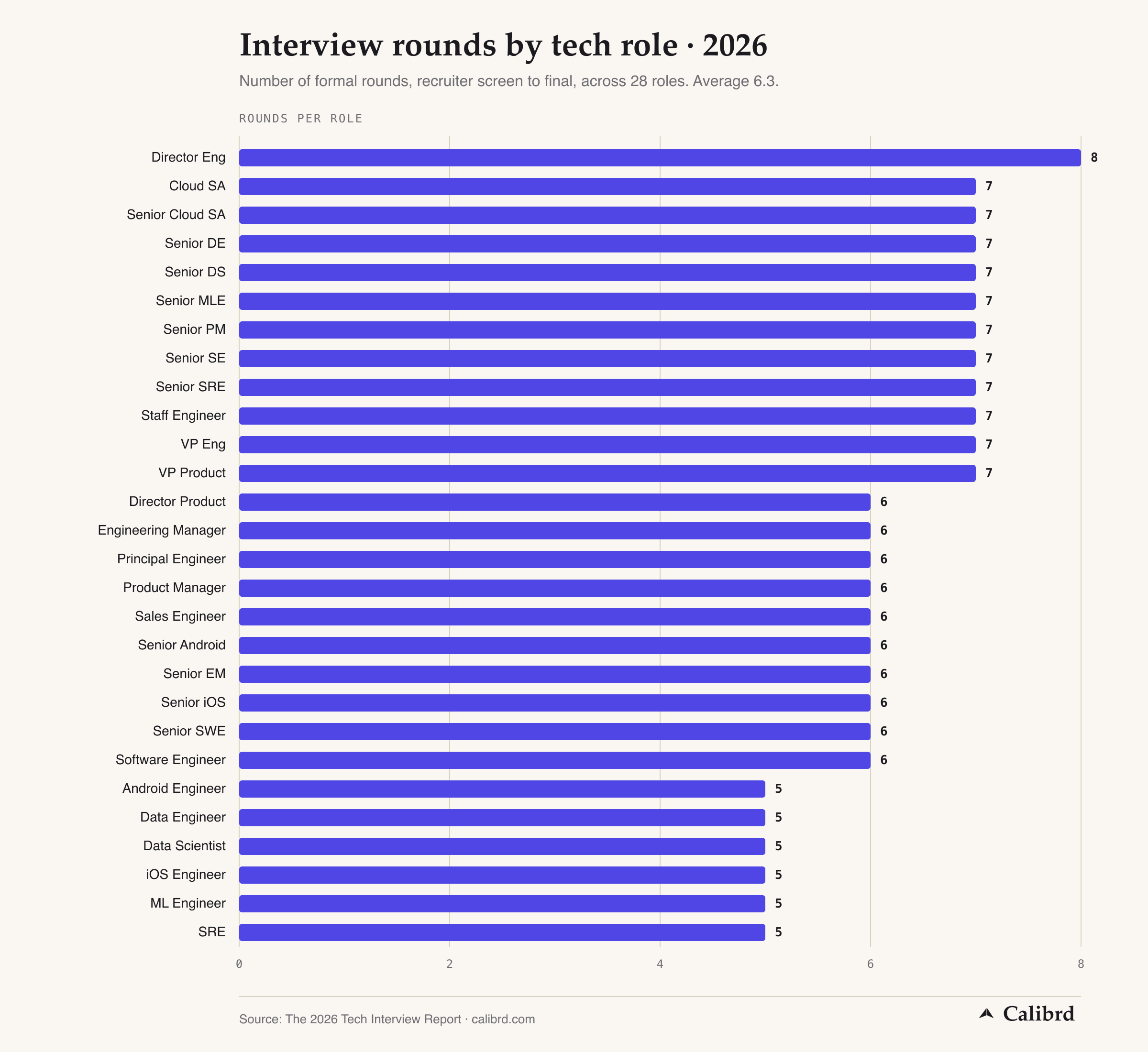
7 rounds · 6–10 weeksMost companies follow a similar pattern for Senior Cloud SA interviews. Total calendar time is 6–10 weeks from recruiter screen to offer.
Calibration to senior level, scope of past enterprise accounts, pay expectations
Recent strategic wins, philosophy on enterprise cloud adoption, why this platform
Walk through an enterprise architecture you've owned. The panel grills on customer politics, technical trade-offs, cost-optimisation work, and what you'd do differently with hindsight
A strategic-account simulation, Fortune 500 CTO is evaluating multi-cloud, your platform vs incumbent + a competitor. You scope the situation and propose your approach
How you escalate field signal to product, balance customer demands with platform roadmap, partner across functions at senior level
AWS-specific: deep-dive STAR stories against 4–6 LPs. Azure / GCP have their own variants
Hiring manager's manager probes scope ambition, technical-evangelism stories, and fit for the SA discipline at scale
Sample questions you should be ready for
10 of the ones that decide itRepresentative of what companies ask at this level. Every question here can be practised out loud, which is the fastest way to find out whether your answer holds up under follow-ups. Calibrd adds voice practice with coaching on every answer, and a full voice mock interview: a live round with an AI interviewer who has read the role and your CV, then an honest debrief.
- 01“A Fortune 100 bank wants to migrate their core trading platform to your cloud. 1.5PB of data, sub-millisecond latency requirements, regulatory audit and explainability. Walk me through how you'd structure the architectural conversation across the first 90 days, and what reference design you'd propose.”
- 02“A streaming customer wants to consolidate 4 data platforms into one on your cloud. 50PB total data, 3000 engineers, mixed batch + real-time + ML workloads. Walk me through the migration architecture and the operating-model changes you'd recommend alongside it.”
- 03“Your platform just launched a new compute service that overlaps with the customer's existing investment in your platform's older compute. Walk me through how you'd brief a strategic customer on when to migrate, when to stay, and how to think about the cost trade-off.”
- 04“Your platform is losing strategic accounts to a competitor with better multi-cloud orchestration. Walk me through what you'd push product to prioritise, and how you'd brief the field on positioning in the meantime.”
- 05“How do you decide which architecture practices to standardise across your team's accounts vs. let each Cloud SA tailor for their customer?”
- 06“If you ran the Cloud SA practice at this company for a year, what would you change first and why?”
- 07“Tell me about a strategic-account architecture you owned that started troubled. What was wrong, and how did you turn it around?”
- 08“Describe a customer where you pushed back on a request from their CTO. How did the conversation go, and what was the outcome?”
- 09“Walk through a time you escalated a feature gap to platform product engineering. What was the gap, how did you frame the business case, and what shipped because of it?”
- 10“Tell me about mentoring a mid-level Cloud SA through a strategic account. What was the specific thing you taught, and how did you know it landed?”
These are the general ones. Paste a real posting and Calibrd predicts the questions that company asks for that exact role, then interviews you on them.
Predict my questions →Compensation benchmark
US majors · USD · medianTypical pay for Senior Cloud SA at major US tech companies, headline numbers in USD. Typical pay in London, Berlin and Singapore is meaningfully lower, and equity varies a lot by company stage.
AWS L6 Senior Cloud SA total pay is typically $390–550k. Azure Principal Solutions Architect / GCP Senior Cloud Architect equivalent. Snowflake / Databricks Senior Solutions Architect pays $350–500k OTE. Variable pay at AWS at this level is smaller than pure-SE roles. London Senior Cloud SA total pay ~£210–290k.
How to prep
5 tactical tipsLead behavioural answers with the STAR method: Situation, Task, Action, Result. The tips below build on that structure for this specific role.
- Pick 1–2 enterprise architectures you've owned and rehearse the deep-dive cold, every customer politics moment, every cost-optimisation decision, every counterfactual
- Re-read the platform's Well-Architected Framework alongside recent customer case studies, senior rounds expect you to know both the principles and the patterns
- Have 12–15 STAR stories tagged across senior signals: strategic account turn-around, customer political moment, feature gap escalated, Cloud SA mentored, competitive displacement
- For AWS specifically: drill the 16 Leadership Principles at depth. Senior LP rounds probe with multi-layer follow-ups, "and then what happened?", until they find the seam
- Read recent product, engineering, and field blog posts from the platform you're interviewing at, senior loops expect you to have an opinion on direction
Where do Senior Cloud SA candidates fail?
Spot it in a mock firstA few common mistakes that get Senior Cloud SA candidates rejected even when they are otherwise strong. Worth catching in a mock interview before they show up in a real one.
Walking through past enterprise architectures as "I designed X" without naming the customer politics or stakeholder dynamics that shaped the design.
Why it fails
Senior Cloud SA interviews calibrate against the enterprise-customer relationship, not just the technical artefact. "I designed the platform for Customer X" is a mid-level story. "Customer X's CTO had committed to a competing platform 18 months earlier, I owned the technical relationship that turned the renewal around by surfacing a compliance gap his team hadn't fully scoped" is a senior story. The senior signal is the stakeholder dynamics behind the design.
Fix
For each architecture story, push past "what you designed" to "who you needed to convince and how the political dynamics shaped the technical choices." If you can't name a specific moment of stakeholder pushback or alignment-building, the project was implementation work, pick a different story.
Doing senior architecture deep-dives without ever discussing cost optimisation or commit decisions.
Why it fails
Senior Cloud SAs are calibrated against multi-year TCO thinking, not just architecture correctness. An enterprise account deep-dive that doesn't cover the commit / reserved-instance / committed-use planning, the regional-distribution cost trade-offs, or the data-tier optimisation work signals "strong on architecture, doesn't yet think like an enterprise customer's CFO." The senior pattern is to surface cost as a first-class constraint from minute one.
Fix
In any senior architecture deep-dive, name the commit and cost-optimisation decisions explicitly: "We committed to X amount of reserved capacity in year one to lock in pricing, with Y% reserved for variable workloads. Data tiering saved $Z/month at year-two scale." Even rough numbers earn the senior signal.
Treating the cross-functional product-engineering round as a soft conversation about partnership.
Why it fails
Senior Cloud SA cross-functional rounds probe specifically for friction: a platform product leader who deprioritised a feature you needed, a customer's CTO who lost faith after a release issue, an engineering team whose API changes broke your customer's integration. Generic "we partner well with product" answers signal you haven't operated at the senior level where these conflicts are real.
Fix
Prep 2–3 stories where you held a position with senior product / engineering leadership: a feature you forced onto the roadmap because customer data demanded it, an architecture decision you reversed after engineering pushback, a release-notes warning you negotiated for. Specificity here separates senior Cloud SA stories from mid-level "team player" framings.
Recommended resources
No affiliate linksBooks, courses, and tools that come up most often in Senior Cloud SA prep.
- 01AWS Well-Architected Framework →
Re-read for the senior round. Chapters on cost optimisation, performance efficiency, and operational excellence are the highest-leverage at L5+.
- 02Azure Cloud Adoption Framework →
Enterprise-adoption-focused content. The strategy and plan sections come up in senior Azure SA strategic-account rounds.
- 03GCP Architecture Framework →
Re-read the operational excellence and reliability pillars before senior GCP SA interviews.
- 04AWS re:Invent keynotes + architecture sessions →
Senior AWS SA rounds expect you to know recent platform direction. Watch the keynote + 5–6 architecture deep-dive sessions before final-stage interviews.
- 05Designing Data-Intensive Applications (Kleppmann) →
Foundational. Re-read chapters 5–11 for the senior architecture-review topics: replication, partitioning, consistency, stream processing.
- 06Cloud FinOps, 2nd Edition (Storment & Fuller) →
The reference for the commit, reserved-capacity, and TCO strategy conversations the enterprise rounds hinge on. Read it to think like the customer's CFO.
Frequently asked questions
I'm currently a Cloud SA (L4 / IC3). Should I read this guide or the Cloud SA guide first?
Read the Cloud SA guide first. Companies calibrate L5 / IC4 candidates against the L4 / IC3 bar with a clear scope-gap lens, they want to see where you stand today, then probe the gap up to L5 / IC4. Read this guide AFTER you understand the L4 / IC3 baseline, so you know exactly which signals you need to demonstrate for the step-up.
How long should I prep before my Senior Cloud SA onsite?
The process takes 6–10 weeks. Add 8–12 weeks of prep, the enterprise architecture deep-dive and AWS Leadership Principles rounds (if applicable) are the highest-leverage. Pick 1–2 enterprise accounts you've owned and rehearse them cold.
What's the most common mistake candidates make at the Senior Cloud SA bar?
Describing tactical architecture work as strategic. Senior Cloud SA interviews calibrate against the customer relationship and multi-year planning, not the technical artefact. Strong L4 "I designed this reference architecture" stories will get you hired a level down if you can't articulate the enterprise-customer politics and cost-strategy work behind them.
What if my interview process is different from what's listed?
Most variation is at the edges. Major tech companies (FAANG, scale-ups, mid-size SaaS) follow processes within 1–2 rounds of what's described. Smaller startups often run fewer rounds (3–4) but the bar at each round is similar; less-tech-mature companies sometimes skip system design or behavioural rounds entirely. Read the posting and ask the recruiter on the screening call; they'll tell you what's coming.
How does this guide compare to running a free scan?
This guide covers the general bar at L5 / IC4. The free scan reads one real posting and opens the report right here: the questions that role and company will ask, a pay benchmark matched to the level and, with your CV, the gaps an interviewer will probe and a CV score. No account or email first; the report is on screen in about a minute.
Walk in ready
Walk into your Senior Cloud SA interview ready.
Paste your actual job and Calibrd predicts what that company asks for this role, where your CV is thin, and what it should pay. Then rehearse the round out loud with honest feedback until you're confident. Free to start.
Free to start · No card · Encrypted at rest, never used to train AI, remove anytime