2026 update
A few things have changed in 2026. AI is now allowed in coding rounds at Canva and Meta, detection has improved at companies that still ban it, pay has split at staff+, and the post-onsite wait got longer. Read what changed in 2026 →
What you'll be expected to do
What they're grading- Research target accounts and find the people most likely to buy
- Open conversations by phone, email and LinkedIn, and book first meetings for Account Executives
- Qualify interest on the first call so the Account Executive gets meetings worth taking
- Log every call, email and meeting in the CRM so the team can see what works
- Hit a monthly target, usually counted in qualified meetings or new opportunities
- Learn the product and the buyer well enough to move up to an Account Executive role
What does the interview loop look like?
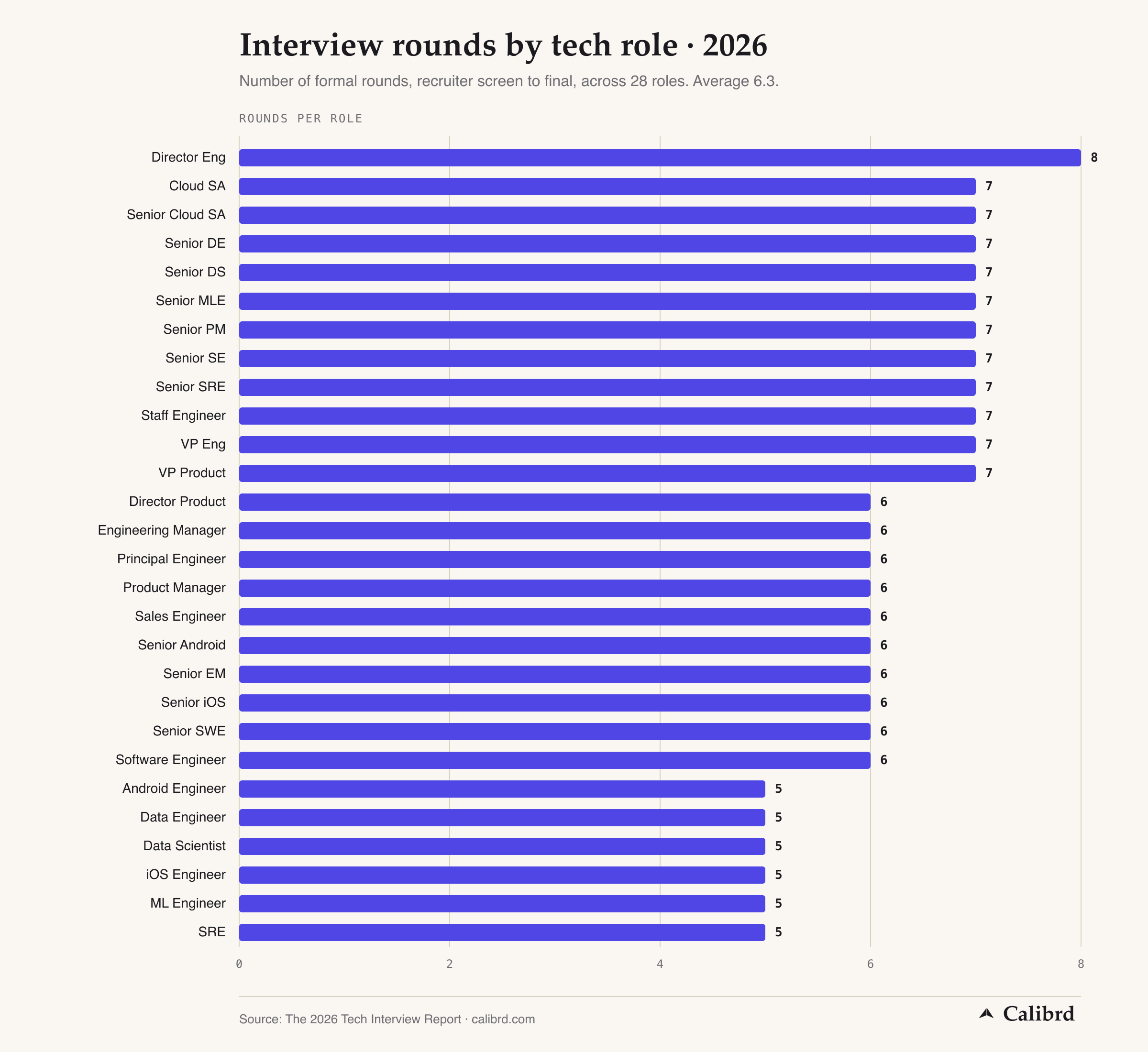
5 rounds · 1–3 weeksMost companies follow a similar pattern for SDR interviews. Total calendar time is 1–3 weeks from recruiter screen to offer.
Why sales, why this company, what you did before, and your pay expectations
What they're scoring
- How you sound on a call, because the phone is most of the job
- One clear reason you want a job where most conversations end in a no
Behavioural and scenario questions: targets you chased, rejection you handled, how you learn a new subject fast
What they're scoring
- A real story about working towards a number, with the number in it
- What you did the day after something went badly
- Questions about how the team is measured and coached
Write to a prospect such as a CFO and try to get a meeting
What they're scoring
- A reason to write that is about the buyer's company, found through research
- Short enough to read on a phone, with one clear ask
You call the manager, who plays a busy prospect and pushes back once or twice
What they're scoring
- The reason for the call comes out in the first 30 seconds, followed by a specific meeting time
- A question back when the prospect says no
- A visibly different second attempt after the manager gives you feedback
Fit with the team, and the questions you ask about ramp, targets and promotion
Sample questions you should be ready for
6 of the ones that decide itRepresentative of what companies ask at this level. Every question here can be practised out loud, which is the fastest way to find out whether your answer holds up under follow-ups. Calibrd adds voice practice with coaching on every answer, and a full voice mock interview: a live round with an AI interviewer who has read the role and your CV, then an honest debrief.
- 01“Here is our website. Who would you call first at a 500-person logistics company, and why that person?”
- 02“Write me a cold email to the Head of Finance at a company that just raised a Series B. You have ten minutes.”
- 03“I'm a VP of Sales and I've picked up your call. I have two minutes. Go.”
- 04“Why do you want to start your career in sales, and why as an SDR?”
- 05“Tell me about a time you had a target and were behind halfway through. What did you do?”
- 06“Tell me about a time you got a lot of rejection. How did you keep going?”
These are the general ones. Paste a real posting and Calibrd predicts the questions that company asks for that exact role, then interviews you on them.
Predict my questions →How to answer the hardest ones
Worked approachesThe structure and the level of detail interviewers expect on the questions that decide this loop. The numbers are placeholders, so swap in your own.
“Why do you want to start your career in sales, and why as an SDR?”
Answer in three short parts. First, the thing about the work you want: being paid on results, learning how companies buy, or a clear path to closing deals. Second, one piece of proof from your past that you already like that kind of work, with a number in it, from a job, a sport, a society or a side project. Third, why this company: the buyer you would be calling and why you think they need the product. Keep it under a minute. Finish by saying you want to become an Account Executive, because SDR managers hire for that path and like to hear you have thought about it.
“Here is our website. Who would you call first at a 500-person logistics company, and why that person?”
Show the research an SDR does before a call. Start with the problem the product solves and the job title that feels that problem every week. Then name the person who can say yes to a first meeting, which is often the head of that team. Give one reason to call now, such as job postings, a funding round, a new site or a leadership change. Finish with the opening line you would use. Interviewers are checking that you connect a person, a problem and a reason, in that order.
Compensation benchmark
US majors · USD · medianTypical pay for SDR at major US tech companies, headline numbers in USD. Typical pay in London, Berlin and Singapore is meaningfully lower, and equity varies a lot by company stage.
The Bridge Group's 2025 survey of 351 B2B companies puts median SDR on-target earnings (OTE) at $80k: $55k base and $25k variable, a 68/32 split (read 30 Sep 2026). London SaaS SDRs see £38–48k base and £58–78k OTE, per the recruiter Live Digital (May 2026). Paris junior business developers earn €26–35k fixed plus €5–10k variable, often capped (Monsieur Lead, Aug 2025).
How to prep
5 tactical tipsLead behavioural answers with the STAR method: Situation, Task, Action, Result. The tips below build on that structure for this specific role.
- Run the mock cold call out loud at least five times before the interview, with a friend playing a rude prospect. Record one and listen for the pause before your ask
- Research the company the way you would as an SDR: who buys the product, what job title signs off, and one recent event at a customer that gives a reason to call
- Bring numbers from whatever you did before: shifts covered, sales made in retail, society members recruited, fundraising totals. Managers hire people who already count their own activity
- Prepare a two-sentence answer to 'why sales' that names something about the work itself, such as being paid on results or learning a market fast
- Ask the manager how long SDRs usually take to get promoted and how the team is coached. It shows you are planning to stay and improve
The cold call opening for the mock call
Bring this to the roundMost SDR loops include a short role-play where the manager plays the prospect. The first 30 seconds decide whether you get to the ask. This structure follows the telephone framework in Jeb Blount's Fanatical Prospecting; the words have to be yours.
Use their name. Say the prospect's name first. It gets attention and confirms you have the right person.
Say who you are and why you are calling. Your name, your company, and 'I'm calling because', all in one breath. Do not ask how they are doing and do not pause.
Give them a reason. One line about their company that makes the call worth their time: a hiring spree, a new product, a problem similar companies report.
Ask for a specific meeting. Name the length and the time, such as '15 minutes on Thursday at 10'. A vague 'sometime next week' is easy to turn down.
Stop talking, then handle the no. Let them answer. If they push back, acknowledge it in a few words, ask one question about their situation, and ask for the meeting again.
Where do SDR candidates fail?
Spot it in a mock firstA few common mistakes that get SDR candidates rejected even when they are otherwise strong. Worth catching in a mock interview before they show up in a real one.
Opening the mock cold call with a long pitch, pausing after the introduction, and never asking for a meeting.
Why it fails
The role-play exists to check the one thing the job needs every day: can you earn thirty more seconds and then ask for time. A pause after 'how are you today' invites the hang-up, and a pitch with no ask gives the manager nothing to score. Jeb Blount's rule in Fanatical Prospecting is to say who you are, why you are calling and what you want without stopping, then stop talking and let the prospect answer.
The losing answer
“"Hi, is this Sarah? Great, how are you today? So I'm calling from Acme, we're a platform that helps finance teams automate their processes with AI and we work with lots of companies like yours and we have integrations with all the major ERPs and..."”
The winning answer
“"Hi Sarah, it's Alex from Acme. I'll be quick: I'm calling because you just opened two finance roles, and teams hiring that fast usually tell us month-end close is where it hurts. Could we take 15 minutes on Thursday at 10 to see if that's true for you?"”
Fix
Script only the first 20 seconds: name, reason, one line on why it matters to them, and a specific ask such as 'Could we take 15 minutes on Thursday at 10?'. Then be quiet and wait.
Answering 'why sales?' with 'I'm a people person' or 'I'm really competitive'.
Why it fails
Every candidate says it, so it gives the manager nothing to remember and nothing to check. SDR managers are looking for a reason that survives a month of rejection: you want to be paid on what you produce, you want to learn how companies buy, you want the Account Executive job in two years. A reason about the work tells them you know what the job is.
The losing answer
“"I've always been a people person and I'm really competitive, so I think sales would be a great fit for me."”
The winning answer
“"I want a job where my results are visible every week. In my bar job I tracked my own upsell rate and got it from about one table in ten to one in four over a summer. I'd like to do that with something bigger, and move into an Account Executive role within two years." (The numbers here are illustrative; use your own.)”
Fix
Name one thing about the work itself that you want, and one piece of evidence from your past that you like that kind of work.
Having no story about rejection or a missed target, or telling one where nothing went wrong.
Why it fails
Most prospecting calls and emails get no reply or a no, and managers know the people who leave the job early are the ones who take that personally. A story where you were never really behind tells them nothing about how you will react in your third week. They want one real setback, what you changed, and what happened next.
The losing answer
“"I don't really get discouraged. I just stay positive and keep pushing."”
The winning answer
“"I ran fundraising for my university society and after two weeks we'd raised £300 of a £2,000 goal. I stopped sending the group email and called 40 alumni myself, kept a sheet of who said no and why, and changed my ask after the first ten calls. We finished at £1,700. I missed the goal, but I learned that a short call with a clear ask beats a long email." (The numbers here are illustrative; use your own.)”
Fix
Pick one time you fell short of something you cared about, say plainly what went wrong, and spend most of the answer on what you did differently afterwards.
Defending your first role-play attempt when the manager gives feedback, or running the second attempt exactly like the first.
Why it fails
Managers often give one piece of feedback after the mock call and ask you to try again, and they score how much the second attempt changes. It is the closest thing to watching you in your first month, when you will be coached on calls every week. Explaining why your first version was fine tells them you will be hard to coach.
Fix
Say thank you, repeat the feedback back in one line, and make that one change obvious in the second attempt, even if the rest is rougher.
Recommended resources
No affiliate linksBooks, courses, and tools that come up most often in SDR prep.
- 01Fanatical Prospecting (Jeb Blount) →
The standard book on prospecting. Read the telephone chapters before the mock cold call.
- 02Predictable Revenue (Aaron Ross and Marylou Tyler) →
The book that described the split between prospecting and closing at Salesforce, which is where the SDR role comes from.
- 03Jeb Blount on phone prospecting (InsideSales) →
A short interview covering the call framework and why pausing loses the call. Good the night before a role-play.
- 04Surviving your first 90 days as an SDR (Predictable Revenue) →
What the job looks like in the first three months, so you can talk about it credibly in the interview.
- 05SDR Models, Motions and Metrics, 2025 (The Bridge Group) →
Benchmark survey of 351 B2B companies: pay, quota, ramp time and tenure. Useful for pay talks and for asking good questions.
Common scenarios
Situations that come up a lotHow do I prepare for an SDR interview with no sales experience?
Most SDR hires have none, so managers are not screening for it. They look for three things you can show from any background: you can hold a conversation with a stranger, you keep going after a no, and you change what you do after feedback. Collect two stories with numbers from jobs, sport, societies or volunteering: one where you worked towards a target, and one where something went wrong. Then practise the mock cold call out loud, five times or more, with someone who pushes back. Finally, research the company the way an SDR would: who buys the product, and one reason to call that buyer this month.
What should I do the day before an SDR mock cold call?
Write only your first 20 seconds: the prospect's name, your name and company, why you are calling, one line about their business, and a specific meeting ask such as 15 minutes on Thursday. Then list the three brush-offs you expect: 'not interested', 'send me an email' and 'we already use someone'. For each, prepare one question to ask back. Run the whole call aloud with a friend at least three times, and have them hang up on you once. On the day, expect feedback after the first attempt and a second go; managers watch how much the second attempt changes.
Should I take an SDR job at a big company or at a startup?
It depends on what you want from the first two years. Larger sales organisations usually have structured training, a set call process and a known promotion path, which helps if you have never sold before. Startups often give you more range, such as helping write the email sequences or talking to the founders about the market, with less coaching and a less predictable path. In either case, ask in the interview how many SDRs were promoted to Account Executive in the last year, how long it took, and who coaches your calls each week. Those answers tell you more than the company's size.
How long does it take to get promoted from SDR to Account Executive?
Plan on one to two years. The Bridge Group's 2025 survey of 351 B2B companies puts average SDR tenure at 1.9 years, and promotions made up 16% of SDR attrition, down from 34% in 2020, so promotion is slower than it was a few years ago. The usual requirements are hitting your meeting target for several months in a row and showing you can run a discovery call yourself. It is a good question to ask in the interview: how many SDRs moved up last year, and what they had in common.
What makes a good cold email for an SDR interview assignment?
Keep it short: the assignments usually ask for 75 to 150 words, and buyers read on their phones. Open with a reason that is about their company, such as a new hire, a funding round or a product launch you found in research. Connect that to one problem the product solves, in their words. Make one ask, for a short meeting at a specific time. Leave out the list of features and the paragraph about your own company. If the task is a sequence of three emails, make each follow-up add something new, such as a customer example or a different angle. A line like 'just bumping this up' gives them no reason to reply.
Frequently asked questions
Do I need sales experience to get an SDR job?
No. The SDR role is where most people start in B2B sales, so managers hire graduates and career changers all the time. What they check is whether you can do the daily work: open a conversation with a stranger, ask for a meeting clearly, handle a no without getting flustered, and take feedback. The mock cold call and the email exercise test exactly that. Customer-facing jobs such as retail, hospitality or call centres help, as do sport and fundraising, because they give you stories about targets and rejection.
How long should I prep before my SDR onsite?
SDR loops usually take one to three weeks. The highest-value practice is the mock cold call, done out loud with someone who pushes back, followed by a second run after one piece of feedback.
What's the most common mistake candidates make at the SDR bar?
Treating the interview like a general graduate interview. Polished answers matter less than the role-play: a candidate who asks for the meeting clearly and gets better after feedback beats a candidate with a perfect 'tell me about yourself'.
What if my interview process is different from what's listed?
Most variation is at the edges. Major tech companies (FAANG, scale-ups, mid-size SaaS) follow processes within 1–2 rounds of what's described. Smaller startups often run fewer rounds (3–4) but the bar at each round is similar; less-tech-mature companies sometimes skip system design or behavioural rounds entirely. Read the posting and ask the recruiter on the screening call; they'll tell you what's coming.
How does this guide compare to running a free scan?
This guide covers the general bar at Entry level. The free scan reads one real posting and opens the report right here: the questions that role and company will ask, a pay benchmark matched to the level and, with your CV, the gaps an interviewer will probe and a CV score. No account or email first; the report is on screen in about a minute.
Walk in ready
Walk into your SDR interview ready.
Paste your actual job and Calibrd predicts what that company asks for this role, where your CV is thin, and what it should pay. Then rehearse the round out loud with honest feedback until you're confident. Free to start.
Free to start · No card · Encrypted at rest, never used to train AI, remove anytime