2026 update
A few things have changed in 2026. AI is now allowed in coding rounds at Canva and Meta, detection has improved at companies that still ban it, pay has split at staff+, and the post-onsite wait got longer. Read what changed in 2026 →
What you'll be expected to do
What they're grading- Embed with customers and ship production integrations on top of the core platform
- Turn a vague business problem into a scoped technical plan, often within the first week on site
- Own deployments end to end: data pipelines, integrations, LLM and agent workflows, and the demos that prove value
- Manage the customer's technical stakeholders day to day, from their engineers to their executives
- Feed field learnings back to the product team; deployments are the roadmap's sharpest signal
- Travel to customer sites, commonly 25–75% depending on the company and the account model
What does the interview loop look like?
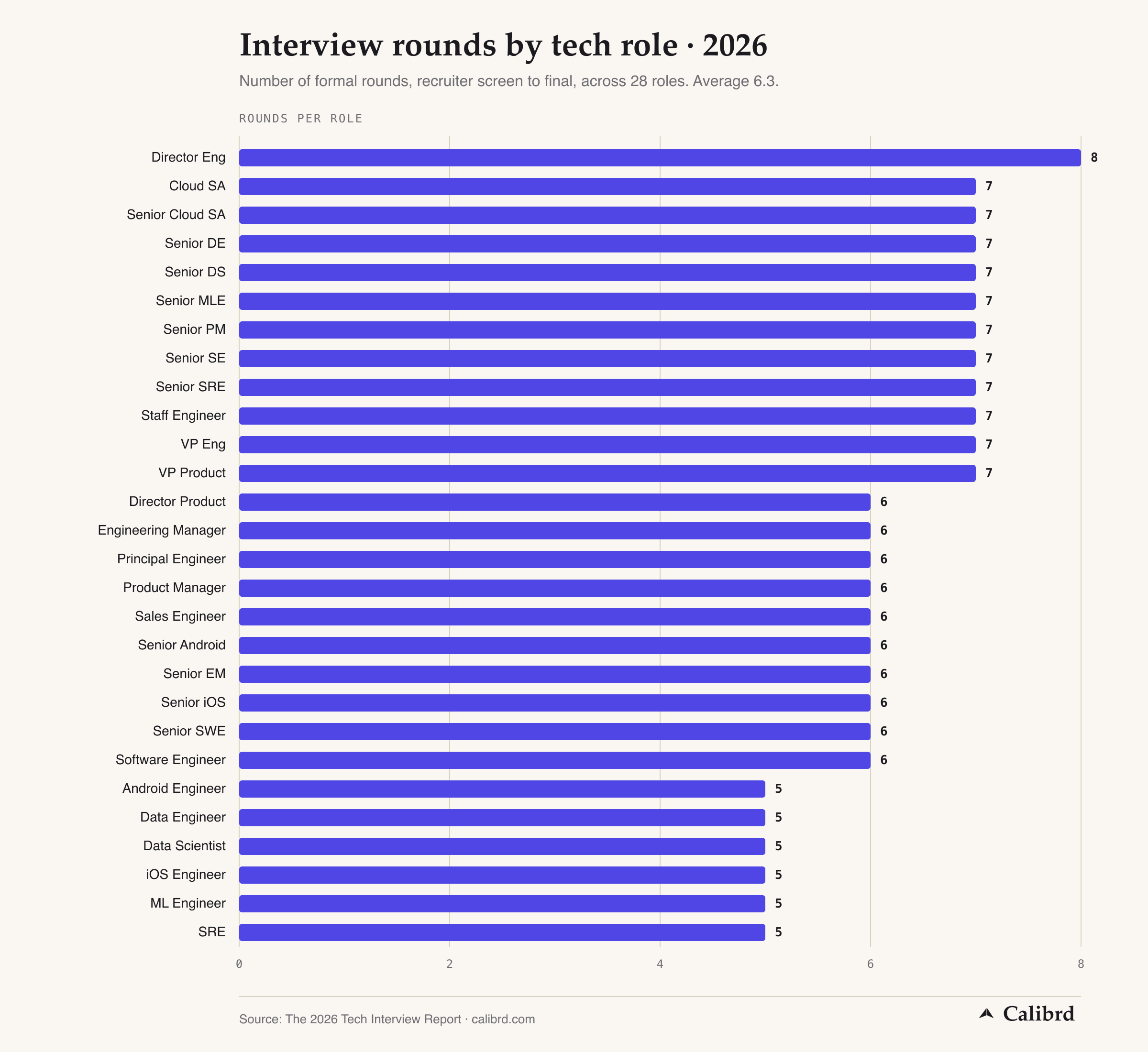
6 rounds · 3–5 weeksMost companies follow a similar pattern for Forward Deployed Eng interviews. Total calendar time is 3–5 weeks from recruiter screen to offer.
Background, motivation for customer-facing work, travel expectations
Practical coding around LeetCode medium. Palantir leans algorithmic; AI labs lean applied — parse messy data, call an API, build a small pipeline
The FDE signature round: a broad business problem with no clean spec, e.g. “a hospital network wants shorter ER wait times — what do you build?”
What they're scoring
- Structures the mess before proposing technology: stakeholders, what data actually exists, the constraint that binds
- Asks about the organisation and its data reality, not just the algorithm
- Lands on a shippable first slice with an explicit measure of success
Deep detail on a system you shipped. At AI labs this often doubles as applied LLM system design: RAG, agents, evals, guardrails on a customer case
A sceptical stakeholder, a mid-deployment scope change, or an executive who wants yesterday's promise today
What they're scoring
- Restates the objection before answering it, and asks what's behind it
- Protects the deployment's outcome without protecting their ego
Autonomy stories, the travel reality, why field engineering rather than product engineering
Sample questions you should be ready for
8 of the ones that decide itRepresentative of what companies ask at this level. Every question here can be practised out loud, which is the fastest way to find out whether your answer holds up under follow-ups. Calibrd adds voice practice with coaching on every answer, and a full voice mock interview: a live round with an AI interviewer who has read the role and your CV, then an honest debrief.
- 01“Here's a messy CSV export from a customer's inventory system. Design the pipeline that keeps it in sync with our platform daily, including what breaks.”
- 02“A customer's RAG deployment answers correctly on test documents and fails on their real ones. Walk me through your diagnosis.”
- 03“Design the integration between our platform and a customer ERP that only exposes a nightly batch file.”
- 04“A hospital network wants to reduce ER wait times with our platform. Decompose the problem: what do you ask, what do you build first, and how do you measure success?”
- 05“Design an agent workflow that drafts a bank's compliance reports, with a human-in-the-loop review step the regulator will accept.”
- 06“Tell me about shipping something usable inside a week. What did you cut, and how did you decide?”
- 07“Describe working with a stakeholder who didn't want your project to succeed.”
- 08“Tell me about being dropped into a domain you knew nothing about. How did you get productive?”
These are the general ones. Paste a real posting and Calibrd predicts the questions that company asks for that exact role, then interviews you on them.
Predict my questions →How to answer the hardest ones
Worked approachesThe structure and the level of detail interviewers expect on the questions that decide this loop. The numbers are placeholders, so swap in your own.
“A hospital network wants to reduce ER wait times with our platform. Decompose the problem.”
Resist the urge to design. Start with stakeholders: who owns the number — the ER director, the nursing lead, hospital ops? Then the data reality: what does the network actually record about a patient's journey, in what systems, at what latency? Then the constraint: is the bottleneck triage staffing, bed turnover, or discharge paperwork — and which one does the data let you see? Only then scope a first slice: one hospital, one bottleneck, a live dashboard of door-to-provider time with an agreed baseline. Close on the measure: “we'd call this working if door-to-provider drops X% in eight weeks at the pilot site.” The content matters less than the order — mess first, technology last.
Compensation benchmark
US majors · USD · medianTypical pay for Forward Deployed Eng at major US tech companies, headline numbers in USD. Typical pay in London, Berlin and Singapore is meaningfully lower, and equity varies a lot by company stage.
Palantir, which invented the title, posts $135–200k base by level for Forward Deployed Software Engineers. OpenAI and Anthropic forward-deployed roles sit near their standard engineering bands — $300–500k+ total at senior levels per levels.fyi reports. Startup FDE offers vary the most; ask whether heavy travel weeks are recognised in comp.
How to prep
5 tactical tipsLead behavioural answers with the STAR method: Situation, Task, Action, Result. The tips below build on that structure for this specific role.
- Rehearse the decomposition round out loud: take an ambiguous prompt and practise structuring for ten minutes before naming any technology
- Bring two build-fast stories with real constraints: what you shipped in days, what you deliberately cut, what broke and how you handled it
- For AI-lab loops, know RAG, agent orchestration and evals as deployed systems — failure modes and guardrails, not just demos
- Prepare your travel answer honestly; the role is on-site by design and panels screen out ambivalence
- Read Palantir's own writing on the role — the loop still follows the shape they invented
The first-week decomposition
Bring this to the roundThe decomposition round is a compressed version of your actual first week on site, and interviewers grade the order of your moves as much as the moves themselves.
Stakeholders. Name who owns the problem, who feels it daily, and who can kill the project
Data reality. Establish what's actually recorded, where it lives, and how stale it is — before believing any of it
Binding constraint. Find the one bottleneck the data lets you see; everything else waits
First slice. Scope something shippable in weeks at one site, not a platform for all sites
Measure. Agree the number that defines success, and its baseline, before you build
Where do Forward Deployed Eng candidates fail?
Spot it in a mock firstA few common mistakes that get Forward Deployed Eng candidates rejected even when they are otherwise strong. Worth catching in a mock interview before they show up in a real one.
Treating the decomposition round like a system design interview and jumping straight to architecture.
Why it fails
The round simulates day one on a customer site, and the signal is whether you structure the mess first: which stakeholders, what data actually exists, what success measurably means. A candidate who draws boxes in the first five minutes reads as someone who would build the wrong thing quickly.
Fix
Spend the opening minutes mapping the problem out loud — people, data, the binding constraint, the measure of success — and only then propose the first shippable slice.
Presenting as a pure builder, with no evidence of managing the humans around the build.
Why it fails
Half the job is stakeholder management, and the panel needs stories where you handled a sceptical customer engineer or an executive changing scope mid-deployment. All-code stories read as a strong SWE applying to the wrong loop.
Fix
Attach a person to every story: who resisted, who you convinced, and what changed in the room after you did.
Recommended resources
No affiliate linksBooks, courses, and tools that come up most often in Forward Deployed Eng prep.
- 01Palantir — A Day in the Life of a Forward Deployed Software Engineer →
The role from the company that invented it; the loop still tests what this describes
- 02Nabeel S. Qureshi — Reflections on Palantir →
First-person account of FDE culture and what the job actually selects for
- 03levels.fyi — Palantir & OpenAI →
Live comp bands for FDSE and forward-deployed roles; the spread between companies is real
- 04Designing Data-Intensive Applications (Kleppmann) →
The integration and pipeline depth the drill-down round expects
Common scenarios
Situations that come up a lotIs a Forward Deployed Engineer the same as a Solutions Engineer or Sales Engineer?
No, and the loops differ accordingly. A Sales Engineer proves value before the deal closes: demos, discovery, POCs, with the Account Executive owning the commercial close — so the SE loop centres on a demo dry-run. A Forward Deployed Engineer ships production software after the deal, embedded with the customer, so the FDE loop centres on a decomposition round and a real coding screen. If your process includes a demo dry-run, you're interviewing for an SE role whatever the title says; if it includes an ambiguous-problem round and a drill-down on systems you've shipped, it's an FDE loop.
How do I prepare for a Palantir Forward Deployed Software Engineer interview?
Palantir's loop is the original: an algorithmic coding screen, a decomposition round on a deliberately vague problem, and a drill-down that goes deep on something you built. The decomposition round is the one to rehearse — take prompts like “a city wants to reduce traffic congestion” and practise structuring out loud for ten minutes before naming any technology: stakeholders, data reality, the binding constraint, a first shippable slice, a measure of success. Coding prep is standard LeetCode-medium fluency. For the drill-down, pick your two deepest systems and revise them to the level of specific technical decisions and what you'd change now.
Do Forward Deployed Engineers at OpenAI and Anthropic write production code?
Yes — the AI-lab version of the role is closer to a deployed staff engineer than to a solutions consultant. You build the integrations, retrieval pipelines, agent workflows and evals that make the lab's models work inside a customer's organisation, and the interview reflects it: applied coding, LLM system design grounded in deployment failure modes (retrieval quality, guardrails, eval coverage), and a customer round. What differs from a product SWE role is where the code runs and who you sit with — customer constraints, customer data, customer stakeholders.
Can I move from Software Engineer to Forward Deployed Engineer, and is it good for my career?
The move is common and the technical bar transfers directly; what you need to add is evidence with people in it. Recast your strongest projects as stakeholder stories: who you had to convince, what changed after a hard conversation, what you shipped under a real deadline. Career-wise, FDE compresses years of customer exposure into every deployment — a strong route toward product leadership, field engineering leadership, or founding, since you watch real organisations adopt (or reject) software up close. The trade is lifestyle: heavy travel and customer-site pressure are structural, not incidental.
How much travel does a Forward Deployed Engineer role involve?
Commonly anywhere from 25% to 75%, and it varies more by account model than by company: some teams embed on site for weeks at a stretch, others run deployments mostly remotely with periodic visits. Ask the panel directly how the team staffs accounts — days per week on site during a live deployment, how long deployments run, and whether accounts are local to your hub. Interviewers treat the question as diligence, not hesitation; what they screen out is ambivalence about the on-site nature of the work itself.
Frequently asked questions
Should I read the Sales Engineer guide or this one?
By what your loop contains, not the job title. A demo dry-run and discovery role-plays mean the Sales Engineer guide; a decomposition round, a coding screen and a technical drill-down mean this one. Some startups use the titles interchangeably — the round list is the truth.
How long should I prep before my Forward Deployed Eng onsite?
Loops run three to five weeks. The highest-leverage drill before the onsite is the decomposition round, rehearsed out loud: structure an ambiguous problem for ten minutes without naming a technology, then land on a first slice and a measure of success.
What's the most common mistake candidates make at the Forward Deployed Eng bar?
Preparing it like a pure SWE loop. Clean code with no customer instinct fails the decomposition and scenario rounds — the panel is hiring the person they can drop into a hostile conference room, not just a strong pull request.
What if my interview process is different from what's listed?
Most variation is at the edges. Large tech companies and scale-ups stay within a round or two of what is described here. Smaller startups often run fewer rounds (three or four) with a similar bar at each, and some companies skip the system design or behavioural round. Read the posting and ask the recruiter on the screening call what is coming.
How does this guide compare to running a free scan?
This guide covers the general bar at L4–L5 / IC3–IC4. The free scan reads one real posting and opens the report right here: the questions that role and company will ask, a pay benchmark matched to the level and, with your CV, the gaps an interviewer will probe and a CV score. No account or email first; the report is on screen in about a minute.
Walk in ready
Walk into your Forward Deployed Eng interview ready.
Paste your actual job and Calibrd predicts what that company asks for this role, where your CV is thin, and what it should pay. Then rehearse the round out loud with honest feedback until you're confident. Free to start.
Not interviewing yet? See if your CV would make the shortlist for a Forward Deployed Eng role →
Free to start · No card · Encrypted at rest, never used to train AI, remove anytime