2026 update
A few things have changed in 2026. AI is now allowed in coding rounds at Canva and Meta, detection has improved at companies that still ban it, pay has split at staff+, and the post-onsite wait got longer. Read what changed in 2026 →
What you'll be expected to do
What they're grading- Implement well-scoped features and bug fixes under a mentor or tech lead's guidance
- Learn the codebase, tooling, and review process; turn feedback around quickly
- Write tests and follow the team's coding standards
- Ask good questions early rather than stay blocked for hours
- Grow from closely-scoped tickets toward owning a small feature end-to-end
What does the interview loop look like?
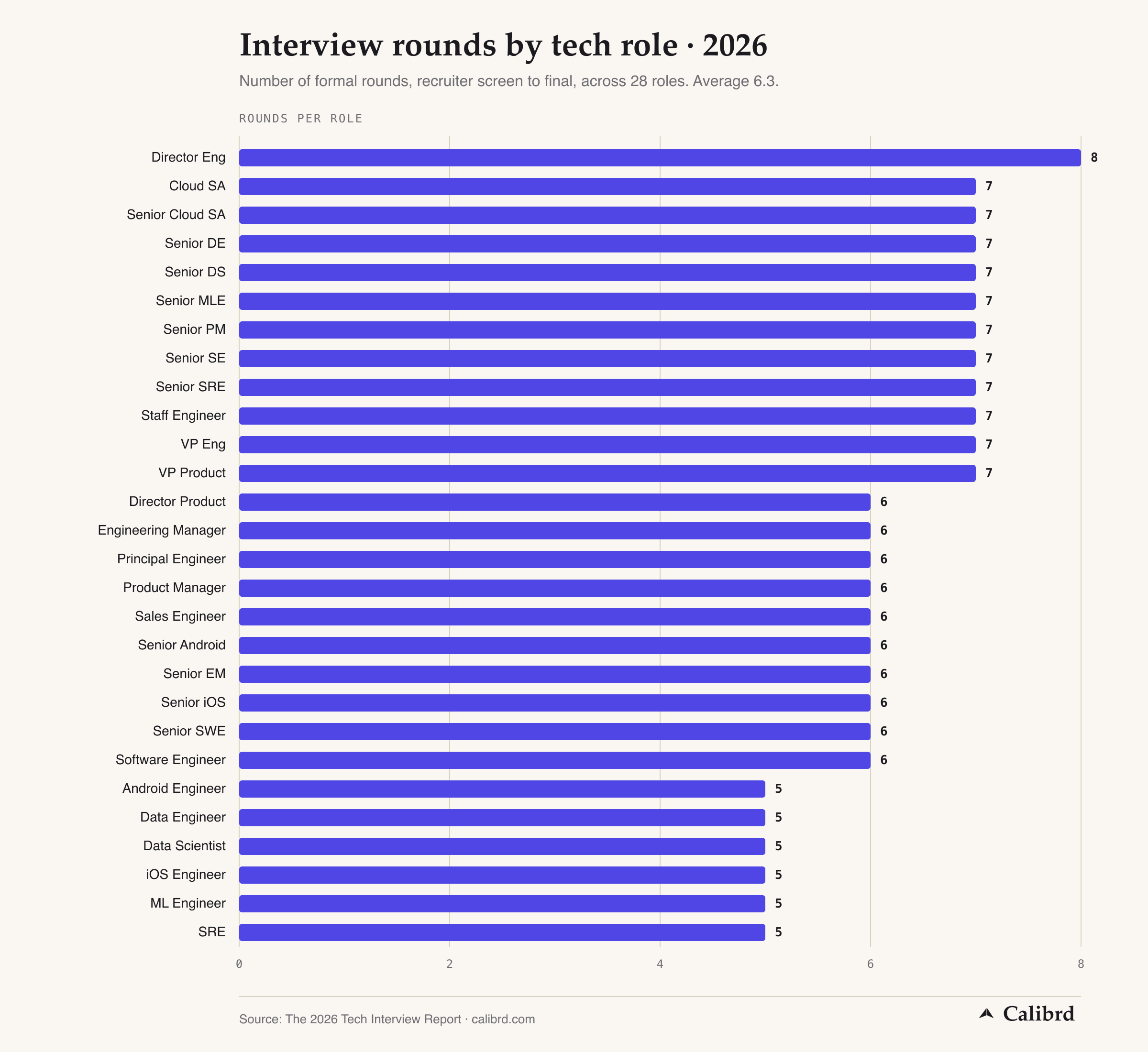
5 rounds · 2–4 weeksMost companies follow a similar pattern for New Grad SWE interviews. Total calendar time is 2–4 weeks from recruiter screen to offer.
Motivation, basic fit, and logistics (grad date, work authorisation)
1–2 algorithm problems auto-graded on hidden test cases (HackerRank / CodeSignal)
One easy-to-medium data-structures problem plus a complexity discussion
A second problem, or CS fundamentals — OOP, hashing, recursion, basic OS/DB
Projects, teamwork, a group-project disagreement, and why this company
Sample questions you should be ready for
6 of the ones that decide itRepresentative of what companies ask at this level. Every question here can be practised out loud, which is the fastest way to find out whether your answer holds up under follow-ups. Calibrd adds voice practice with coaching on every answer, and a full voice mock interview: a live round with an AI interviewer who has read the role and your CV, then an honest debrief.
- 01“Given an array of integers, return the indices of the two numbers that add up to a target (Two Sum). What's the trade-off between the brute-force and hashmap approaches?”
- 02“Check whether a string of brackets is balanced using a stack. Walk through what the stack holds at each step.”
- 03“Given a binary tree, return its level-order (breadth-first) traversal. Which data structure drives the traversal, and why?”
- 04“Walk me through a project — course, personal, or internship — you're proud of. What was your specific part?”
- 05“Tell me about a time you disagreed with a teammate on a group project. How did you handle it?”
- 06“Tell me about a bug or a concept you struggled with. How did you work through it?”
These are the general ones. Paste a real posting and Calibrd predicts the questions that company asks for that exact role, then interviews you on them.
Predict my questions →Compensation benchmark
US majors · USD · medianTypical pay for New Grad SWE at major US tech companies, headline numbers in USD. Typical pay in London, Berlin and Singapore is meaningfully lower, and equity varies a lot by company stage.
FAANG new-grad total comp typically $150–190k. London new-grad SWE ~£45–65k base; Berlin ~€55–65k; Bangalore ~₹18–30 LPA. Sign-on and relocation are the most negotiable levers here; base is usually cohort-fixed.
How to prep
6 tactical tipsLead behavioural answers with the STAR method: Situation, Task, Action, Result. The tips below build on that structure for this specific role.
- 01Drill Blind 75 / NeetCode 150 — arrays, strings, hashmaps, two-pointers, trees, BFS/DFS. Volume of easy-mediums matters more than a handful of hards
- 02Practise the online assessment under a timer. The assessment filters most candidates out, and passing all test cases is the whole game
- 03Be able to explain your own projects line by line — why that data structure, what you'd change. Interviewers probe the code you claim
- 04Prepare 3–4 project or coursework stories (STAR): an internship, a capstone, a hackathon — anything with a specific contribution and a rough number
- 05Know your CS fundamentals out loud: Big-O, hashing, recursion vs iteration, and one or two OS/DB basics. Entry loops test these directly
- 06Ship one real project with AI and deploy it where an interviewer can click it. AI has thinned the junior rung, and this is the cheapest way to show you can already work above it — plus it gives you a technical decision you actually made to defend
Where do New Grad SWE candidates fail?
Spot it in a mock firstA few common mistakes that get New Grad SWE candidates rejected even when they are otherwise strong. Worth catching in a mock interview before they show up in a real one.
Listing a project on the CV but not being able to explain how your own code works when the interviewer digs in.
Why it fails
At the entry level your projects ARE your experience — they're the main evidence you can actually build. When you can't explain why you picked a hashmap over a list, or what happens when the input is empty, the interviewer starts to wonder whether you wrote it or followed a tutorial. That doubt sinks the whole signal.
Fix
Before the loop, re-read your own repos. For each project, be ready to answer: what problem did it solve, what was the hardest part, why did you structure the data the way you did, and what would you refactor now. Own the code.
Freezing on the online assessment and running out of time with a partial solution and no passing test cases.
Why it fails
The assessment is auto-graded and usually the biggest single filter in a new-grad funnel — often more candidates are cut here than in every live round combined. A partial answer that passes zero tests reads the same as no answer. It isn't measuring elegance; it's measuring whether you can produce a working solution under a clock.
Fix
Time-box your practice: solve two easy-mediums in 45 minutes, every day for two weeks. Get a brute-force that passes SOME tests down first, then optimise. A correct O(n²) that passes beats an unfinished O(n).
Undervaluing an internship or a TA role — mentioning it in one line and moving on.
Why it fails
New grads routinely bury their strongest evidence. A real internship where you shipped code, or a TA role where you explained hard concepts to 30 students, is exactly the signal interviewers want: production exposure and communication. Glossing over it leaves them with only coursework to judge you on.
Fix
Treat your internship or TA work the way a mid-level engineer treats a launch: what did you build or teach, who used it, what changed. Lead with it in the behavioural round instead of apologising for 'only' having an internship.
Recommended resources
No affiliate linksBooks, courses, and tools that come up most often in New Grad SWE prep.
- 01NeetCode 150 →
The highest-signal free practice list for entry loops. Work the patterns (two pointers, sliding window, BFS/DFS) rather than random problems.
- 02Blind 75 →
The classic 75-problem shortlist. If you do only one thing before a new-grad loop, do these cold.
- 03Cracking the Coding Interview (McDowell) →
The entry-level bible. Data structures, the behavioural framework, and what an interviewer is actually scoring.
- 04CodeSignal / HackerRank practice →
Practise the actual assessment format under a timer — most new-grad screens run on one of these platforms.
- 05Tech Interview Handbook →
Free, no-fluff prep plan and behavioural guide aimed squarely at new grads and students.
- 06The Missing README (Riccomini & Ryaboy) →
The canonical what-your-first-job-actually-expects book: code review, on-call, working with your manager. Reads like the responsibilities list above, expanded.
Common scenarios
Situations that come up a lotHow do I prepare for new-grad SWE interviews if I have no internships and only personal projects?
Projects can absolutely carry a new-grad loop — but they have to be real and you have to own them. Pick your two strongest, ideally something with users or a non-trivial technical piece (an app you deployed, a tool people actually used, a project with a database and auth). Be ready to explain every design decision: why that data structure, what breaks at scale, what you'd change. Interviewers can tell tutorial-followers from builders in about two questions. For the coding rounds, no internship means the assessment and live rounds carry more weight, so over-index on Blind 75 / NeetCode until easy-mediums are automatic. In the behavioural round, don't apologise for lacking internships; frame your projects as what you built and shipped. A candidate who deeply understands two real projects beats one who lists ten they can't explain.
Is a CS degree required for new-grad SWE roles, or can I get in from a bootcamp?
You can get in from a bootcamp, but the funnel is harder and the prep is the same. The interview tests skills, not credentials — the assessment and coding rounds don't care where you learned. What a CS degree gives you is fundamentals (Big-O, data structures, a bit of OS and networks) that bootcamps often skip, and those show up directly in entry loops. If you're bootcamp-trained, close that gap deliberately: work through the data-structures and algorithms sections of Cracking the Coding Interview, and be able to reason about complexity out loud. The other gap is resume screening — some companies filter by degree, so lean on referrals and projects to get past that stage. Once you're in the loop, a bootcamp grad who's drilled fundamentals is on equal footing.
I have two exploding new-grad offers with a deadline before my top choice responds. What do I do?
First, ask your top choice to expedite — recruiters do this constantly for new grads, and 'I have a competing offer expiring on [date], you're my first choice, is there any way to speed things up?' is a normal, effective email. Second, ask the exploding offers for an extension — one to two weeks is a reasonable ask and rarely rescinds an offer; a company that won't budge at all is telling you something. Third, don't let a deadline stampede you into the wrong choice, but don't lose a good offer chasing a maybe either. If the top choice can't commit before the deadline, weigh a real offer in hand against a probability. Be polite and direct with everyone; the new-grad recruiting world is small.
How much does the online assessment actually matter for new-grad SWE roles?
For most large companies it's the single biggest filter — more new grads are cut at the assessment than at any live round. It's usually one to two algorithm problems, auto-graded on hidden test cases, on a strict timer (60–90 minutes). Because it's automated there's no benefit of the doubt: a beautiful partial solution that passes zero tests scores zero. The implication for prep: practise the exact format under a clock until producing a working solution is automatic, and get something that passes SOME tests first, then optimise. Also watch for anti-cheat (webcam, plagiarism detection) and the 'behavioural' or 'code review' sections some assessments bolt on. Treat it as the round most likely to end your candidacy, and prep it first.
Does the new-grad SWE interview differ between the US, UK, and Europe, and how do visa or work-authorisation questions come up?
The core loop is similar everywhere — online assessment, coding rounds, a behavioural — but the emphasis shifts by market. US loops lean hardest on the timed assessment and quote total comp (base + stock + sign-on). UK and European loops often run fewer rounds, weight the behavioural and 'why this company' more, and quote base salary with little or no equity; timelines can be slower and more relationship-led. Work authorisation comes up early, usually in the recruiter screen: 'will you now or in future need visa sponsorship?'. Answer plainly — in the US that's your OPT / STEM-OPT window or H-1B status; in the UK, whether you'll need Skilled Worker sponsorship. Most large tech firms sponsor and many startups don't, so build your company list around who actually sponsors, and never hide your status, because a mismatch found late wastes the whole loop. Your prep doesn't change; your shortlist does.
I've never had a real interview before. How do I prepare for my first full-time one?
Your projects and coursework are your experience, so start there: pick three you can explain end to end, and be ready for 'walk me through what you built and what was hard'. Then get the fundamentals automatic — enough Blind 75 / NeetCode that the online assessment and coding rounds don't surprise you — and prepare a real answer to 'why this company'. The highest-leverage prep is doing at least one full mock out loud: most first-timers freeze not because they don't know the material but because they've never said it under mild pressure. In the room, narrate your thinking, restate the problem before you solve it, and remember the interviewer is calibrating an entry-level candidate. They expect you to be early-career, not a finished engineer.
Frequently asked questions
I'm currently a SWE Intern (Internship · student). Should I read this guide or the SWE Intern guide first?
Read the SWE Intern guide first. Companies calibrate New grad · L3 / E3 / SDE I candidates against the Internship · student bar with a clear scope-gap lens, they want to see where you stand today, then probe the gap up to New grad · L3 / E3 / SDE I. Read this guide AFTER you understand the Internship · student baseline, so you know exactly which signals you need to demonstrate for the step-up.
How long should I prep before my New Grad SWE onsite?
The loop runs 2–4 weeks, but the online assessment gates everything — clear that first. Two to four weeks of daily Blind 75 / NeetCode, plus being able to explain your own projects cold, is the priority order.
What's the most common mistake candidates make at the New Grad SWE bar?
Treating the online assessment as a formality. It's the biggest filter in the funnel — most new grads are cut there. Drill the timed format until a working solution is automatic before you touch the behavioural prep.
What if my interview process is different from what's listed?
Most variation is at the edges. Major tech companies (FAANG, scale-ups, mid-size SaaS) follow processes within 1–2 rounds of what's described. Smaller startups often run fewer rounds (3–4) but the bar at each round is similar; less-tech-mature companies sometimes skip system design or behavioural rounds entirely. Read the posting and ask the recruiter on the screening call; they'll tell you what's coming.
How does this guide compare to running a free scan?
This guide covers the general bar at New grad · L3 / E3 / SDE I. The free scan reads one real posting and opens the report right here: the questions that role and company will ask, a pay benchmark matched to the level and, with your CV, the gaps an interviewer will probe and a CV score. No account or email first; the report is on screen in about a minute.
Walk in ready
Walk into your New Grad SWE interview ready.
Paste your actual job and Calibrd predicts what that company asks for this role, where your CV is thin, and what it should pay. Then rehearse the round out loud with honest feedback until you're confident. Free to start.
Free to start · No card · Encrypted at rest, never used to train AI, remove anytime